ERP for Rubber Products Industry
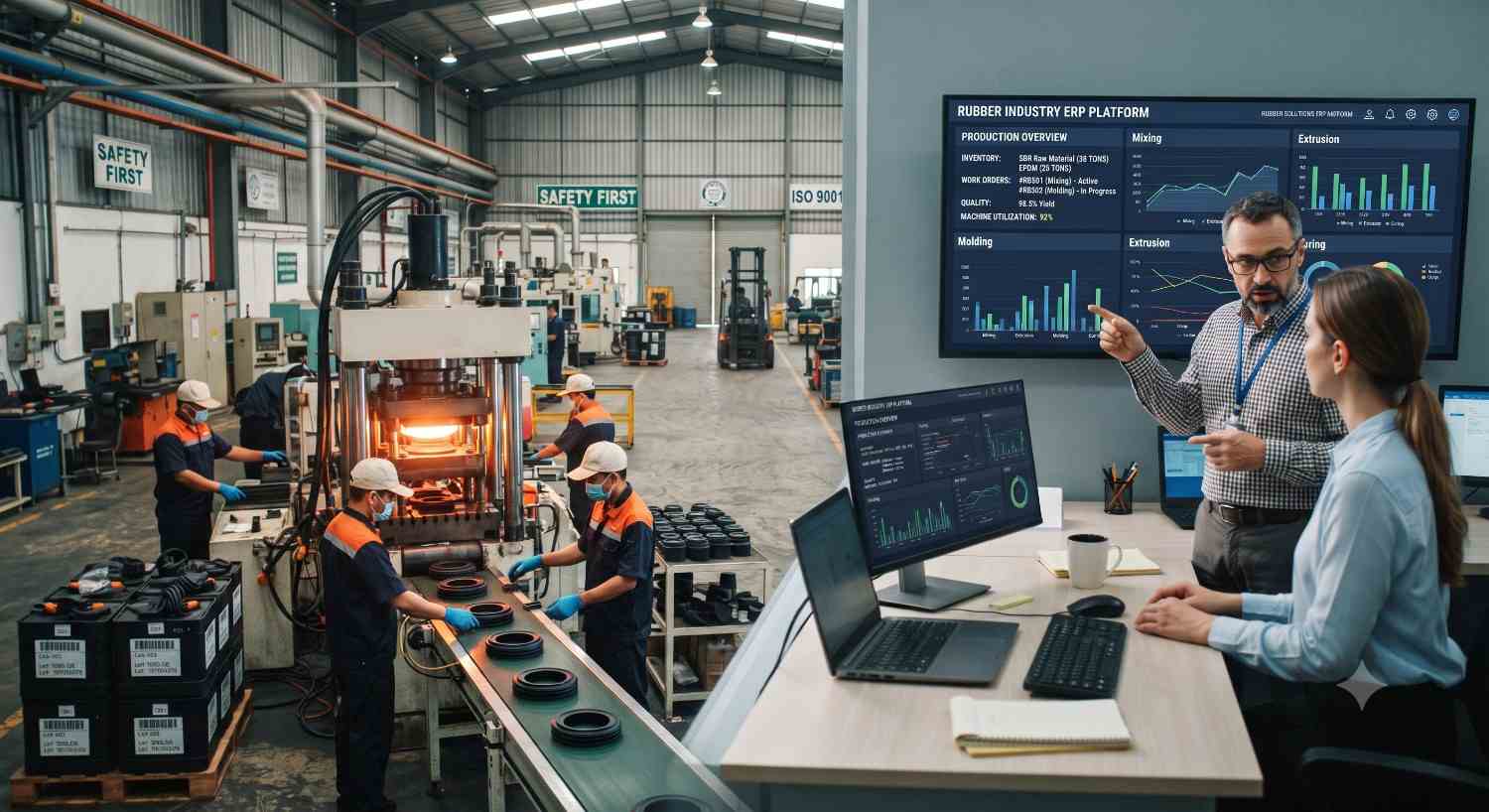
Walk into any rubber processing unit in India — a tyre component plant in Chennai, a conveyor belt manufacturer near Kolkata, an auto-rubber parts unit in the Kottayam-Kochi rubber belt, or a moulded rubber goods exporter in the Delhi-NCR industrial corridor — and you’ll notice the same pattern. The production floor runs on formulas, batch sheets, and curing cycles, while the office runs on spreadsheets, WhatsApp updates, and paper travelers. Somewhere between the compounding room and the accounts department, information gets lost, and that gap is where rubber manufacturers quietly lose margin every single month.
Rubber manufacturing is not like assembling a product from fixed components. It is a formulation-driven, process-intensive industry where a single change in a compound — a different grade of carbon black, a shift in sulphur ratio, a new batch of natural rubber with different Mooney viscosity — can change scrap rates, curing time, and finished-product quality. Managing this complexity on disconnected systems is why so many rubber processors in India still struggle with inconsistent batch quality, raw material wastage, and inventory that never quite matches what’s on the shop floor.
This is exactly the gap an ERP for rubber products industry is built to close — and SAP Business One, implemented correctly, is one of the few ERP platforms that genuinely understands formulation-based, batch-process manufacturing rather than forcing rubber companies into a generic discrete-manufacturing mould.
Why Rubber Manufacturing Needs a Different Kind of ERP
Most ERP systems are built around a bill of materials that assumes fixed quantities of fixed components. Rubber compounding doesn’t work that way. A compound recipe is a formula expressed in percentages or parts-per-hundred-rubber (phr), and the actual quantities used depend on batch size, mixer capacity, and the specific properties of the raw rubber lot being used that day. Natural rubber (RSS, ISNR grades) and synthetic rubber (SBR, NBR, EPDM, butyl) each behave differently, and compounders routinely adjust accelerators, activators, antioxidants, and fillers based on lab feedback from the previous batch.
On top of that, rubber processing runs through multiple transformation stages — mastication, compounding/mixing, extrusion or calendering, moulding, and vulcanization (curing) — each with its own cycle time, scrap potential, and quality checkpoint. A generic ERP that treats this as a single “manufacturing" step gives management almost no visibility into where cost and quality are actually being determined.
An ERP built for the rubber products industry needs to natively handle:
● Formula-based bills of material with percentage-based or phr-based recipes that recalculate automatically against batch size
● Multi-stage production routing from mixing through curing, with cycle times and machine capacity for each stage
● Batch and lot traceability from raw rubber lot to finished product, since recalls and customer complaints in rubber (especially in automotive and industrial supply chains) are always traced back to a specific batch
● Shelf-life and pot-life tracking for rubber compounds and chemicals, many of which degrade or must be used within a defined window
● Quality parameters unique to rubber — Mooney viscosity, cure rheometer data (scorch time, cure time), hardness (Shore A), tensile strength, and specific gravity — captured against each batch, not buried in a separate lab notebook
Connecting Formulation to Production: Where SAP Business One Adds Real Value
The biggest operational risk in rubber manufacturing is the disconnect between what the formulation/R&D team designs and what actually gets mixed on the shop floor. When formulas live in one Excel file, batch cards are printed separately, and production reports come back manually at shift end, deviations creep in — an operator rounds off a chemical quantity, or uses the nearest available grade of carbon black instead of the specified one, and nobody finds out until a customer rejects a shipment weeks later.
SAP Business One’s Production module, when configured for formula-based manufacturing, lets 2iSolutions build rubber compound formulas as structured bills of material with defined tolerances. When a production order is released, the system generates the exact quantity of each ingredient required for that specific batch size, pulls from the correct raw material lot based on FIFO or expiry, and records actual consumption against planned consumption automatically. Any variance beyond the defined tolerance triggers a flag before the batch moves to the next stage — mixing, extrusion, moulding, or curing.
This connection matters even more at the curing stage. Vulcanization parameters — temperature, pressure, and cure time — determine whether a rubber part meets its mechanical specifications. By linking the production order to the specific compound batch and its rheometer data, SAP Business One gives quality teams a direct line from “this finished part failed a hardness test" back to “this raw material lot, this mixing shift, this curing cycle" — the kind of root-cause traceability that manual systems simply cannot deliver at speed.
Quick answer: SAP Business One connects rubber manufacturing by linking formula-based bills of material, multi-stage production orders (mixing, extrusion, moulding, curing), batch-level quality data, and real-time raw material inventory into one system — so a change in compound formulation, a quality deviation, or a stock shortfall is visible across the business immediately, instead of surfacing weeks later as a customer complaint or a stockout.
Quality Management: Making Rubber-Specific Testing Part of the System, Not a Side Process
Quality in rubber manufacturing isn’t a single pass/fail checkpoint — it’s a sequence of tests at different stages, each with numeric tolerances that vary by product and customer specification. A tyre component supplier to an OEM will have far tighter tolerances than a manufacturer of general-purpose industrial gaskets, and both need those specifications enforced consistently, batch after batch.
SAP Business One’s Quality Management functionality allows 2iSolutions to configure inspection templates specific to rubber processing — incoming inspection for raw rubber and chemicals (checking certificates of analysis against purchase specifications), in-process checks during mixing (Mooney viscosity, dispersion quality), and final inspection of cured products (hardness, tensile strength, compression set, dimensional accuracy). Each inspection result is recorded against the batch and production order, so a quality manager can pull a complete certificate of conformance for any shipped lot in minutes rather than reconstructing it from paper records.
This matters commercially, not just operationally. Automotive and industrial buyers increasingly require documented quality traceability as a condition of doing business, and export customers routinely ask for batch-wise test certificates before container loading. A rubber manufacturer that can generate this instantly from the ERP — rather than promising to “send it by tomorrow" — wins trust and repeat orders faster.
Inventory Management: The Part Every Rubber Manufacturer Underestimates
Raw material inventory in rubber manufacturing is unusually complex compared to most industries. A mid-sized rubber goods manufacturer typically carries 80 to 150 distinct raw materials — natural and synthetic rubber grades, multiple carbon black grades, plasticizers, accelerators, activators, antioxidants, pigments, and reinforcing fabrics — many sourced from different vendors with different lead times, and several with defined shelf lives that, if exceeded, compromise the final compound’s properties.
Manually tracking which chemical lot is nearing expiry, which carbon black grade is running low against a scheduled production run, and which raw rubber batch needs to be consumed first under FIFO is close to impossible once daily production crosses even a modest number of batches. The result, in most unorganized rubber units, is one of two expensive outcomes: excess safety stock tying up working capital “just in case," or last-minute production stoppages because a critical chemical ran out.
SAP Business One’s inventory and MRP functionality gives rubber manufacturers batch-and-lot-controlled stock visibility, automatic reorder point calculation tied to actual consumption patterns from the formula-based BOM, and expiry-date alerts for shelf-life-sensitive chemicals. Because production orders consume raw materials automatically against the formula, inventory levels update in real time as each batch is mixed — not at month-end stock-take, when it’s too late to prevent a shortage. For manufacturers running multiple plants or warehouses (common in the Kerala–Tamil Nadu rubber belt and in industrial clusters around Kolkata and Delhi-NCR), the same visibility extends across locations, so inter-plant stock transfers and centralized procurement decisions are based on real numbers.
GST, E-Invoicing, and Compliance for Indian Rubber Manufacturers
Indian rubber processors — whether supplying tyre OEMs, auto-component manufacturers, or exporting moulded and extruded rubber goods — operate under GST compliance requirements that touch nearly every transaction: HSN-code-wise GST rates on raw rubber and finished goods, mandatory e-invoicing above the applicable turnover threshold, e-way bills for interstate raw material and finished goods movement, and job-work provisions under Rule 55 for units that send compounds out for mixing or moulding to third-party processors.
SAP Business One, implemented with India-localized configuration, handles GST-compliant invoicing, HSN/SAC code mapping, e-invoice generation through the government’s IRP integration, and e-way bill creation directly from sales and delivery documents — removing the manual reconciliation that otherwise consumes hours of the accounts team’s time every month. For manufacturers using job-work arrangements with third-party rubber processors, the system can track goods sent for job work and returned finished goods against the applicable compliance documentation, reducing the audit risk that comes with manual tracking of subcontracted rubber processing.
What a Real SAP Business One Implementation Looks Like for a Rubber Manufacturer
An ERP for rubber products industry only delivers this level of connection when the implementation itself is done by a partner who understands rubber processing — not just SAP Business One as a generic accounting-plus-inventory system. At 2iSolutions, a SAP Business One Implementation for a rubber manufacturer typically starts with mapping the existing formulation library into structured, percentage-based bills of material, followed by configuring the production routing to match the plant’s actual stages — mixing, extrusion or calendering, moulding, curing, and finishing.
Quality inspection templates are then built around the specific tests the manufacturer’s customers require, whether that’s Shore A hardness for industrial gaskets or cure rheometer data for tyre components. Inventory is configured with batch/lot tracking and expiry management from day one, since retrofitting this after go-live is far more disruptive. Finally, GST, e-invoicing, and job-work workflows are configured to match how the manufacturer actually transacts — including any existing job-work relationships with third-party compounders or moulders.
Because rubber manufacturing rarely stands still — new customer specifications, new compound formulations, new regulatory requirements — SAP Business One Support after go-live matters just as much as the implementation itself. Ongoing support covers formula updates as R&D develops new compounds, adjustments to quality inspection parameters as customer specifications evolve, and system tuning as production volumes grow or new product lines (say, moving from general rubber goods into precision automotive components) are added.
The Business Case: Why This Connection Pays Off
Rubber manufacturers who connect formulation, production, quality, and inventory in one system typically see the payoff in three places. First, raw material wastage drops because batches are mixed to exact formula specifications with real-time variance tracking, instead of operators eyeballing quantities. Second, quality rejections and customer complaints fall because deviations are caught at the mixing or curing stage rather than discovered in a finished-goods inspection or, worse, at the customer’s dock. Third, working capital tied up in raw material inventory reduces because reorder points are based on actual formula-driven consumption rather than guesswork, freeing up cash that’s currently sitting in excess carbon black, chemicals, or rubber stock.
For a rubber products manufacturer competing on both cost and quality — particularly one supplying automotive OEMs or export markets where documentation and traceability are non-negotiable — SAP Business One for Rubber Products Industry isn’t a back-office upgrade. It’s the difference between running the plant on intuition and running it on data that connects the compounding room to the accounts ledger, in real time.
Frequently Asked Questions
1. How is ERP for the rubber products industry different from ERP for general manufacturing?
General manufacturing ERP assumes fixed-quantity bills of material. Rubber manufacturing needs formula-based (percentage or phr-based) bills of material that recalculate against batch size, multi-stage production routing for mixing, extrusion, moulding, and curing, and rubber-specific quality parameters like Mooney viscosity and cure rheometer data — all of which require a properly configured SAP Business One implementation rather than an out-of-the-box setup.
2. Can SAP Business One handle batch and lot traceability for rubber compounds?
Yes. SAP Business One tracks raw material lots, compound batches, and finished-goods batches together, so any quality issue in a finished product can be traced back to the specific raw rubber lot, mixing batch, and curing cycle that produced it — essential for automotive and export customers who require documented traceability.
3. Does SAP Business One support India-specific compliance like GST and e-invoicing for rubber manufacturers?
Yes. With India localization, SAP Business One handles GST-compliant invoicing, HSN code mapping for raw rubber and finished goods, e-invoice generation through the government IRP, e-way bill creation, and job-work tracking under Rule 55 for compounds or components sent to third-party processors.
4. What does SAP Business One Implementation for a rubber manufacturer typically involve?
A rubber-industry SAP Business One implementation typically includes mapping existing compound formulas into structured bills of material, configuring multi-stage production routing (mixing through curing), setting up rubber-specific quality inspection templates, enabling batch/lot and expiry-based inventory management, and configuring GST/e-invoicing and job-work compliance — followed by ongoing SAP Business One Support as formulations, customer specifications, and production volumes evolve.
5. Is SAP Business One suitable for small and mid-sized rubber processing units, or only large manufacturers?
SAP Business One is built for small and mid-sized manufacturers and scales with the business. A rubber processing unit running even a few hundred batches a month benefits from formula-based production control and batch traceability, and the system can expand as the manufacturer adds product lines, plants, or export customers with stricter documentation requirements.