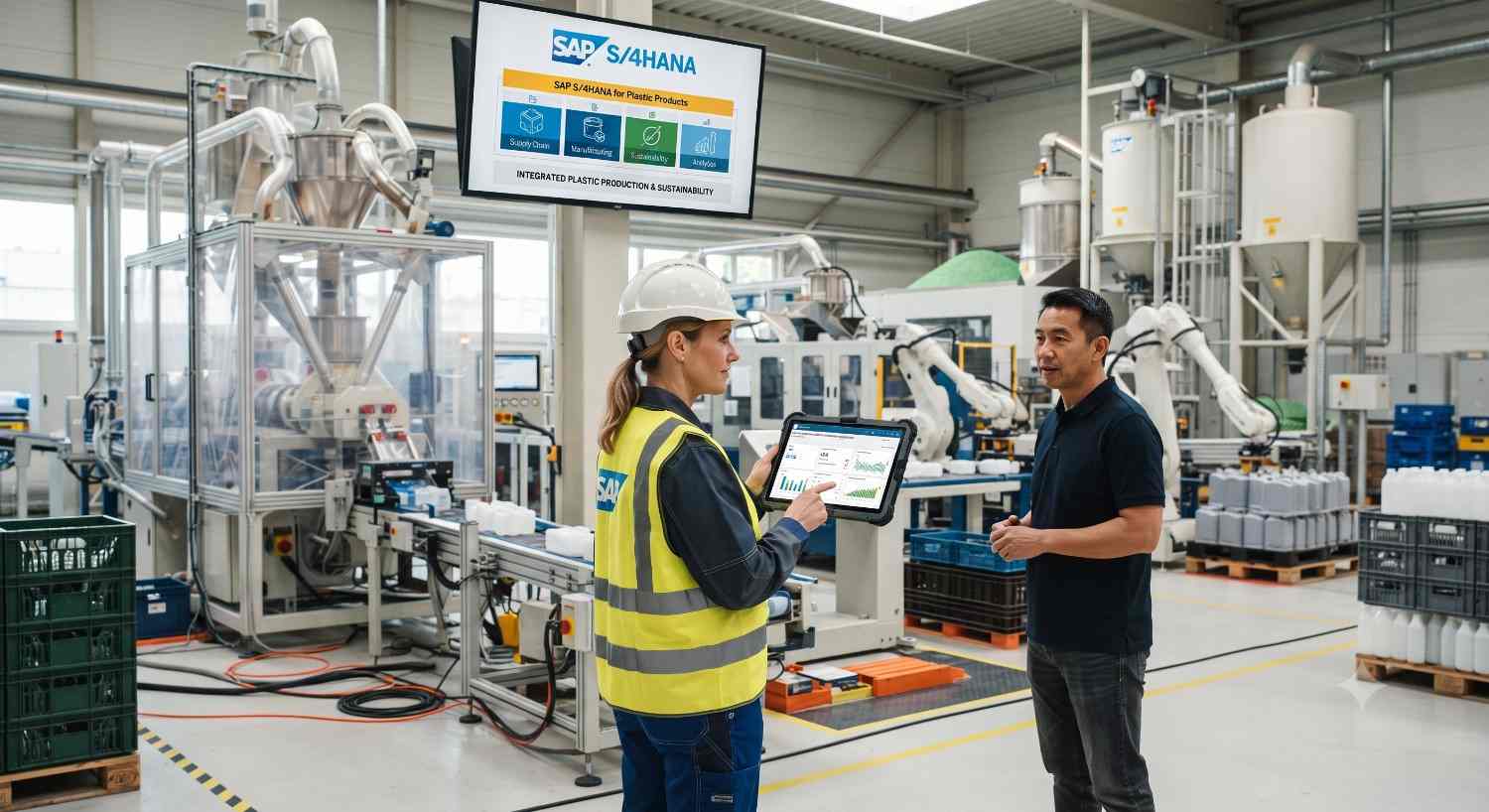
SAP S/4HANA for Plastic Products
The plastics industry runs on tight margins, unpredictable raw material prices, and production lines that can’t afford downtime. Whether you’re manufacturing injection-molded components, PET packaging, extruded pipes, or industrial films, the difference between a profitable quarter and a painful one often comes down to how well you manage production, materials, and costs. This is exactly where SAP S/4HANA for Plastic Products has become a game-changer for manufacturers across the globe.
If you’ve been researching ERP options for your plastics business, you’ve probably noticed that generic systems fall short. They weren’t built to handle batch tracking for resin blends, real-time scrap monitoring, or the volatile pricing of polymers. SAP S/4HANA, on the other hand, was designed with modern manufacturing complexity in mind — and when configured specifically for plastic manufacturers, it becomes a powerful engine for growth.
In this guide, we’ll break down exactly how SAP S/4HANA improves production efficiency, streamlines material planning, and tightens cost control, while also covering what a successful SAP S/4HANA implementation looks like and why more companies are shifting toward SAP S/4HANA Cloud Services.
Why the Plastic Industry Needs a Purpose-Built ERP
Plastic manufacturing isn’t like assembling standardized parts. It involves continuous and batch processes, multiple resin grades, color matching, mold changeovers, and strict quality specifications for industries like automotive, packaging, medical, and consumer goods. A generic ERP for Plastic Products often can’t keep up with these nuances.
Common pain points plastic manufacturers face include:
-
Inaccurate raw material forecasting, leading to excess inventory or stockouts
-
Poor visibility into machine downtime and scrap rates
-
Difficulty tracking costs down to the batch or job order level
-
Manual processes for quality checks and compliance documentation
-
Disconnected systems between production floor and finance/ERP
These challenges directly affect profitability. Without a system built to handle real-time production data alongside financial and material information, plastic manufacturers are essentially flying blind. This is the core reason SAP S/4HANA for Plastic Products has gained so much traction — it bridges the gap between shop floor reality and business decision-making.
What Makes SAP S/4HANA Different
SAP S/4HANA is SAP’s next-generation ERP suite, built on the in-memory HANA database. Unlike older ERP systems that rely on batch processing and overnight reports, S/4HANA processes transactions and analytics in real time. For a plastics manufacturer, that means:
-
Instant visibility into inventory levels across warehouses and plants
-
Real-time production order tracking, from raw material issue to finished goods
-
Live cost analysis instead of waiting for month-end closing
-
A simplified data model that reduces redundant tables and speeds up reporting
When plastic product companies adopt SAP S/4HANA, they’re not just upgrading software — they’re rebuilding how information flows across procurement, production, quality, and finance.
Improving Production Efficiency with SAP S/4HANA
Real-Time Production Monitoring
One of the biggest advantages of SAP S/4HANA for Plastic Products is real-time production monitoring. Manufacturers can track machine utilization, cycle times, and scrap rates as they happen, rather than reviewing shift reports the next day. This allows plant managers to spot bottlenecks — like a mold running slower than expected or a machine generating excessive rejects — and respond immediately instead of losing an entire shift’s output.
Integrated Production Planning (PP) and Manufacturing Execution
SAP S/4HANA’s Production Planning module integrates tightly with Manufacturing Execution Systems (MES), giving plastic manufacturers a single source of truth for shop floor activity. Production orders, work centers, and routing data sync automatically, reducing the manual data entry that often leads to errors in extrusion, blow molding, or injection molding operations.
Predictive Maintenance
Unplanned downtime is one of the costliest problems in plastic manufacturing — a single mold failure can halt an entire line. With embedded analytics and IoT integration, SAP S/4HANA can flag machines that are trending toward failure based on sensor data, enabling predictive maintenance schedules instead of reactive repairs.
Quality Management Built In
Plastic products often need to meet strict industry certifications (ISO, FDA, automotive IATF standards). SAP S/4HANA’s Quality Management module automates inspection lots, tracks non-conformances, and ties quality data directly to specific production batches — making audits and recalls far less painful.
Streamlining Material Planning
Material planning is arguably where SAP S/4HANA for Plastic Products delivers the most immediate ROI. Resin and polymer prices fluctuate constantly, and running out of a critical raw material can shut down an entire production line.
Advanced MRP (Material Requirements Planning)
SAP S/4HANA’s MRP engine runs significantly faster than legacy systems, allowing planners to simulate multiple demand scenarios in minutes instead of hours. This means a plastics manufacturer can react to a sudden spike in customer orders or a supplier delay without waiting for an overnight batch run.
Batch and Lot Traceability
Because plastic products often blend virgin resin with recycled or regrind material, batch traceability is essential. SAP S/4HANA tracks material genealogy from the raw resin lot all the way to the finished product, which is invaluable for quality investigations and sustainability reporting.
Demand-Driven Replenishment
Using SAP’s Demand-Driven MRP (DDMRP) capabilities, plastic manufacturers can position strategic inventory buffers at key points in the supply chain. This reduces the “bullwhip effect" where small changes in customer demand cause massive overreactions in raw material ordering.
Supplier Collaboration
SAP S/4HANA integrates with SAP Ariba and supplier portals, giving procurement teams real-time visibility into supplier lead times and pricing — critical when polymer costs can shift week to week based on crude oil prices.
Tightening Cost Control Across the Business
Cost control is where many plastic manufacturers struggle the most, mainly because costs are scattered across machine time, material waste, energy consumption, and labor. SAP S/4HANA consolidates all of this into a unified costing framework.
Real-Time Product Costing
Instead of calculating standard costs once a quarter, SAP S/4HANA allows finance and operations teams to see real-time variances between planned and actual costs. If scrap rates spike on a particular product line, the cost impact is visible almost immediately, not buried in a report weeks later.
Margin Analysis by Product, Customer, and Batch
Plastic manufacturers often run thin margins on commodity products while maintaining healthier margins on specialized or custom items. SAP S/4HANA’s embedded analytics let finance teams break down profitability by SKU, customer, or even individual production batch — informing smarter pricing and sales decisions.
Energy and Utility Cost Tracking
Extrusion and injection molding are energy-intensive processes. SAP S/4HANA can integrate with utility monitoring systems to allocate energy costs directly to production orders, giving a truer picture of per-unit production cost.
Reduced Waste Through Better Visibility
When material usage, scrap, and rework are tracked accurately, manufacturers can identify recurring waste patterns — a particular mold that consistently produces defects, for example — and address the root cause rather than absorbing the cost repeatedly.
SAP S/4HANA Implementation: What to Expect
A successful SAP S/4HANA implementation in a plastics manufacturing environment typically follows these phases:
-
Discovery and Process Mapping — Understanding current workflows across production, procurement, quality, and finance, and identifying gaps against SAP best practices.
-
System Design and Configuration — Setting up plant structures, work centers, routings, bill of materials (BOMs), and costing variants specific to plastic manufacturing processes.
-
Data Migration — Cleaning and migrating master data, including material masters, vendor records, and historical production data.
-
Integration — Connecting SAP S/4HANA with MES, IoT sensors, lab equipment, and supplier systems.
-
Testing and Training — Running realistic production scenarios and training shop floor staff, planners, and finance teams.
-
Go-Live and Hypercare — Launching the system with dedicated support to resolve issues quickly during the critical first weeks.
Manufacturers should budget realistic timelines — a mid-sized plastic products company typically needs 6 to 12 months for a well-executed SAP S/4HANA implementation, depending on the number of plants and complexity of existing processes.
Why More Manufacturers Are Choosing SAP S/4HANA Cloud Services
Traditionally, ERP implementations meant heavy upfront infrastructure investment. That’s changing rapidly. SAP S/4HANA Cloud Services now allow plastic manufacturers — including small and mid-sized producers — to access the same enterprise-grade capabilities without maintaining on-premise servers.
Benefits of moving to SAP S/4HANA Cloud Services include:
-
Lower upfront costs — subscription-based pricing instead of large capital expenditure
-
Faster deployment — pre-configured industry best practices accelerate go-live timelines
-
Automatic updates — new features and security patches roll out without disrupting operations
-
Scalability — easily add new plants, users, or modules as the business grows
-
Remote accessibility — plant managers and executives can monitor operations from anywhere
For plastic manufacturers expanding into new regions or managing multiple production facilities, SAP S/4HANA Cloud Services offer the flexibility to scale operations without the traditional IT burden.
Real-World Impact: What Plastic Manufacturers Typically See
While results vary by company size and implementation quality, plastic product manufacturers using SAP S/4HANA commonly report:
-
Reduction in raw material inventory holding costs due to more accurate demand forecasting
-
Fewer stockouts and production stoppages caused by material shortages
-
Improved on-time delivery performance through better production scheduling
-
Faster month-end close processes due to real-time financial data
-
Better visibility into scrap and waste, leading to measurable cost savings over time
These outcomes are why SAP S/4HANA for Plastic Products has become a standard consideration for manufacturers looking to modernize operations rather than a niche technology investment.
Frequently Asked Questions
What is SAP S/4HANA used for in plastic manufacturing?
SAP S/4HANA is used to manage production planning, material requirements planning, quality control, and cost accounting for plastic manufacturers, giving real-time visibility across the entire manufacturing process.
How long does an SAP S/4HANA implementation take for a plastics company?
Most mid-sized plastic manufacturers complete implementation within 6 to 12 months, depending on the number of production sites and the complexity of existing processes.
Is SAP S/4HANA Cloud better than on-premise for plastic manufacturers?
SAP S/4HANA Cloud Services are generally better suited for companies wanting lower upfront costs, faster deployment, and easier scalability, while on-premise may suit large enterprises with highly customized processes and existing data center infrastructure.
Can SAP S/4HANA help reduce material waste in plastic production?
Yes. Through batch traceability, real-time scrap tracking, and integrated quality management, SAP S/4HANA helps manufacturers identify waste sources and reduce material losses.
What makes ERP for plastic products different from standard manufacturing ERP?
ERP for plastic products needs to handle resin blending, batch/lot traceability, regrind material tracking, and specification-driven quality checks — capabilities that generic ERP systems often lack without significant customization.
Final Thoughts
The plastics industry is being reshaped by rising material costs, sustainability pressure, and increasing customer expectations for speed and quality. Manufacturers that continue relying on outdated systems or fragmented spreadsheets will struggle to keep pace with competitors who have real-time visibility into their operations.
SAP S/4HANA for Plastic Products offers a path forward — one where production efficiency, material planning, and cost control aren’t managed in silos but work together as part of a connected, intelligent system. Whether you choose a full SAP S/4HANA implementation on-premise or take advantage of SAP S/4HANA Cloud Services for faster, more flexible deployment, the underlying goal remains the same: turning data into decisions that protect margins and drive growth.
For plastic manufacturers evaluating their next ERP move, the question is no longer whether to modernize, but how quickly they can get there.