ERP for Plastic Products
Walk into any plastic products manufacturing unit — whether it’s making injection-molded components, extruded pipes, blow-molded containers, or packaging films — and you’ll notice the same operational headache repeating itself. Production runs on one spreadsheet. Raw material batches are tracked on another. Quality inspection reports live in a separate folder. And by the time the finance team calculates actual product cost, the month is already over.
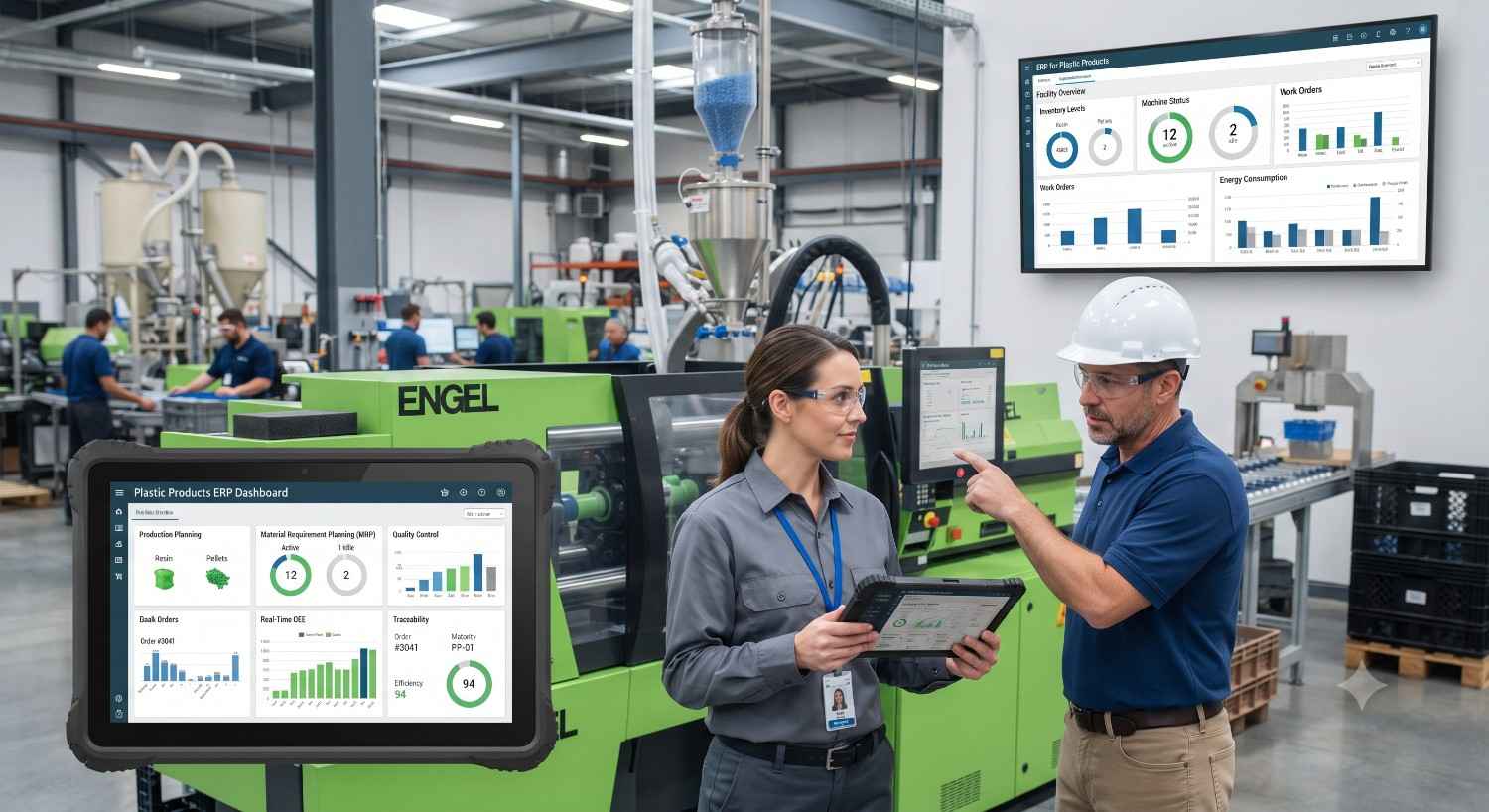
This disconnect is exactly why so many plastic manufacturers are moving to a dedicated ERP for plastic products like SAP Business One. Unlike generic accounting software or fragmented shop-floor tools, SAP Business One pulls production, material traceability, quality checks, and costing into a single, real-time system — so decisions are based on what’s actually happening on the floor, not last week’s paperwork.
In this blog, we’ll break down exactly how this works, why plastic manufacturers specifically benefit from it, what a SAP Business One implementation actually involves, and why ongoing SAP Business One support is just as important as the rollout itself.
Why Plastic Manufacturers Struggle Without an Integrated ERP
Plastic manufacturing is unlike most other industries because of a few unique variables:
-
Resin and material variability — Same polymer, different lot, different melt flow index, different results.
-
Multi-stage processes — Molding, extrusion, assembly, printing, and packing often happen in separate work centers.
-
Scrap and regrind tracking — Runners, sprues, and rejected parts are frequently reground and reused, which complicates material costing.
-
Tight tolerances — Even a small variation in temperature, pressure, or cooling time can push a batch out of specification.
-
Customer-specific traceability demands — Automotive, medical, and packaging clients often require full batch-to-batch traceability from raw resin to finished part.
When these variables are managed through disconnected spreadsheets, WhatsApp updates, and manual logbooks, manufacturers lose visibility. Machines run inefficiently, defective batches go unnoticed until they reach the customer, and true product cost becomes a guessing game rather than a calculation.
This is the exact gap that a purpose-fit ERP for plastic products is built to close.
What Makes SAP Business One a Strong Fit for Plastic Manufacturing?
SAP Business One is a mid-market ERP built by SAP specifically for small and mid-sized businesses that need enterprise-grade control without enterprise-grade complexity. For plastic product manufacturers, its strength lies in how tightly it links four critical functions:
-
Production planning and execution
-
Material and batch traceability
-
Quality management
-
Real-time cost control
Instead of these functions living in isolated tools, SAP Business One treats them as one continuous data flow — a material lot entering the warehouse is linked to the production order it’s consumed in, which is linked to the quality inspection performed on it, which is linked to the final landed cost of the finished part.
Let’s look at each piece individually.
1. Production Planning and Scheduling
At the core of any plastic manufacturing ERP is the ability to plan production against real demand and real capacity — not guesswork.
With SAP Business One, plastic manufacturers can:
-
Create Bills of Materials (BOMs) for each mold, part, or assembly, including resin type, colorant, additives, and packaging materials.
-
Generate production orders automatically from sales orders or forecasted demand.
-
Schedule machine time across injection molding, extrusion, or blow molding lines using available capacity.
-
Track work-in-progress (WIP) in real time as parts move from molding to trimming, assembly, printing, and packing.
-
Flag material shortages before a production run starts, avoiding mid-shift stoppages.
Because production orders are tied directly to inventory and purchasing modules, a plant manager can see — in real time — whether there’s enough resin on hand for the next shift, without physically walking the warehouse floor.
2. Material Traceability: From Resin to Finished Product
Traceability is where a proper ERP for plastic products proves its value most clearly, especially for manufacturers supplying automotive, medical device, food-grade packaging, or export markets.
SAP Business One supports batch and lot management, which means:
-
Every incoming resin, masterbatch, or additive shipment is recorded with a unique batch number, supplier reference, and certificate of analysis.
-
When that batch is consumed in a production order, the system automatically records which batch went into which finished goods.
-
If a customer later reports an issue with a specific product batch, the manufacturer can trace it backward — instantly — to the exact raw material lot, supplier, production date, and machine used.
-
Regrind and scrap materials can also be tracked as sub-batches, maintaining traceability even when reprocessed material is blended back into virgin resin.
This level of traceability isn’t just good practice — for many plastic manufacturers, it’s a contractual requirement. Full backward and forward traceability, delivered instantly instead of after days of manual digging, is one of the strongest reasons manufacturers cite when they invest in a plastic manufacturing ERP software like SAP Business One.
3. Quality Control Built Into the Workflow
In plastic manufacturing, quality issues rarely come from a single cause — they’re usually the result of a material variation, a machine parameter drift, or a process deviation. Catching these early requires quality checks to be part of the production workflow, not an afterthought.
SAP Business One allows manufacturers to:
-
Define quality inspection templates for incoming raw materials, in-process checks, and final product inspection.
-
Trigger automatic quality holds on a batch that fails inspection, preventing it from being used or shipped.
-
Record inspection results (dimensional checks, tensile strength, melt flow index, visual defects) directly against the batch and production order.
-
Generate Certificates of Analysis (CoA) automatically for customers who require documented quality proof.
-
Track defect trends over time by machine, shift, operator, or material supplier — helping identify recurring root causes.
Because this data connects back to material traceability and production records, quality isn’t a separate silo — it’s a natural checkpoint inside the same system that’s already tracking materials and production.
4. Real-Time Cost Control
Perhaps the most underestimated benefit of an integrated ERP for plastic products is accurate, real-time cost visibility.
In a disconnected environment, “cost per part" is usually a rough estimate based on standard costing done once a year. But plastic manufacturing costs shift constantly — resin prices fluctuate, scrap rates vary by shift, and machine downtime eats into margins.
SAP Business One enables:
-
Actual costing based on real material consumption, labor time, and machine hours per production order — not just standard estimates.
-
Automatic capture of scrap and rework costs, so the true cost of a defective batch is visible, not hidden.
-
Landed cost tracking for imported resins and additives, including freight, duty, and handling.
-
Real-time profitability analysis by product, customer, or production batch.
-
Variance reporting that compares planned cost against actual cost, helping identify exactly where margin is being lost.
For plastic manufacturers operating on thin margins — which is most of them — this level of cost visibility often pays for the ERP system within the first year.
SAP Business One Implementation: What the Process Actually Looks Like
A common misconception is that SAP Business One implementation is just “installing software." In reality, for plastic manufacturers, it’s a structured process that maps your actual shop-floor workflow into the system.
A typical implementation includes:
-
Discovery and process mapping — Understanding your BOM structures, machine types, scrap handling, and quality checkpoints.
-
System configuration — Setting up production orders, batch management, quality templates, and costing methods specific to your plant.
-
Data migration — Moving existing customer, vendor, item master, and inventory data into the new system.
-
Integration — Connecting SAP Business One with machine data (if applicable), barcode/label printers, and any existing accounting tools.
-
User training — Training shop-floor supervisors, quality inspectors, and finance teams on their specific modules.
-
Testing and go-live — Running parallel processes before fully switching over, to catch gaps before they affect production.
A rushed or generic SAP Business One implementation is one of the biggest reasons ERP projects underperform. Working with a partner who understands plastic manufacturing specifically — not just generic manufacturing — makes a measurable difference in how quickly the system delivers value.
Why Ongoing SAP Business One Support Matters
Implementation is just the starting point. Plastic manufacturing environments change constantly — new molds, new customers with new traceability requirements, new resin suppliers, seasonal demand shifts. This is where reliable SAP Business One support becomes essential, not optional.
Good ongoing support typically covers:
-
Troubleshooting day-to-day issues without production downtime.
-
Adjusting BOMs, routings, and quality templates as products or processes change.
-
Adding new reports or dashboards as management’s reporting needs evolve.
-
Applying system updates and patches without disrupting operations.
-
Training new employees as staff turnover happens on the shop floor.
Manufacturers who treat SAP Business One support as an ongoing partnership — rather than a one-time helpdesk ticket — tend to get significantly more long-term value out of their ERP investment than those who only reach out when something breaks.
Frequently Asked Questions
Q: Is SAP Business One suitable for small and mid-sized plastic manufacturers, or only large factories?
A: SAP Business One is specifically designed for small and mid-sized businesses. It’s one of the most commonly implemented ERP for plastic products among manufacturers with roughly 10 to 500 employees.
Q: How long does a typical SAP Business One implementation take for a plastics plant?
A: Most implementations for a single-plant plastic manufacturer take between 8 and 16 weeks, depending on the number of production lines, integrations, and data complexity.
Q: Can SAP Business One track regrind and scrap material separately from virgin resin?
A: Yes. Through batch and lot management, regrind can be tracked as its own sub-batch, maintaining full traceability even when it’s blended back into new production runs.
Q: Does SAP Business One integrate with injection molding or extrusion machine data?
A: SAP Business One can integrate with machine monitoring systems and IoT devices through add-ons and middleware, allowing real-time machine data to feed into production and quality records.
Q: What happens after go-live — do we still need SAP Business One support?
A: Yes. Ongoing SAP Business One support is essential for handling configuration changes, new user training, system updates, and troubleshooting as your production environment evolves.
Final Thoughts
For plastic product manufacturers, the real competitive advantage isn’t just making parts faster — it’s knowing, at any given moment, exactly what material went into what batch, whether that batch passed quality, and what it actually cost to produce. That level of visibility simply isn’t possible with disconnected spreadsheets and manual logs.
A well-planned SAP Business One implementation, backed by dependable SAP Business One support, turns this from a manual struggle into a real-time, data-driven advantage. If you’re evaluating an ERP for plastic products for your plant, the right starting point isn’t the software itself — it’s mapping your production, traceability, quality, and costing needs first, and then configuring the system around them.