Odoo for High-Tech Manufacturing
High-tech manufacturing doesn’t forgive sloppy data. When you’re building electronics, medical devices, aerospace components, or precision machinery, a single wrong resistor value or an outdated bill of materials can shut down a production line, trigger a recall, or blow a compliance audit wide open. Spreadsheets, disconnected PLM tools, and legacy ERP systems simply weren’t built for the pace at which components change, engineers revise designs, and supply chains shift. This is exactly why more manufacturers are turning to Odoo ERP Software as the backbone of their operations.
If you’ve ever tried explaining to a floor supervisor why the manufacturing order still references a capacitor that was discontinued three weeks ago, you already understand the problem this blog is solving. Below, we’ll break down how Odoo for High-Tech Manufacturing handles complex, multi-level bills of materials, manages component changes without chaos, and unifies production planning, inventory, and quality control into a single connected system — and why the right Odoo Implementation Services partner makes or breaks that outcome.
Why High-Tech Manufacturing Needs a Different Kind of ERP
Traditional manufacturing ERP systems were designed around simple, linear production: raw material goes in, finished product comes out, and the bill of materials rarely changes. High-tech manufacturing doesn’t work that way.
A single high-tech product might have:
-
Dozens of sub-assemblies, each with its own multi-level BOM
-
Components that get revised, substituted, or discontinued every few weeks
-
Serial and lot traceability requirements for compliance (ISO, FDA, ITAR, RoHS)
-
Frequent engineering change orders (ECOs) coming from R&D
-
Multiple BOM versions running in parallel across different product revisions
-
Tight integration needs between design, procurement, and the shop floor
This is where ERP for High Tech Industry requirements diverge sharply from what works for, say, furniture or food production. You need a system that treats engineering change as a normal, everyday event — not a fire drill. That’s precisely the gap Odoo was built to close.
What Makes Odoo Different for Complex BOM Management
At the core of any high-tech manufacturing operation sits the bill of materials. Get the BOM wrong, and everything downstream — purchasing, scheduling, costing, quality — is wrong too. Odoo’s manufacturing module treats the BOM not as a static document but as a living structure that can be versioned, audited, and updated without breaking active production.
Multi-Level and Nested BOMs
Odoo supports deeply nested, multi-level bills of materials, so a finished product can reference sub-assemblies, which in turn reference their own components and operations. This mirrors how real high-tech products are engineered — a PCB assembly feeding into a larger enclosure, feeding into a final packaged unit. Instead of managing this hierarchy across scattered spreadsheets, everything lives in one traceable structure inside the platform.
Variant and Kit-Based BOMs
High-tech manufacturers rarely build just one version of a product. Odoo lets you define BOM rules based on product variants — voltage, size, color, or configuration — so you don’t need a separate BOM for every SKU combination. Kits and virtual BOMs also let you bundle components for sales orders without triggering unnecessary manufacturing steps.
Subcontracting BOMs
For manufacturers who send certain sub-assemblies to third-party vendors, Odoo maintains a dedicated subcontracting BOM type that tracks components shipped out and finished goods received back, keeping inventory accurate even when part of the process happens off-site.
Version Control Built In
Every time a component changes, Odoo doesn’t just overwrite the old BOM — it retains version history. This means engineers, quality teams, and auditors can always trace exactly which BOM version was used to build a specific batch or serial number, which is non-negotiable in regulated high-tech environments.
Managing Component Changes Without Breaking Production
This is where most legacy systems fall apart. A component gets discontinued, an engineer approves a substitute part, and suddenly there’s a scramble to figure out which manufacturing orders are affected. Odoo’s Product Lifecycle Management (PLM) module, tightly integrated with Manufacturing, solves this through Engineering Change Orders (ECOs).
Here’s how the workflow typically plays out inside Odoo:
-
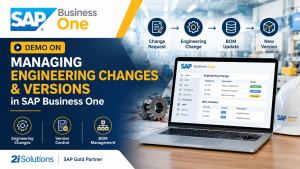
An ECO is raised — whether it’s a component substitution, a routing change, or an update to picking instructions, work center details, operation duration, or even attached CAD files.
-
Changes are drafted and compared in a dedicated ECO tab that shows exactly what’s different between the current production BOM and the revised version.
-
Approval triggers a controlled rollout. Once an ECO is approved, the new BOM version can be pushed live, and draft manufacturing orders can be updated to the new specification with a single click.
-
In-progress orders stay untouched. Manufacturing orders that are already underway continue using the original BOM, so nothing on the floor gets disrupted mid-run.
-
Every change is fully traceable and reversible, and Odoo even manages merge conflicts when two ECOs target the same BOM at the same time.
The practical result: operators on the shop floor are always working from the latest approved specification, engineers get a clean audit trail, and nobody is manually chasing down which version of a document is “the real one." For manufacturers who’ve been burned by a costly material mismatch — building weeks of product against an outdated spec — this single capability alone often justifies the move to Odoo.
Production Planning That Reflects Reality
Managing the BOM is only half the equation. High-tech manufacturers also need production planning that adapts to real shop-floor conditions — labor availability, machine capacity, and material readiness, all in real time.
Odoo brings this together through:
-
Manufacturing Orders (MOs) that connect directly to the correct BOM, routing, and work orders, giving full visibility into progress and material consumption.
-
Master Production Schedule (MPS) and Gantt-based planning tools that help teams allocate labor, machines, and materials against actual demand.
-
Material Requirements Planning (MRP) that calculates what to order and when, based on current stock, lead times, and forecasted demand — with both net-change and full regenerative planning runs available.
-
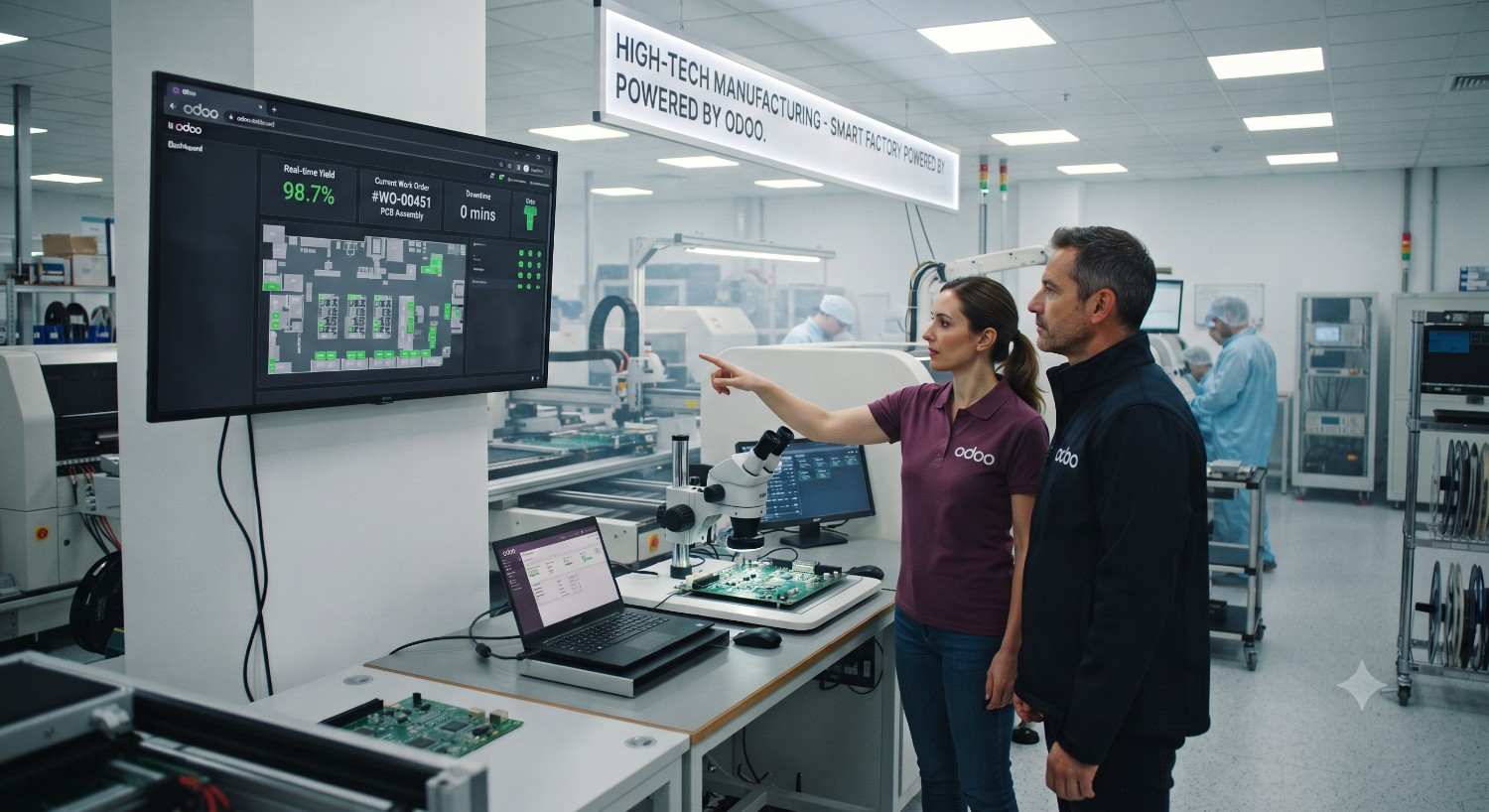
Shop-floor (MES-style) execution through tablet interfaces, where operators log work order progress, trigger quality checks, and even kick off maintenance requests directly from the production line.
-
Quality control checkpoints embedded at each stage of production, rather than bolted on as a separate system.
-
Maintenance integration that connects work centers to usage thresholds or IoT sensor data, automatically creating maintenance requests before a machine failure disrupts a production run.
Because Manufacturing, Inventory, Purchase, Quality, and Accounting all sit on the same Odoo platform, a single manufacturing order can trigger material reservations, generate purchase requests for missing components, calculate real-time production costs, and update sales order fulfillment — all without manual reconciliation between disconnected systems.
One System Instead of Five
Ask any operations leader in high-tech manufacturing what their biggest headache is, and “too many disconnected tools" comes up almost every time. Engineering keeps CAD and BOM data in one place, purchasing runs on a separate spreadsheet, the shop floor tracks work orders on paper or a whiteboard, and finance reconciles everything at month-end using guesswork.
Odoo for High-Tech Manufacturing consolidates these functions:
When everything runs on one data model, a change made in one place — a component swap, a new routing, a revised quantity — immediately reflects everywhere else it matters. That’s the real value proposition behind Odoo ERP Software for complex manufacturing environments.
Why Odoo Implementation Services Matter So Much Here
Odoo is powerful out of the box, but high-tech manufacturing is unforgiving of a poorly configured system. Rushed or generic implementations are where most of the pain comes from — misconfigured work centers, incomplete BOM structures, and routing errors that take months to unwind later.
A capable Odoo Implementation Services partner will typically:
-
Map your existing BOM structures, revision history, and engineering workflows before touching the system
-
Configure PLM and ECO approval flows that match your actual change-control process, not a generic template
-
Set up manufacturing routings, work centers, and quality checkpoints specific to your production reality
-
Integrate Odoo with existing CAD, IoT, or subcontractor systems where needed
-
Migrate historical BOM and inventory data accurately, preserving traceability
-
Train engineering, procurement, and shop-floor teams so adoption actually sticks
A full manufacturing stack implementation — covering Manufacturing, Shop Floor, Quality, PLM, Maintenance, and MPS — is rarely a quick job. Manufacturers who try to compress this into a few weeks typically end up with poorly configured work centers and BOM errors that resurface for months afterward. Partnering with an experienced Odoo team, and giving the implementation the time it needs, is what separates a smooth rollout from a costly do-over.
Who Benefits Most from Odoo in High-Tech Manufacturing
Odoo scales across a wide range of high-tech and precision manufacturing environments, including:
-
Electronics and PCB assembly — where component substitutions and RoHS compliance are constant realities
-
Medical device manufacturing — where full lot and serial traceability is a regulatory requirement, not a nice-to-have
-
Aerospace and precision machinery — where engineering change control and audit trails are mission-critical
-
Industrial equipment producers — who manage high product variety with lower production volumes and need tight control over engineering changes
-
Contract and subcontract manufacturers — who need visibility into components shipped out and finished goods received back
Whether you’re running discrete assembly, process manufacturing, or a mixed-mode operation, the same underlying structure — connected BOMs, controlled change management, and unified production data — applies.
Frequently Asked Questions
What makes Odoo suitable for complex, multi-level BOMs in high-tech manufacturing?
Odoo supports nested BOM structures, variant-based BOM rules, kits, and subcontracting BOMs, all with built-in version control. This lets manufacturers manage deep product hierarchies and frequent revisions without losing traceability.
How does Odoo handle component changes without disrupting active production?
Through its PLM module and Engineering Change Orders (ECOs). Approved changes update draft manufacturing orders automatically, while orders already in progress continue on the original BOM, preventing mid-run disruptions.
Is Odoo ERP Software good for regulated high-tech industries like medical devices or aerospace?
Yes. Odoo’s traceability features track lot and serial numbers from raw material through to finished unit, and its version-controlled BOMs provide the audit trail regulated industries typically require.
Do I need Odoo Implementation Services, or can I set it up myself?
Odoo’s flexibility is also why implementation quality matters so much. For high-tech manufacturing specifically — with its complex routings, quality checkpoints, and ECO workflows — working with an experienced implementation partner significantly reduces the risk of costly misconfiguration.
How long does a full Odoo manufacturing implementation typically take?
A complete manufacturing stack rollout (MRP, Shop Floor, Quality, PLM, and Maintenance) generally takes several weeks to a few months, depending on complexity. Rushing this process is one of the most common causes of downstream BOM and work-center errors.
Final Thoughts
High-tech manufacturing runs on precision, and precision starts with clean, connected data. Odoo for High-Tech Manufacturing brings BOM management, engineering change control, and production planning into a single system, replacing the spreadsheets and disconnected tools that quietly cost manufacturers time, money, and compliance risk. Paired with the right Odoo Implementation Services, it becomes more than just software — it becomes the operational backbone that lets engineering, procurement, and the shop floor finally work from the same source of truth.
If your current setup for ERP for High Tech Industry operations still relies on manual BOM tracking or disconnected change management, it may be time to evaluate whether Odoo ERP Software can close that gap for your production environment.
Contact form