Odoo for pharmaceutical companies
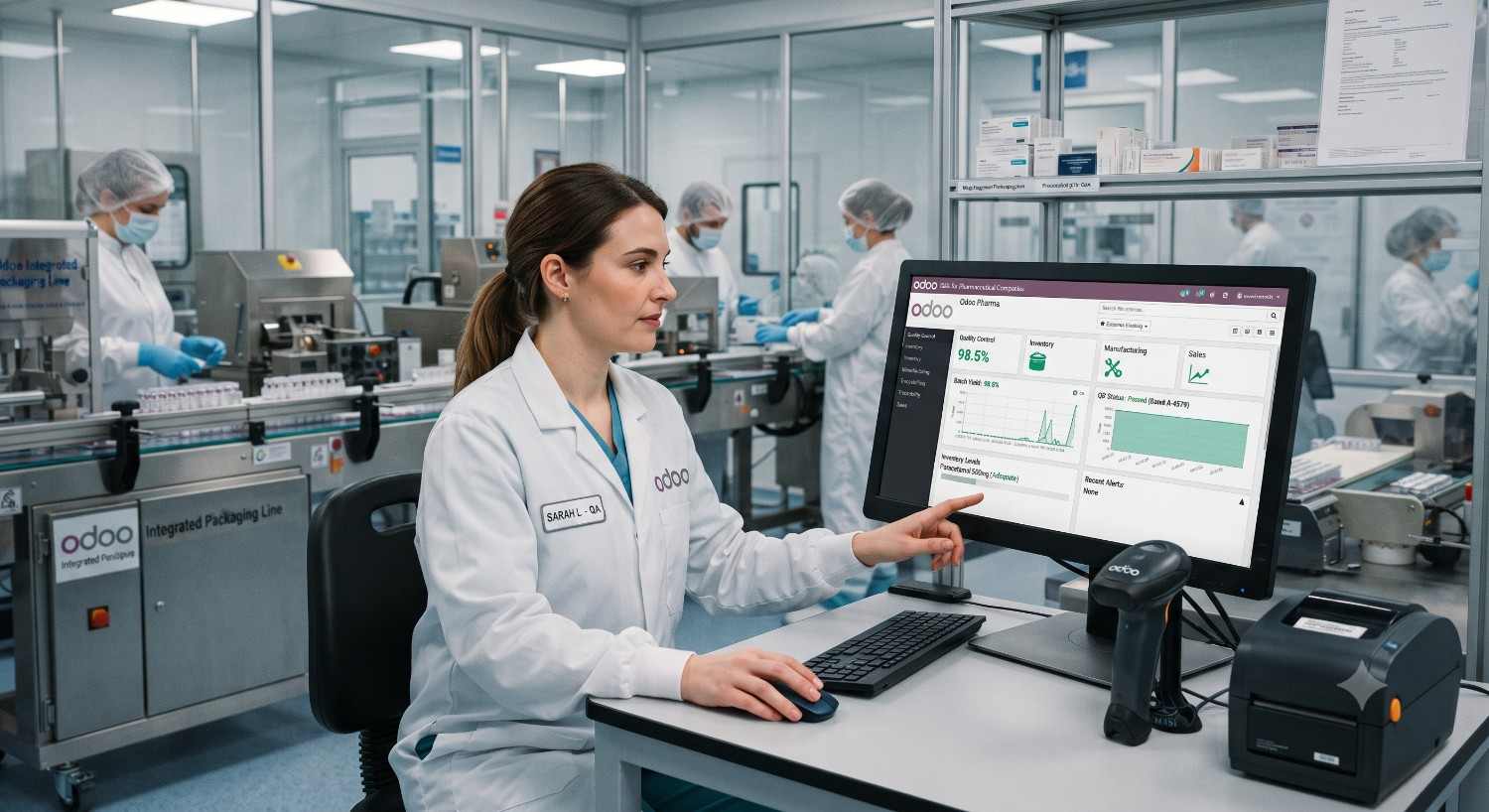
Odoo for pharmaceutical companies by running manufacturing, batch-level inventory, quality control, and supply chain on one connected system, so every raw material, production batch, and finished-goods lot is traceable, quality-checked, and visible in real time, instead of being managed across disconnected spreadsheets and standalone software.
Pharmaceutical manufacturing runs on a promise that most industries do not have to make: every single unit that leaves the plant has to be traceable back to the exact raw material lot it came from, the exact quality checks it passed, and the exact conditions it was stored and shipped under. That promise is hard enough to keep with a good system. It is nearly impossible with a patchwork of spreadsheets, a separate quality register, a standalone inventory tool, and a production log that nobody updates in real time.
This is the operational reality that pushes pharmaceutical companies toward a proper ERP for pharmaceutical industry needs, and it is exactly where Odoo for pharmaceutical companies earns its place. Odoo is not a generic manufacturing tool with a compliance module bolted on as an afterthought. It is a connected system where manufacturing, inventory, quality, and supply chain share the same data, in real time, which is the only way batch traceability and regulatory readiness actually work in practice.
Why Disconnected Systems Fail Pharmaceutical Manufacturers
Most pharmaceutical manufacturers do not struggle because they lack data. They struggle because their data is scattered across systems that do not talk to each other. Production logs live on the shop floor in paper registers or a local spreadsheet. Quality control results sit in a separate quality management tool, or worse, in email threads and PDF reports. Inventory counts are tracked in yet another system, often updated a day or more after the actual movement happened.
The consequences show up in predictable, costly ways:
● A batch recall investigation takes days instead of hours, because tracing raw material lots to finished goods means manually cross-referencing three or four different records.
● Expired or near-expiry stock ships out because the warehouse team has no automated way to enforce first-expiry-first-out picking.
● Quality holds are not reflected in available stock, so sales or dispatch teams unknowingly commit to shipping batches that have not yet cleared quality checks.
● Regulatory audits become a scramble to assemble batch records, certificates of analysis, and deviation reports from multiple disconnected sources.
None of this reflects a lack of effort from plant or quality teams. It reflects the absence of a system built to connect manufacturing, inventory, quality, and supply chain as one continuous process, which is precisely the gap a well-implemented ERP for pharmaceutical industry operations is designed to close.
How Odoo Connects Manufacturing, Inventory, Quality, and Supply Chain
Odoo’s advantage for pharmaceutical manufacturing comes from running these four functions as connected modules on one database, not as separate applications stitched together with exports and manual re-entry.
1. Manufacturing and Formulation Management
Odoo’s Manufacturing module handles multi-level bills of materials, which is essential for pharmaceutical formulations that involve active ingredients, excipients, and multiple production stages. Work orders are generated directly from production plans, and every material consumed during manufacturing is automatically deducted from inventory and tied to its lot number, so the link between raw materials and the batch being produced is captured as it happens, not reconstructed afterward.
2. Batch and Lot-Level Inventory Control
Every item in Odoo can be tracked by lot or serial number, with full genealogy from receipt to consumption to shipment. This is the foundation of pharmaceutical traceability. If a quality issue is discovered in one raw material lot, the system can immediately show every production batch that used it, and every customer shipment that included those batches, without a manual trace-back exercise.
3. Integrated Quality Control Checkpoints
Odoo’s Quality module lets manufacturers define quality checkpoints at incoming inspection, in-process stages, and finished-goods release. A production order can be configured to automatically trigger a quality check before the batch is allowed to move to available stock, which prevents unreleased or failed batches from being picked, packed, or shipped by mistake. Quality failures, deviations, and corrective actions are logged against the specific batch, building the audit trail regulators expect to see.
4. Expiry Management and FEFO Stock Rotation
Because pharmaceutical inventory is expiry-sensitive, Odoo supports first-expiry-first-out removal strategies natively. Warehouse staff are automatically directed to pick the stock closest to expiry first, and the system can flag batches approaching expiry well ahead of time, reducing the risk of expired stock reaching distributors, pharmacies, or hospitals.
5. Real-Time Supply Chain and Distribution Visibility
Once a batch clears quality and is available, Odoo feeds that stock position directly into sales, purchasing, and distribution planning in real time. Supply chain teams see accurate, quality-cleared inventory rather than a stale snapshot, which improves order fulfillment accuracy and reduces the manual reconciliation that typically happens between warehouse, quality, and sales teams.
Odoo Implementation Services: What a Pharmaceutical Rollout Looks Like
A serious pharmaceutical deployment is not a simple software installation. It is a structured project that has to reflect how a regulated manufacturer actually operates. Odoo Implementation Services for a pharmaceutical company generally follow a clear path:
● Process and compliance mapping — documenting existing manufacturing, quality, and warehousing workflows alongside applicable regulatory requirements such as CDSCO guidelines and Schedule M provisions.
● Master data setup — structuring formulations, bills of materials, lot-controlled items, and quality checkpoints so the system reflects actual production reality from day one.
● Quality and traceability configuration — setting up quality control points, expiry rules, FEFO strategies, and batch genealogy tracking.
● Integration — connecting Odoo with weighing systems, lab instruments, or barcode/label printing hardware used on the shop floor, where applicable.
● Pilot rollout — validating the configuration on one production line or product family before scaling across the full plant.
● Go-live and stabilization — moving to full production use with close monitoring through the first few manufacturing and quality cycles.
Pharmaceutical manufacturers who plan their Odoo Implementation Services engagement carefully typically start with their most complex or highest-volume product line, prove the traceability and quality workflows there, and then extend the same configuration to the rest of the plant. Rushing a full-plant go-live without this validation step is one of the more common causes of post-launch disruption in regulated manufacturing environments.
A Practical Example: From Raw Material to Finished Batch
Consider a mid-sized pharmaceutical manufacturer producing tablets and capsules across two product lines, previously running production on paper batch records, a separate spreadsheet-based inventory count, and a standalone quality register maintained by the QA team. Tracing a single finished batch back to its raw material lots for an audit routinely took the QA team the better part of a day, cross-referencing three separate sources.
After moving to Odoo for pharmaceutical companies, the same manufacturer configured lot tracking on every raw material and finished product, with quality checkpoints built into the production workflow. A production order for a tablet batch now automatically consumes the correct raw material lots, holds the batch pending quality release, and only makes it available to the supply chain once the quality check passes. When an audit requires a batch trace, the full genealogy — from raw material lot to finished batch to every shipment it was included in — is available in the system immediately, rather than reconstructed from paper records.
The change was not a reinvention of how the plant manufactures products. It was the same manufacturing and quality process the team already followed, now captured accurately and traceably as it happened, with the system doing the reconciliation work that used to consume hours of manual effort.
Odoo ERP Software and India-Specific Pharma Compliance
Pharmaceutical manufacturing in India operates under a specific regulatory and operational context that a generic global ERP often does not address well. Odoo ERP software can be configured to support these realities directly:
● CDSCO and Schedule M alignment, with documented quality checkpoints, batch records, and deviation tracking that map to what Indian regulators expect during inspections.
● GST-compliant billing and e-invoicing, built into the same system that manages inventory and dispatch, so compliance is not a separate manual step.
● WHO-GMP documentation support, useful for manufacturers exporting to markets that require WHO-GMP certification alongside domestic approvals.
● Multi-location and multi-warehouse operations, common for manufacturers running a plant alongside regional distribution warehouses, with lot traceability maintained across every location.
These are not optional extras. They are central to why Odoo functions as a credible ERP for pharmaceutical industry operations in India specifically, rather than a system retrofitted from a market with different regulatory expectations.
Why Pharmaceutical Companies Choose Odoo Over Point Solutions
Many pharmaceutical manufacturers start with separate tools: a manufacturing execution system, a standalone quality management tool, a basic inventory spreadsheet, and accounting software that does not talk to any of them. This works only until a batch recall, an audit, or a stock discrepancy forces someone to reconcile all four sources manually, usually under time pressure.
Odoo ERP software replaces that patchwork with manufacturing, inventory, quality, and supply chain running as one connected system. The practical outcome is straightforward: batch traceability is immediate rather than reconstructed, quality holds are enforced automatically rather than tracked separately, and supply chain teams work from real-time, quality-cleared stock data instead of a lagging snapshot.
Getting Started
For a pharmaceutical manufacturer still running production, quality, and inventory as separate systems, the right time to evaluate an ERP for a pharmaceutical industry platform is before the next audit or batch recall exposes the gap, not after. A carefully scoped Odoo Implementation Services engagement, focused first on the highest-risk or highest-volume product line, gives manufacturers a real path to full batch traceability, enforced quality gates, and accurate, real-time supply chain visibility.
Connecting manufacturing, inventory, quality, and supply chain does not have to mean a multi-year enterprise software project. With Odoo for pharmaceutical companies, it becomes a phased, achievable rollout built around how regulated manufacturing actually works.
Frequently Asked Questions
How does Odoo help pharmaceutical companies with batch traceability?
Odoo for pharmaceutical companies tracks every raw material lot, work-in-progress batch, and finished-good batch through a single traceability chain. Each transaction, from goods receipt to production consumption to final dispatch, is tied to a lot number, so a manufacturer can trace any finished batch back to its exact raw materials and forward to every customer it was shipped to, in minutes rather than days of manual record review.
Is Odoo ERP software suitable for GMP and regulatory compliance in pharma manufacturing?
Yes. Odoo ERP software supports GMP-aligned workflows including quality control checkpoints at incoming, in-process, and finished-goods stages, controlled document versioning, electronic batch records, and expiry-based inventory management. For Indian manufacturers, this maps directly to CDSCO and Schedule M requirements, and can be configured to support WHO-GMP documentation practices.
What does an Odoo implementation for a pharmaceutical company typically involve?
Odoo Implementation Services for a pharmaceutical manufacturer typically cover process mapping across manufacturing, quality, and warehousing; master data setup for formulations, bill of materials, and lot-controlled items; configuration of quality control points and expiry rules; integration with weighing and lab instruments where needed; and a phased rollout, often starting with one manufacturing line before scaling to the full plant.
Can Odoo manage expiry dates and FEFO stock rotation for pharmaceutical inventory?
Yes. Odoo supports first-expiry-first-out (FEFO) removal strategies natively, so warehouse staff are automatically directed to pick stock nearing expiry before newer batches. Combined with expiry alerts and near-expiry reporting, this reduces the risk of expired stock reaching the supply chain and cuts down on write-offs from unsold, expired inventory.
How does Odoo connect manufacturing, quality, and supply chain for pharma companies?
Odoo runs manufacturing, inventory, quality, and supply chain as connected modules on one database rather than separate systems. A production order automatically triggers quality checks, updates real-time stock levels once a batch passes, and feeds live availability into sales and distribution planning, removing the manual handoffs and reconciliation delays that typically slow pharmaceutical operations.