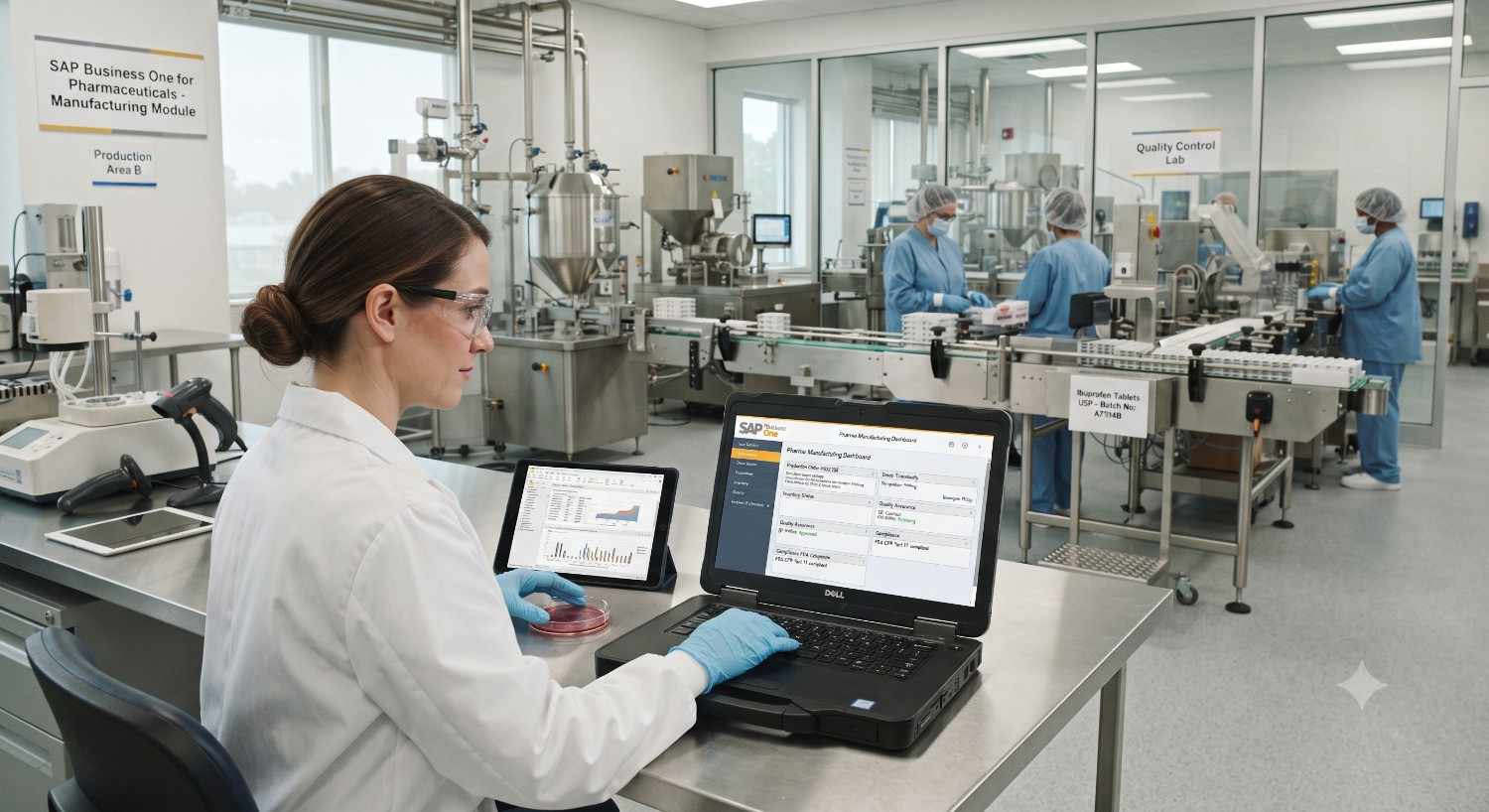
SAP Business One for Pharma
Batch rejection is the single most expensive four-letter word in a pharmaceutical plant. One failed batch can mean thousands of dollars in wasted raw material, a delayed shipment, an anxious quality team, and — if it happens too often — a regulator asking uncomfortable questions. For mid-sized pharmaceutical manufacturers, who don’t have the deep pockets of Big Pharma to absorb these losses, batch rejections aren’t just a line item. They’re a threat to margins, reputation, and growth.
This is the story of how one mid-sized pharmaceutical manufacturer turned that problem around — not with a bigger QC team or more inspectors, but with the right ERP for Pharmaceutical Industry operations: SAP Business One for Pharma. Along the way, we’ll unpack exactly what changed on the shop floor, what a proper SAP Business One Implementation looks like in a regulated manufacturing environment, and why ongoing SAP Business One Support turned out to be just as important as the software itself.
The Real Cost of Batch Rejections in Pharma Manufacturing
Before we get to the fix, it’s worth sitting with the problem for a moment, because most pharma leaders underestimate how much batch rejections actually cost them.
A rejected batch isn’t just the raw material and machine time you lose. It cascades:
-
Idle production lines while the batch is investigated
-
Overtime for the quality team to complete deviation reports
-
Delayed customer deliveries and possible penalty clauses
-
Increased scrutiny during the next regulatory audit
-
Erosion of trust with distributors who depend on consistent supply
For a large pharmaceutical company, one bad batch is a rounding error. For a mid-sized manufacturer running lean margins on a handful of product lines, it’s a bad month. That gap in resilience is exactly why mid-sized manufacturers need to get batch quality right the first time, every time — and why so many of them eventually look for a smarter operating backbone rather than throwing more people at the problem.
Why Legacy Systems Quietly Cause Rejections
In our case study company’s plant — a mid-sized manufacturer producing solid-dose formulations and a small oral liquids line — nothing was dramatically broken. That’s the tricky part. The systems “worked." Production ran. Products shipped. But underneath the surface, three quiet problems were pushing rejection rates higher than they needed to be:
1. Disconnected data across departments.
Production logged batch data in one spreadsheet, QC recorded test results in another, and the warehouse tracked raw material lots in a third system entirely. Nobody had one version of the truth in real time.
2. Manual batch record entry.
Operators filled out paper batch manufacturing records (BMRs), which were later transcribed into digital files. Every manual transcription was a chance for a decimal point, a lot number, or a timestamp to be entered wrong — and a wrong entry during an audit trail review is enough to trigger a full batch investigation.
3. No real-time deviation alerts.
By the time a temperature excursion or an out-of-specification (OOS) raw material was flagged, the batch had often already moved several stages down the line. Catching the issue late meant rejecting far more products than necessary.
None of this showed up as a single root cause. It showed up as a slow, steady drip of rejected batches — roughly one in every twelve batches failing quality release, well above industry benchmarks for a plant of that size.
Choosing the Right ERP for Pharmaceutical Industry Needs
The leadership team’s first instinct was to add more manual checks. Thankfully, their quality head pushed back with a simple observation: “We don’t have a checking problem. We have a visibility problem." That reframing changed everything.
They began evaluating enterprise resource planning platforms with one non-negotiable requirement: the system had to be purpose-fit for a regulated, batch-driven manufacturing environment — not a generic finance-and-inventory tool bolted onto production. That search led them to SAP Business One for Pharma, specifically configured for pharmaceutical manufacturing with:
-
Batch and lot traceability from raw material receipt to finished goods dispatch
-
Integrated quality management workflows tied directly to production orders
-
Electronic batch records with audit trails
-
Real-time alerts for deviations, expiries, and quarantine holds
-
Seamless integration with existing lab and warehouse systems
What made SAP Business One stand out for a mid-sized operation specifically was scale-appropriateness. It offered enterprise-grade traceability and compliance capability without the cost, complexity, or multi-year rollout timeline of a Tier 1 ERP built for multinational pharma giants. For a company this size, that combination — pharma-grade control at mid-market cost — was the deciding factor.
Inside the SAP Business One Implementation
A rushed implementation in a regulated industry is how you trade one set of problems for another. The SAP Business One Implementation partner ran the project in four deliberate phases over roughly five months.
Phase 1 — Process Mapping and Validation Planning. Before a single screen was configured, the team mapped every existing batch workflow: material receipt, dispensing, granulation, compression, coating, packaging, and QC release. This mapping doubled as the foundation for computer system validation (CSV) documentation, which regulated manufacturers can’t skip.
Phase 2 — Configuration and Master Data Cleanup. This is the unglamorous phase nobody talks about, and the one that determines whether the whole project succeeds. Item masters, bill of materials (BOMs), batch numbering conventions, and quality parameters were standardized and loaded. Years of inconsistent naming conventions in the old spreadsheets got cleaned up here.
Phase 3 — Pilot Run on One Product Line. Rather than switching the entire plant over at once, the team piloted the new system on the solid-dose line for six weeks, running it in parallel with the old paper-based process to compare results before fully cutting over.
Phase 4 — Full Rollout and Training. Once the pilot proved out, the system went live across all product lines, with role-based training for operators, QC analysts, and warehouse staff — because an ERP is only as good as the people entering data into it.
Post-launch, the manufacturer kept a dedicated SAP Business One Support arrangement in place with their implementation partner rather than treating go-live as the finish line. This turned out to be one of the smartest decisions in the whole project.
What Actually Reduced the Batch Rejections
Three specific capabilities did the heavy lifting.
1. End-to-End Batch Traceability
Every raw material lot was now tagged and tracked automatically from goods receipt through every production stage to the finished batch. If a supplier’s raw material lot later showed a quality flag, the system could instantly identify every batch that had used it — something that used to take QC staff hours of manual cross-referencing across three different files.
2. Real-Time Quality Holds and Deviation Alerts
Instead of discovering a deviation during final release testing, supervisors now got flagged the moment an in-process parameter drifted out of range. A batch could be placed on quarantine hold immediately, contained before more material was consumed downstream, and investigated with full context already logged in the system.
3. Electronic Batch Records with Built-In Validation Rules
Manual transcription errors — the quiet, persistent source of “administrative" batch rejections — dropped sharply once operators entered data directly into validated electronic batch records with built-in range checks. The system simply wouldn’t let an operator log an impossible value, catching human error at the point of entry instead of during a post-hoc audit.
The Results
Within eight months of full rollout, the manufacturer saw measurable, sustained improvement:
-
Batch rejection rate fell from roughly 8% to under 3%
-
Time to release a batch for shipment shortened by nearly 40%
-
Deviation investigations dropped significantly because most issues were caught and contained in-process rather than at final QC
-
Regulatory audit preparation time was cut nearly in half, since batch history and audit trails were a few clicks away instead of a multi-day document hunt
These figures are illustrative of the kind of improvement mid-sized pharma manufacturers commonly report after a well-run implementation — actual results vary by starting baseline, product complexity, and how disciplined the rollout is.
Why Ongoing Support Mattered as Much as the Software
It would be easy to credit the software alone, but that misses half the story. Pharma regulations evolve. Product lines get added. New raw material suppliers come on board. A static, “set it and forget it" ERP configuration slowly drifts out of sync with real operations.
The manufacturer’s continued relationship with their SAP Business One Support provider meant that as new products launched, quality parameters were reconfigured in days rather than months. When a regulatory update changed documentation requirements, the support team adjusted the electronic batch record templates before the next audit cycle — not after a finding forced their hand.
That ongoing partnership, more than any single feature, is what kept rejection rates low well past the initial post-implementation honeymoon period.
Lessons for Other Mid-Sized Pharma Manufacturers
If there’s a takeaway for other manufacturers eyeing a similar transformation, it’s this: batch rejections are rarely caused by one dramatic failure. They’re caused by small, invisible gaps — a spreadsheet here, a manual entry there, a delayed alert somewhere else — that compound over thousands of production cycles.
A handful of practical lessons stood out:
-
Don’t skip master data cleanup. A perfectly configured ERP running on messy item and batch data will still produce messy results.
-
Pilot before you scale. Running parallel on one line first catches configuration issues before they touch your entire output.
-
Budget for support, not just implementation. The go-live date is the beginning of the value curve, not the end of it.
-
Involve QC from day one. Quality teams, not just IT or operations, should shape how deviation and hold workflows are configured.
Frequently Asked Questions
Q: Is SAP Business One suitable for pharmaceutical manufacturers, or only for generic industries?
A: SAP Business One can be configured specifically for pharmaceutical manufacturing, with batch traceability, quality management, and electronic batch record features that meet regulated industry needs — making it a genuine ERP for Pharmaceutical Industry use cases, not just a generic business tool.
Q: How long does a typical SAP Business One Implementation take for a pharma plant?
A: For a mid-sized manufacturer, a phased rollout — process mapping, configuration, a pilot run, and full go-live — typically takes four to six months, depending on the number of product lines and existing data quality.
Q: Can SAP Business One reduce batch rejections on its own?
A: The software provides the traceability, real-time alerts, and validated data entry that prevent many rejection causes. But sustained results depend equally on disciplined implementation and continued SAP Business One Support to keep configurations aligned with evolving products and regulations.
Q: What’s the biggest mistake pharma manufacturers make during implementation?
A: Rushing master data cleanup and skipping a pilot phase. Both shortcuts tend to surface as production problems months after go-live, when they’re far more expensive to fix.
Final Thoughts
Batch rejections feel like a quality control problem, but they’re usually a visibility problem in disguise. For this mid-sized pharmaceutical manufacturer, the fix wasn’t more inspectors or more paperwork — it was a properly implemented, properly supported ERP that gave SAP Business One for Pharma for every department the same real-time picture of every batch, every lot, and every deviation.
If your plant is seeing rejection rates that feel a little too routine, it may be worth asking the same question this manufacturer’s quality head asked: is this a checking problem, or a visibility problem? The answer usually points straight to the ERP running underneath your production floor.
Contact form