SAP S/4HANA AI Evolution in 2026
For most of the last decade, “digital transformation” in SAP circles meant one thing: automation. Bots that matched invoices, workflows that routed approvals, background jobs that reconciled ledgers overnight. It worked, but it was blind. A rule-based bot could execute a step perfectly and still have no idea whether that step was the right one, whether it was creating a bottleneck three stages downstream, or whether the same exception kept recurring for the same silent reason every month.
That is the gap 2026 is closing. SAP S/4HANA AI has moved past scripted automation into something enterprises are now calling process intelligence — systems that don’t just execute a process but understand it, watch it, and improve it in real time. If you are planning a SAP S/4HANA Implementation this year, or evaluating RISE with SAP S/4HANA Private Cloud as your landing zone, this shift changes what “go-live” actually needs to include.
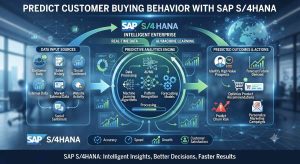
Quick answer: Process intelligence in SAP S/4HANA combines process mining (SAP Signavio), an agentic AI layer (SAP Joule), and domain-trained models to continuously observe business processes, predict where they will break, and take corrective action — instead of simply automating a fixed sequence of steps.
Why “Automation” Stopped Being Enough
Automation solves a narrow problem well: repetition. It cannot answer harder questions that finance, supply chain, and procurement leaders actually lose sleep over — why does the same customer’s invoice get disputed every quarter, why does one plant’s inventory always run short two days before month-end, why do 12% of purchase orders need manual rework. Those are pattern questions, not step questions, and rule-based automation was never built to answer them.
Enterprises running SAP S/4HANA Cloud generate enormous volumes of process data every day — every order, every approval, every exception timestamp. Process intelligence is the discipline of turning that exhaust data into a live, continuously updated map of how the business actually behaves, not how the org chart says it should behave.
The Four Pillars Behind SAP S/4HANA’s AI Evolution
1. SAP Joule — from copilot to agent network
SAP Joule launched as a conversational assistant that could answer questions inside SAP S/4HANA. It has since grown into a genuine agent network with dozens of specialized agents covering finance, HR, procurement, and supply chain scenarios, each acting like a subject-matter expert embedded directly in the transaction. Rather than only surfacing an insight, Joule agents can now initiate the next action — flagging a fulfillment risk, drafting a dispute resolution, or reconciling a payment advice — and hand off to a human only when judgment is genuinely required.
2. SAP Signavio + Joule — process intelligence in action
Process mining has existed for years as a diagnostic tool: something you ran quarterly to find where a process was leaking time or money. The 2026 shift is that SAP Signavio’s process intelligence is now wired directly into Joule, so a detected deviation doesn’t just produce a chart for an analyst to review later — it can trigger an agent to investigate root cause and propose or execute a fix inside SAP S/4HANA the same day.
3. Domain-trained AI models
Generic large language models are good at language, not at your chart of accounts. SAP has been building models trained specifically on SAP business processes, transactional data structures, and documentation, so that when Joule answers a query or generates code, the response is grounded in actual SAP context rather than general internet knowledge. This is what separates enterprise-grade SAP S/4HANA AI from a generic chatbot bolted onto a screen.
4. Embedded predictive and generative AI across modules
Beyond the copilot layer, SAP has quietly embedded machine learning into core S/4HANA modules: predictive cash flow forecasting in FSCM, anomaly detection in finance, demand sensing in supply chain, and predictive maintenance recommendations in plant maintenance. None of this requires a separate AI project — it ships as part of the standard SAP S/4HANA Cloud subscription, which is precisely why implementation planning needs to account for it upfront rather than as a phase-two add-on.
What This Means for a SAP S/4HANA Implementation in 2026

A SAP S/4HANA Implementation built around 2023-era thinking treats AI as a “nice to have” layered on after go-live. That approach now leaves real value on the table. Here’s what a process-intelligence-ready implementation actually looks like:
- Process mining before blueprinting. Map current-state processes with Signavio before finalizing the to-be design, so the implementation is built around how work genuinely flows, not a theoretical org chart.
- AI use-case prioritization in the design phase. Identify two or three high-friction processes — invoice exceptions, order-to-cash disputes, procurement approvals — where a Joule agent or embedded ML model can replace manual triage from day one.
- Clean, governed master data. Every AI recommendation is only as good as the data behind it. Data cleansing and governance move from a technical checklist item to a strategic gate before any AI feature goes live.
- Role-based AI enablement, not a big-bang rollout. Activate Joule and AI agents incrementally by process area, with validated master data and access controls, rather than switching everything on at once.
- Change management for AI-assisted work. End users need training not just on new Fiori apps, but on when to trust an AI recommendation, when to override it, and how to escalate.
RISE with SAP S/4HANA Private Cloud: The Foundation Most AI Roadmaps Need
RISE with SAP S/4HANA Private Cloud has become the default landing zone for enterprises that want the innovation pace of the cloud without giving up the control a regulated or complex organization needs. It matters specifically for AI adoption for a few reasons:
- Single-tenant governance. Private Cloud customers get a dedicated environment, which matters when AI agents are reading and acting on sensitive financial or HR data.
- Managed innovation cadence. SAP handles the underlying infrastructure and keeps the system current with new Joule agents and Business AI releases, so enterprises aren’t stuck maintaining AI infrastructure themselves.
- Built-in access to SAP Business Technology Platform (BTP). BTP is where Joule Studio, custom agent development, and integration flows live — and it’s included as part of the RISE commercial model.
- A realistic bridge from ECC. For the large population of enterprises still migrating off SAP ECC ahead of the end-of-maintenance deadline, RISE with SAP S/4HANA Private Cloud offers a managed migration path that lands directly on an AI-ready platform, rather than a lift-and-shift that still needs re-platforming later.
| Consideration | SAP S/4HANA Cloud Public Edition | RISE with SAP S/4HANA Private Cloud |
| Customization depth | Limited, standardized processes | High — supports custom code and complex processes |
| AI / Joule access | Yes, standard release cycle | Yes, with more control over rollout timing |
| Best fit | Mid-market, standardized industries | Large enterprise, regulated or complex landscapes |
| Infrastructure management | Fully SAP-managed | SAP-managed, dedicated tenant |
A Practical Roadmap for Indian Enterprises
For enterprises in India, the process intelligence shift lines up with a few local realities worth planning around:
- GST and e-invoicing automation. AI-assisted validation is reducing manual rework in GST-compliant e-invoicing, catching mismatches before they become compliance issues rather than after.
- Multi-entity, multi-GSTIN complexity. Indian conglomerates running multiple legal entities benefit from process mining that shows where intercompany processes diverge across business units — a pattern that’s hard to see manually across dozens of GSTINs.
- Talent and change readiness. The Indian SAP talent market has deep implementation experience but less hands-on exposure to agentic AI configuration, so implementation partners with proven Joule and Business AI delivery experience are worth prioritizing over pure staffing-based vendors.
- Cost predictability. INR-denominated RISE with SAP contracts and phased AI activation help finance teams avoid a large upfront AI spend before ROI is proven on a specific process.
Where Enterprises Still Get This Wrong
It’s worth being honest about the gap between the marketing and the reality. Genuinely autonomous, end-to-end financial operations — invoices processed with zero human touch, collections running entirely on behavioral models — are not universally live yet across every SAP customer. The value today is real but uneven: SuccessFactors and Ariba integrations tend to show the most mature, consistent AI results, while full autonomy in core finance processes is still maturing. Enterprises that treat Joule, process mining, and embedded AI as three separate initiatives instead of one integrated capability tend to see fragmented results and disappointing ROI.
The organizations getting real value share a common pattern: they picked a small number of high-friction processes, measured the baseline manual effort honestly, activated AI incrementally with governance in place, and resisted the temptation to switch everything on at once just because the license includes it.
Where 2iSolutions Fits
As an SAP Gold Partner, 2iSolutions works with enterprises across manufacturing, pharmaceuticals, and distribution on both greenfield and brownfield SAP S/4HANA Implementation projects, including migrations onto RISE with SAP S/4HANA Private Cloud. Our approach treats process intelligence as part of the core implementation methodology — process mining during blueprinting, prioritized Joule and Business AI use cases during build, and role-based activation during hypercare — so AI value shows up in the first few months after go-live, not two years later as a separate project.
Planning your next step on SAP S/4HANA? Whether you’re scoping a fresh SAP S/4HANA Implementation, evaluating RISE with SAP S/4HANA Private Cloud, or trying to get more value from the SAP S/4HANA AI capabilities you already own, 2iSolutions can map a roadmap specific to your landscape.
Frequently Asked Questions
What is the difference between process automation and process intelligence in SAP S/4HANA?
Process automation executes predefined, rule-based steps such as three-way invoice matching or approval routing. Process intelligence goes further: it continuously analyzes how processes actually run, using AI to detect bottlenecks, predict outcomes, and recommend or trigger corrective action without waiting for a human to spot the problem.
What is SAP Joule and how does it relate to process intelligence?
SAP Joule is SAP’s AI copilot and agent layer, embedded across SAP S/4HANA, SuccessFactors, and Ariba. When paired with SAP Signavio process mining, Joule moves from answering questions to acting on process insights, closing the loop between detecting an issue and resolving it inside SAP S/4HANA.
Does RISE with SAP S/4HANA Private Cloud include AI capabilities?
Yes. RISE with SAP S/4HANA Private Cloud customers get access to SAP Business AI capabilities, including Joule agents, embedded machine learning, and SAP Business Technology Platform services, within a managed, single-tenant cloud environment governed by SAP-defined SLAs.
How does AI change the approach to SAP S/4HANA Implementation?
A modern SAP S/4HANA Implementation now includes process mining and AI readiness as part of the design phase, not an afterthought. Teams map current-state processes with Signavio, identify where AI agents can remove manual effort, and configure Joule and Business AI use cases alongside standard Fiori apps during build and test.
Is SAP S/4HANA Cloud AI available for Indian enterprises?
Yes. SAP S/4HANA Cloud AI capabilities, including Joule, GST-compliant e-invoicing automation, and predictive finance features, are available to Indian enterprises through both the Public and Private Cloud editions, with data residency and compliance options suited to Indian regulatory requirements.
Contact form