SAP S/4HANA Private Cloud against SAP S/4HANA On-Premise
If you are the one weighing SAP S/4HANA Private Cloud against SAP S/4HANA On-Premise right now, you are not alone. Almost every CIO and IT head we speak with at 2iSolutions is running some version of this comparison in the last two years, usually because the SAP ECC end-of-maintenance clock is ticking and a re-platforming decision can no longer be postponed. This blog breaks down, in plain terms, why SAP S/4HANA Private Cloud is turning out to be the stronger choice for most organizations, and where On-Premise still holds its ground.
Quick answer: SAP S/4HANA Private Cloud is superior to SAP S/4HANA On-Premise for most enterprises because it lowers total cost of ownership, shifts infrastructure and Basis responsibility to SAP or a certified partner, delivers faster upgrade cycles, and includes built-in security and disaster recovery — while still offering the dedicated, single-tenant environment and customization depth that On-Premise users are used to.
Why This Comparison Matters Right Now
SAP has confirmed that mainstream maintenance for SAP ECC 6.0 ends in December 2027. That deadline has turned what used to be a leisurely modernization conversation into an active project on almost every enterprise roadmap. Businesses evaluating their next SAP S/4HANA Implementation are no longer just asking “should we move to S/4HANA," they are asking “should we move to S/4HANA Private Cloud or stay On-Premise." Getting this decision right matters because it shapes your infrastructure budget, your IT headcount, your compliance posture, and how quickly you can adopt SAP’s ongoing innovations for the next decade.
SAP S/4HANA Private Cloud vs SAP S/4HANA On-Premise: The Core Difference
SAP S/4HANA On-Premise is the traditional model. You buy the license, you provision the servers (your own data center or an IaaS provider like AWS or Azure), and your internal team or a managed services partner handles patching, backups, Basis administration and disaster recovery. Every layer of the stack is your responsibility.
SAP S/4HANA Private Cloud, offered through the RISE with SAP program, changes that equation. You still get a dedicated, single-tenant environment — your data is not commingled with any other customer’s — but the infrastructure, hyperscaler capacity, security patching, and Basis operations are bundled into a single subscription managed by SAP or a certified implementation partner. In short: On-Premise gives you full control and full responsibility. Private Cloud gives you dedicated infrastructure with shared operational responsibility.
1. Total Cost of Ownership Favors Private Cloud
On-Premise deployments demand heavy capital expenditure upfront — servers, storage, data center space, networking, and redundant hardware for disaster recovery. Add to that the ongoing cost of a Basis team to patch, monitor and tune the system, and the five-year cost curve climbs steeply.
SAP S/4HANA Private Cloud converts most of that into a predictable operating expense. Infrastructure, hyperscaler consumption, security patching, and a large share of Basis support are wrapped into the subscription. For Indian enterprises budgeting in INR against a fluctuating hardware import cost and GST on capital equipment, converting a capital-heavy project into a subscription is often the single biggest financial argument for Private Cloud. Many finance teams evaluating a fresh SAP S/4HANA Service engagement find the multi-year total cost of ownership 20–30% lower with Private Cloud once hardware refresh cycles are factored in.
2. Faster, Less Disruptive Upgrades
On-Premise upgrades are notoriously heavy. Each major update requires the internal team to plan a regression testing cycle, coordinate downtime windows, and often re-validate custom code against the new kernel — a process that can stretch over months.
SAP S/4HANA Private Cloud comes with a structured, SAP-managed upgrade path. Because the environment is standardized and SAP controls the underlying patching cadence, upgrade windows are shorter and more predictable, and you gain faster access to new Fiori apps, embedded analytics, and AI-driven capabilities as SAP ships them. For organizations trying to keep pace with SAP’s innovation roadmap without dedicating a large internal team to every release cycle, this is a meaningful operational advantage.
3. Built-In Security and Disaster Recovery
Security in an On-Premise landscape is entirely on you: firewalls, intrusion detection, patch management, and disaster recovery infrastructure all have to be designed, built and tested by your own team or a third-party partner you coordinate separately.
SAP S/4HANA Private Cloud includes enterprise-grade security controls, regular patching, and disaster recovery as part of the base offering, backed by defined SLAs. For manufacturing, pharma, and BFSI companies that cannot afford unplanned downtime, having disaster recovery and security baked into the subscription — rather than bolted on separately — removes a significant amount of operational risk.
4. Compliance and Data Residency, Without Giving Up Control
One objection we hear often from Indian enterprises is that cloud deployments raise data-residency and compliance concerns, especially with GST and e-invoicing data flowing through the ERP daily. This is a fair concern with public multi-tenant clouds, but it does not really apply to Private Cloud. Because SAP S/4HANA Private Cloud is single-tenant and can be hosted in data centers located within India, companies get the compliance posture they need for GST reporting, e-invoicing and statutory audits, without the operational burden of running that infrastructure themselves. On-Premise does not offer any inherent compliance advantage over Private Cloud here — both can be hosted in India — so this argument, once a real differentiator, has largely disappeared.
5. Right-Sized for the ECC 2027 Deadline
With mainstream ECC maintenance ending in December 2027, many companies planning their SAP S/4HANA Implementation are asking a practical question: if we have to re-platform anyway, why lock ourselves into another decade of on-premise hardware refresh cycles? Moving straight to SAP S/4HANA Private Cloud lets organizations use this mandatory migration as an opportunity to exit the hardware ownership cycle entirely, rather than simply moving ECC’s problems onto a new S/4HANA On-Premise stack.
Where SAP S/4HANA On-Premise Still Makes Sense
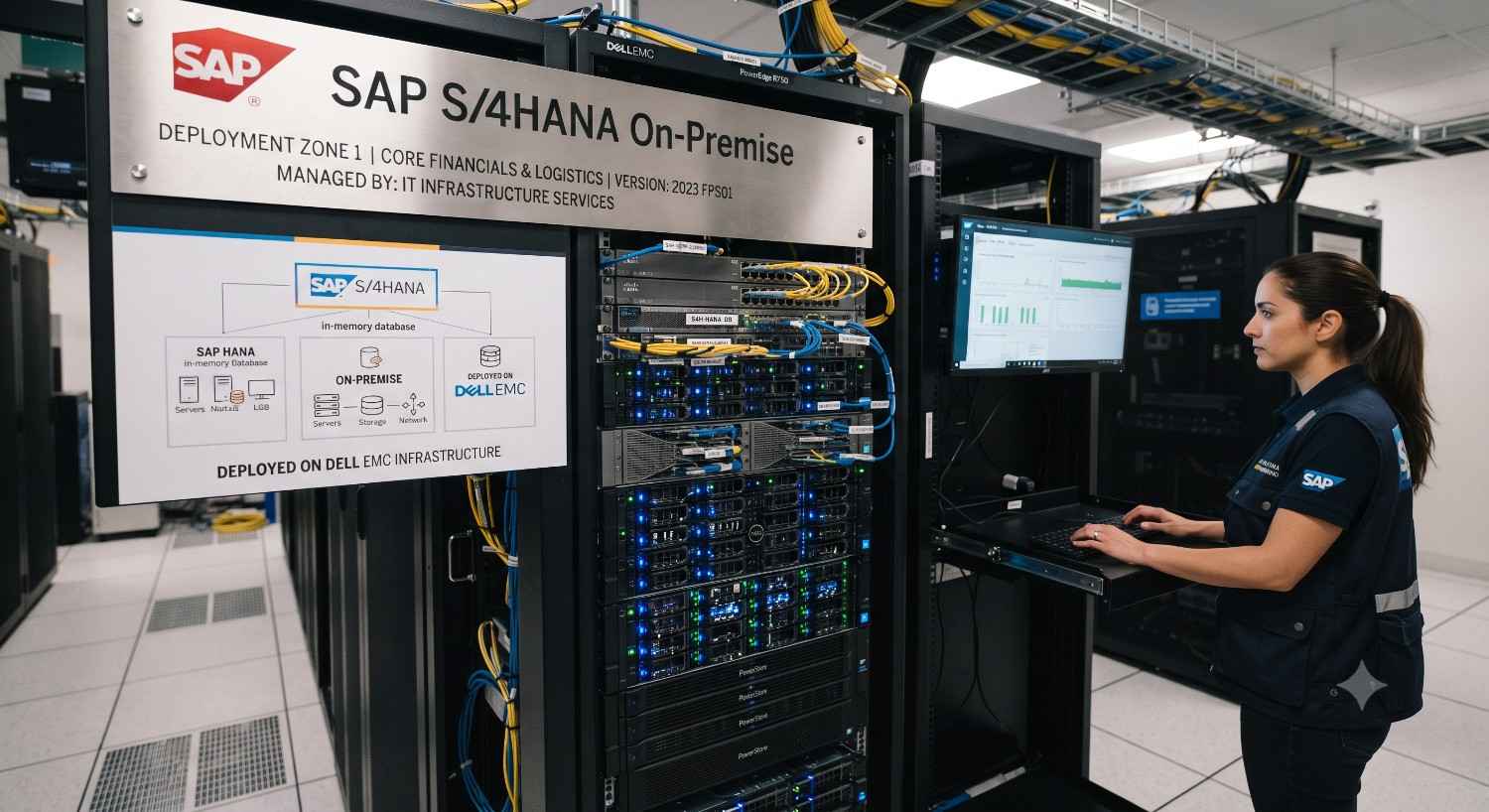
Private Cloud is not universally the right answer, and a good SAP S/4HANA Service partner will tell you that honestly. On-Premise still fits organizations with:
• Extremely heavy custom code or industry-specific add-ons that need direct, unrestricted access to the database layer
• Regulatory environments (certain defense, government, or highly regulated sectors) that mandate infrastructure the company owns outright
• Existing, recently refreshed data center investments they are not ready to retire
• Highly specialized integrations with legacy on-premise systems that are not yet cloud-ready
For these organizations, a well-managed On-Premise SAP S/4HANA Implementation, supported by a strong managed services partner, remains a legitimate and defensible path.
What Changes on the Ground for Your IT Team
The comparison between SAP S/4HANA Private Cloud and On-Premise is not just a finance or infrastructure decision — it changes how your internal IT team spends its time. Under On-Premise, a meaningful share of your Basis and infrastructure team’s week goes into patching, capacity planning, backup verification, and coordinating with hardware vendors. Under Private Cloud, that time gets freed up because SAP or your certified partner absorbs the routine operational load, and your internal team can shift its focus toward configuration, process improvement, and supporting the business rather than keeping the lights on. For IT leaders trying to justify headcount for higher-value work — automation, analytics, integration — this shift is often as valuable as the direct cost savings.
It also changes how incidents are handled. On an On-Premise landscape, a hardware failure or a security patch gone wrong is entirely your team’s problem to diagnose and fix, often late at night. On SAP S/4HANA Private Cloud, SLA-backed support means the responsibility for infrastructure-layer incidents sits with SAP or the managed services partner, and your team is looped in rather than solely responsible.
Common Mistakes Companies Make During This Decision
Having supported multiple SAP S/4HANA Implementation projects, a few patterns show up repeatedly when companies get this decision wrong:
• Comparing sticker price instead of five-year TCO. On-Premise can look cheaper in year one if you already own hardware, but that comparison ignores the refresh cycle three to five years out.
• Assuming Private Cloud means losing customization. Private Cloud still supports extensibility through SAP BTP and side-by-side extensions; it simply pushes teams toward a cleaner core rather than deep core modifications, which pays off at every future upgrade.
• Treating data residency as a blocker without checking hosting location. Many teams rule out Private Cloud over compliance concerns before confirming that India-hosted options exist.
• Delaying the decision until close to the 2027 deadline. A rushed migration under deadline pressure limits your ability to properly plan a clean core strategy, data migration, and user training.
Business Impact Beyond IT
The choice between SAP S/4HANA Private Cloud and On-Premise eventually shows up in business metrics that go well beyond the IT budget. Faster upgrade cycles under Private Cloud mean finance, supply chain and manufacturing teams get access to new Fiori apps and embedded analytics sooner, instead of waiting for the next internally-scheduled upgrade project. Predictable subscription costs make multi-year budgeting easier for the CFO’s office, since there is no large, lumpy capital outlay to plan around every few years. And because uptime and disaster recovery are backed by SLAs, business continuity risk — the kind that shows up as a missed shipment or a delayed statutory filing during a system outage — goes down. These are the arguments that tend to move a SAP S/4HANA Private Cloud business case past the CIO’s desk and into the CFO’s and COO’s conversations as well.
How to Decide: A Practical Checklist
Before choosing between SAP S/4HANA Private Cloud and On-Premise, walk through these questions with your implementation partner:
• What does your five-year total cost of ownership look like under each model, including hardware refresh and Basis headcount?
• How much custom code do you carry today, and how much of it is still relevant after a clean core assessment?
• Do you have a hard data-residency mandate, and can Private Cloud’s India-hosted option satisfy it?
• How important is speed of access to SAP’s newest Fiori and AI capabilities to your business?
• Is your ECC system approaching the December 2027 maintenance deadline, and would a second On-Premise investment make sense given that timeline?
How 2iSolutions Helps
As an SAP Gold Partner, 2iSolutions works with mid-market and enterprise clients across India to evaluate SAP S/4HANA Private Cloud and On-Premise side by side against their actual cost, compliance and customization needs — not a generic template. Our SAP S/4HANA Service covers everything from the initial fit-gap assessment and business case, through migration and cutover planning, to post-go-live managed services, so the decision you make today keeps working for you well past the 2027 deadline.
Frequently Asked Questions
Is SAP S/4HANA Private Cloud better than On-Premise?
For most mid-size and large enterprises, yes. SAP S/4HANA Private Cloud offers lower total cost of ownership, faster deployment, built-in disaster recovery, and predictable subscription pricing, while still giving the dedicated infrastructure and customization control that On-Premise offers. On-Premise remains a fit only for organizations with strict data-residency mandates or heavy legacy customization that cannot yet move.
What is the difference between SAP S/4HANA Private Cloud and On-Premise?
SAP S/4HANA On-Premise is licensed, installed and maintained entirely on infrastructure the company owns or leases, with the company responsible for hardware, patching and disaster recovery. SAP S/4HANA Private Cloud, delivered under RISE with SAP, runs on dedicated single-tenant infrastructure managed by SAP or a certified partner, bundling infrastructure, Basis support, security and upgrades into one subscription.
Does SAP S/4HANA Private Cloud cost less than On-Premise?
Over a five-year horizon, Private Cloud typically costs less because it removes large upfront capital expenditure on servers and data centers, replacing it with an operating expense subscription that includes infrastructure, security patching and Basis administration.
Can Indian companies run SAP S/4HANA Private Cloud with data centers in India?
Yes. SAP and its certified partners offer private cloud hosting through data centers located within India, which helps Indian enterprises meet data-residency expectations while still moving away from on-premise infrastructure.
Is SAP ECC end of maintenance pushing companies to S/4HANA Private Cloud?
Yes. With standard maintenance for SAP ECC ending in December 2027, many companies are using this deadline to skip a second On-Premise investment and move directly to SAP S/4HANA Private Cloud, avoiding the need to re-platform again a few years later.
Contact form