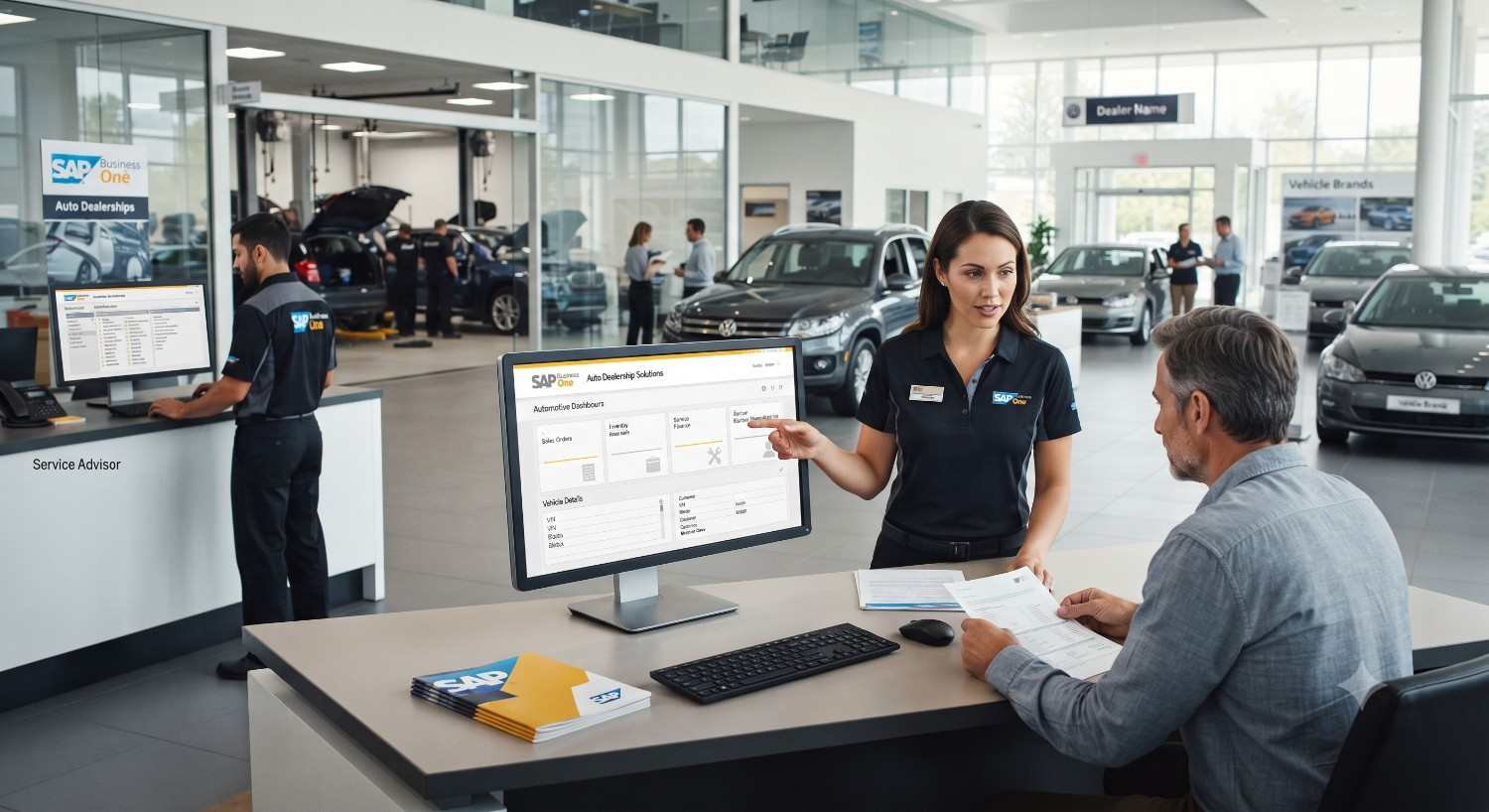
SAP Business One for Auto Dealerships in India
Walk into any auto dealership in India today — a multi-brand car showroom in Pune, a two-wheeler dealer network in Coimbatore, or a commercial vehicle distributor in Ludhiana — and you’ll find the same story playing out behind the scenes. Sales teams are closing deals on WhatsApp, the service department is scheduling repairs on a whiteboard, warranty claims are stuck in email threads with the OEM, and finance is trying to reconcile stock that “should" be in the yard but somehow isn’t. It works, until it doesn’t.
This is exactly why SAP Business One for Auto Dealerships in India has become one of the most searched and most adopted ERP solutions in the automotive retail space over the last few years. Dealerships aren’t just buying software — they’re buying control over three things that make or break profitability: vehicle serial tracking, warranty claims, and service bay scheduling. Let’s break down why this matters, how SAP Business One solves it, and what a proper SAP Business One Implementation actually looks like for a dealership in India.
Why Auto Dealerships in India Need a Dedicated ERP for Automotive Industry
Automotive retail is not like selling FMCG or apparel. Every unit you sell has a chassis number, an engine number, a warranty period, insurance linkage, RTO registration status, and a service history that follows it for years. A generic accounting tool or a basic inventory spreadsheet simply cannot hold this complexity together.
This is where a purpose-fit ERP for Automotive Industry comes in. Unlike generic software, SAP Business One is built to handle serialized inventory, multi-location stock, OEM claim workflows, and after-sales service — all inside one connected system. For a country like India, where dealership networks often span multiple cities, multiple brands, and multiple showrooms under one management group, this single-system visibility isn’t a luxury anymore. It’s survival.
Indian dealerships also operate under tight OEM compliance rules — MSIL, Tata Motors, Mahindra, Hyundai, TVS, Bajaj, and others all expect standardized reporting, timely warranty submissions, and audit-ready vehicle records. A disconnected system of Excel sheets and manual registers simply cannot keep up with these expectations, and that’s precisely the gap SAP Business One is designed to close.
Vehicle Serial Tracking: The Backbone of Dealership Operations
Every vehicle that enters a dealership’s stockyard has a unique identity — chassis number, engine number, colour, variant, and now increasingly, battery serial numbers for EVs. Losing track of even one of these details can mean compliance headaches, insurance mismatches, or worse, delivering the wrong unit to a customer.
With SAP Business One’s serial number management module, dealerships can:
-
Assign and track a unique serial number to every vehicle from the moment it’s received from the manufacturer to the moment it’s billed to the customer
-
Maintain a complete audit trail — inward GRN, yard location, test drive logs, PDI (Pre-Delivery Inspection) status, and final delivery
-
Link each vehicle’s serial number to its invoice, insurance, RTO documentation, and service history in one connected record
-
Get real-time visibility of stock ageing, so aged inventory doesn’t sit idle and lose value
-
Avoid duplicate billing or misallocation errors that are common with manual registers
This isn’t just about record-keeping. Accurate vehicle serial tracking directly protects a dealership’s working capital, since floor-plan financing and OEM stock audits are entirely dependent on knowing exactly what’s sitting in the yard, and for how long.
Warranty Claims Management: Turning a Manual Nightmare Into a Structured Workflow
Ask any service manager in India what eats up the most administrative time, and warranty claims will almost always top the list. A single missed document, an incorrect labour code, or a late submission can mean the dealership absorbs a cost that should have gone to the manufacturer.
SAP Business One brings structure to this chaos by allowing dealerships to:
-
Automatically pull vehicle and customer data (using the same serial number captured earlier) into the warranty claim, eliminating manual re-entry
-
Track claim status — submitted, under review, approved, rejected, or resubmitted — against defined SLAs
-
Attach service history, parts consumption, and labour records directly to each claim for faster OEM approval
-
Generate claim ageing reports so nothing sits unclaimed past the warranty submission window
-
Reduce claim rejection rates by flagging incomplete documentation before submission, not after
For a mid-sized dealership processing hundreds of warranty claims a month, this single improvement often recovers lakhs of rupees annually that would otherwise be written off due to missed or delayed claims. This is one of the clearest, fastest ROI areas dealerships see after adopting SAP Business One.
Service Bay Scheduling: Fixing the Bottleneck That Frustrates Customers the Most
Nothing damages customer loyalty faster than a service appointment that runs late, a bay that’s double-booked, or a technician who’s idle while another is overloaded. In most Indian dealerships, this scheduling is still done manually — a physical register, a shared spreadsheet, or worse, tribal knowledge held by one service advisor.
With SAP Business One’s service module, dealerships can move to a genuinely organized system:
-
Real-time visibility of every service bay’s status — occupied, free, or blocked for a specific job type
-
Appointment booking linked directly to the vehicle’s serial number and warranty status, so the advisor already knows what’s covered before the customer even walks in
-
Technician workload balancing, so high-skill jobs and routine services are distributed efficiently across the floor
-
Automated reminders for scheduled and preventive maintenance, driving repeat visits and higher service retention
-
Job card to invoice automation, cutting down the time a customer spends waiting at the billing counter
This is also where the “ERP for Automotive Industry" advantage becomes visible to the customer directly — shorter wait times, transparent job status, and accurate delivery commitments all translate into higher CSI (Customer Satisfaction Index) scores, which OEMs increasingly tie to dealer incentives.
What a Real SAP Business One Implementation Looks Like for a Dealership
A common mistake dealerships make is treating SAP Business One Implementation as a plug-and-play software install. It isn’t. A proper implementation for an automotive dealership typically includes:
-
Process mapping — understanding how vehicles move from inward stock to delivery, and how service jobs flow from booking to billing
-
Master data setup — vehicle categories, serial number formats, warranty templates, labour and parts pricing
-
Integration planning — connecting SAP Business One with DMS portals, OEM claim systems, and sometimes third-party finance or insurance platforms
-
Customization — automotive-specific add-ons for VIN tracking, PDI checklists, and service bay dashboards, since standard SAP B1 doesn’t ship with these out of the box
-
User training — sales executives, service advisors, warehouse staff, and finance teams all need role-specific training
-
Go-live and stabilization — running parallel processes briefly to catch gaps before fully switching over
Skipping any of these steps is why some dealerships feel ERP software “doesn’t work for us" — when in reality, the implementation wasn’t tailored to automotive workflows in the first place.
Why Ongoing SAP Business One Support Matters More Than the Software Itself
Buying and implementing the system is only half the journey. Automotive dealerships change fast — new OEM policies, new vehicle models, new EV compliance rules, and new tax regulations all require the ERP to adapt continuously.
This is why reliable SAP Business One Support is non-negotiable for dealerships. Good support partners provide:
-
Regular updates aligned with changing GST, e-invoicing, and OEM reporting requirements
-
Quick troubleshooting so billing counters and service bays are never stalled during peak hours
-
Periodic health checks on serial number data integrity and warranty claim accuracy
-
Guidance on scaling the system as the dealership adds new branches or brands
-
Training refreshers when staff turnover brings in new users
Dealerships that treat support as a one-time helpdesk contact, rather than an ongoing partnership, are usually the ones who fall back into spreadsheet habits within a year of going live.
The Bigger Picture: Why This Matters for Growing Dealership Groups in India
India’s automotive retail sector is consolidating fast. Multi-brand dealership groups now commonly run five, ten, or even twenty showrooms across multiple states. At that scale, disconnected systems don’t just create inefficiency — they create risk. A missing vehicle record, an unclaimed warranty, or an overbooked service bay in one branch can silently drain profitability across the entire group.
A well-implemented SAP Business One for Auto Dealerships in India setup gives group-level management something they rarely have with manual systems: a single, real-time view across every showroom, every service centre, and every vehicle in the network — all searchable, auditable, and reportable at the click of a button.
Frequently Asked Questions
Q1. Is SAP Business One suitable for small and mid-sized auto dealerships, or only large groups?
SAP Business One is scalable and works well for single-showroom dealerships as well as multi-branch groups. Its modular design means dealerships can start with core inventory and service modules and add more functionality as they grow.
Q2. How does SAP Business One help with vehicle serial number tracking specifically?
It assigns a unique trackable identity to each vehicle from inward stock through to sale and service, linking chassis/engine numbers to invoices, warranty records, and service history in one connected database.
Q3. Can SAP Business One reduce warranty claim rejections from OEMs?
Yes. By linking documentation, service history, and parts usage automatically to each claim, it reduces the manual errors and missing attachments that are the most common reasons OEMs reject or delay claims.
Q4. How long does a typical SAP Business One Implementation take for a dealership?
Depending on the number of branches and level of customization needed for VIN tracking and service scheduling, implementations typically take anywhere from 6 to 12 weeks.
Q5. Why is ongoing SAP Business One Support important after go-live?
Automotive regulations, OEM policies, and tax rules change frequently in India. Continuous support ensures the system stays compliant, data stays accurate, and new staff are trained properly as the business scales.
Final Thoughts
The dealerships that will lead India’s automotive retail market over the next decade won’t just be the ones selling the most vehicles — they’ll be the ones running the tightest operations behind the scenes. Vehicle serial tracking, warranty claims, and service bay scheduling might sound like back-office details, but together they determine profitability, compliance, and customer trust.
Choosing the right ERP for Automotive Industry, backed by a properly planned SAP Business One Implementation and dependable SAP Business One Support, is how forward-looking dealerships in India are turning these back-office details into a genuine competitive advantage.
Contact form