How Integrated ERP Software Can Improve Manufacturing Visibility with SAP S/4HANA
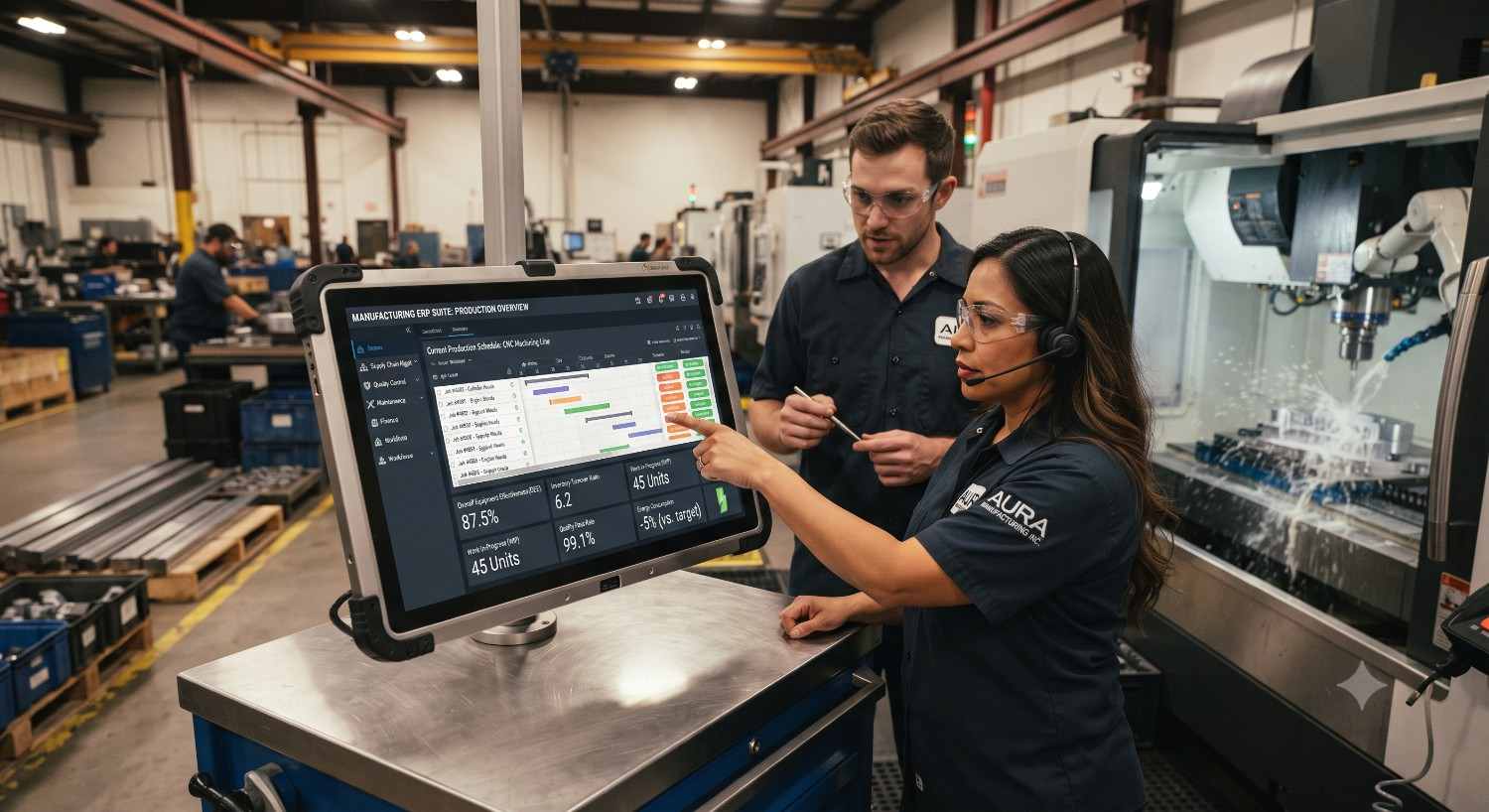
How Integrated ERP Software Can Improve Manufacturing Visibility with SAP S/4HANA
An integrated ERP connects planning, production, inventory, quality and finance on one real-time platform, so manufacturers can see problems early and act before they cost money.
Quick answer: An integrated ERP system connects planning, production, inventory, procurement, quality, maintenance and finance on a single database. Every transaction is recorded once and is instantly visible to everyone who needs it. SAP S/4HANA adds an in-memory database, live analytics and role-based dashboards, so managers can monitor production, stock and costs as they happen instead of waiting for end-of-day or end-of-month reports.
- Visibility means seeing accurate, current data across the whole value chain, not just one department.
- Integrated ERP removes data silos by keeping one version of the truth.
- SAP S/4HANA for Manufacturing Industry teams get real-time analytics, live planning and connected shop floor data.
- A well-planned SAP S/4HANA Implementation matters as much as the software itself.
- Better visibility leads to faster decisions, lower inventory cost and fewer production surprises.
If you have ever stood on a shop floor and asked, "Where exactly is this order right now?" and received three different answers from three different people, you already understand the problem this article is about. It is not a people problem. It is a visibility problem.
Most manufacturers run on a patchwork of spreadsheets, standalone planning tools, a legacy ERP, and a few systems nobody dares to touch. Each holds a small piece of the truth, and none of them agree. The result is late deliveries, excess stock, surprise machine breakdowns, and month-end reports that arrive too late to change anything.
This is where modern ERP software for manufacturing industry operations changes the game. And among the options available today, SAP S/4HANA has become the platform many manufacturers choose when they want one connected view of the business. In this guide, we explain what manufacturing visibility really means, why disconnected systems hurt, and how SAP S/4HANA helps you see, understand and act on your operations in real time.
What Does "Manufacturing Visibility" Actually Mean?
Manufacturing visibility is your ability to see what is happening across the business, accurately and in time to act. It covers far more than watching machines run. A visible operation can answer questions like these instantly:
- Which orders are running late, and why?
- How much raw material do we have, and where is it?
- What is the real cost of producing this product today?
- Which machine is likely to fail next week?
- Can we promise this customer a delivery date and keep it?
If answering those questions takes a phone call, an email chain or an export to Excel, your visibility is limited. True visibility is built on three things:
The Hidden Cost of Disconnected Systems
Many plants grow their IT landscape one problem at a time. Procurement gets one tool, planning gets another, quality gets a third. Over the years, this creates three recurring issues.
Data silos
Sales sees demand in one system while production sees capacity in another. Neither sees the full picture, so planning becomes guesswork.
Delayed information
When systems exchange data in nightly batches, a problem that started this morning is only discovered tomorrow. On a fast production line, that delay is expensive.
Manual reconciliation
Teams spend hours matching numbers between spreadsheets and systems. This is slow, error-prone and takes skilled people away from real analysis.
The business impact is easy to recognise: stock-outs on one side and overstock on the other, missed delivery dates, higher scrap, and finance teams that can only explain last month's results rather than influence this month's.
How ERP Software for Manufacturing Industry Creates One Source of Truth
A purpose-built ERP software for manufacturing industry operations does something simple but powerful: it puts every process on one platform with one shared data model. When a purchase order is received, inventory updates. When inventory updates, planning recalculates. When production consumes material, cost updates. Nobody re-types anything.
For a manufacturer, an integrated ERP typically connects:
Sales and demand planning
Forecasts and customer orders feed directly into production plans.
Production planning and execution
Work orders, routings, bills of materials and capacity.
Inventory and warehouse management
Raw materials, work in progress and finished goods.
Procurement and supplier management
Purchase orders, lead times and supplier performance.
Quality management
Inspections, non-conformances and traceability.
Plant maintenance
Preventive schedules and breakdown history.
Finance and costing complete the picture with real-time cost of goods and profitability. The value is not any single module. It is the connection between them.
How SAP S/4HANA Supports Real-Time Manufacturing Visibility
SAP S/4HANA is SAP's intelligent ERP suite built on the SAP HANA in-memory database. Because data is processed in memory rather than read slowly from disk, reports and calculations that once took hours can run in seconds. That speed is what makes real-time visibility practical, not just a slide in a sales deck.
Here is how SAP S/4HANA supports visibility in the areas manufacturers care about most.
Production Planning and Shop Floor Control
SAP S/4HANA includes MRP Live, which runs material requirements planning in memory, so planners can re-run plans several times a day instead of once overnight. When a rush order arrives or a supplier delays a shipment, the impact on schedules is visible immediately. Production supervisors can track order status, material availability and capacity from a single screen.
With SAP Digital Manufacturing and connected machine data, the system can also compare planned versus actual output as it happens, helping teams catch slow-downs before they turn into missed deadlines.
Inventory and Supply Chain Transparency
Stock accuracy is one of the biggest visibility challenges. SAP S/4HANA simplifies inventory data structures, so stock positions are updated in real time across plants and warehouses. Planners see what is on hand, what is in transit and what is committed to open orders.
Advanced available-to-promise (ATP) checks help sales teams give customers realistic delivery dates based on live stock and production capacity, not optimistic guesses.
Quality Management and Traceability
When a quality issue appears, speed matters. With integrated quality management, inspection results link directly to batches, suppliers and production orders. If a defect is found, you can trace which materials and customers are affected in minutes. This is especially valuable in industries such as automotive, pharma, food and electronics, where traceability is a requirement, not a nice-to-have.
Predictive Maintenance and Asset Visibility
Unplanned downtime is one of the costliest events on a plant floor. Connecting equipment sensors and maintenance records helps teams spot patterns that point to future failures. Instead of reacting to breakdowns, maintenance teams can plan repairs during scheduled windows and keep production running.
Financial Visibility Through the Universal Journal
SAP S/4HANA uses a single Universal Journal that combines financial and management accounting data. For manufacturers, this means product costs, variances and profitability can be viewed at a detailed level without waiting for a month-end close. Finance and operations finally look at the same numbers.
Role-Based Dashboards with SAP Fiori and Embedded Analytics
Visibility is only useful if the right people can see it. SAP Fiori gives each role, such as plant manager, planner, buyer or CFO, a clean, personalised interface. Embedded analytics lets users drill down from a summary KPI to the underlying transaction without exporting anything.
Still Chasing Answers Across Spreadsheets?
See how S/4HANA gives your plant one live view of orders, stock, quality and cost in a demo built around your operations.
SAP S/4HANA for Manufacturing Industry: Key Capabilities at a Glance
The table below summarises how SAP S/4HANA for Manufacturing Industry needs translate into practical visibility.
| Area | What You See | Business Benefit |
|---|---|---|
| Production planning | Live order status, capacity and material availability | Fewer delays, better schedule adherence |
| Inventory | Real-time stock across plants and warehouses | Lower carrying cost, fewer stock-outs |
| Quality | Batch-level traceability and inspection results | Faster root-cause analysis, easier compliance |
| Maintenance | Asset history and maintenance schedules | Less unplanned downtime |
| Finance | Real-time costing and profitability | Faster, more confident decisions |
| Analytics | Role-based dashboards and KPIs | Everyone works from the same numbers |
A Practical Example: From Guesswork to Real-Time Control
Consider a mid-sized auto-component manufacturer (an illustrative scenario, not a specific client). Before moving to an integrated platform, planners built schedules in spreadsheets, stock counts were updated once a day, and cost reports arrived two weeks after month-end. When a key customer changed an order, it took almost a day to understand the impact on materials and capacity.
After adopting SAP S/4HANA, the same change is checked in minutes. Planners re-run MRP, see which materials are short, and view alternative suppliers. Sales confirms a revised delivery date using live ATP data. Finance sees the cost impact the same day. The company has not become faster because people work harder. It has become faster because information finally flows without friction.
SAP S/4HANA Implementation: How to Get Visibility Right
Buying the software is the easy part. A successful SAP S/4HANA Implementation is what turns the technology into results. Here is a practical approach that experienced implementation teams follow.
- 1Define visibility goals first: decide which questions you need answered and which KPIs matter, such as on-time delivery, OEE, inventory turns or cost per unit. These goals shape everything that follows.
- 2Assess your current landscape: map your processes, systems, data quality and integrations. Poor master data is the most common reason visibility projects disappoint, so plan data cleansing early.
- 3Choose the right migration path: options typically include a new implementation (greenfield), a system conversion (brownfield), or a selective approach. With SAP's announced end of mainstream maintenance for ECC 6.0 in 2027, many manufacturers are making this decision now.
- 4Design around best practices: use SAP's standard processes as a baseline and customise only where it creates real competitive advantage. Heavy customisation makes upgrades harder and reduces the benefits of real-time integration.
- 5Connect the shop floor: plan integration with machines, sensors, MES and warehouse systems from the start, not as an afterthought.
- 6Train and involve users: visibility depends on people entering data correctly and using dashboards daily. Involve planners, supervisors and operators early.
- 7Go live in phases and keep improving: many manufacturers start with one plant or process area, learn from it, and then expand. After go-live, keep refining dashboards and KPIs as your questions evolve.
Working with an experienced SAP partner reduces risk significantly. A partner who understands both the technology and the realities of discrete or process manufacturing can help you avoid costly rework. At 2iSolutions, an SAP Gold Partner in India, implementation is planned around your plant's operations rather than a generic template.
Common Mistakes That Reduce Visibility
- Treating it as an IT project. Visibility is a business outcome, so operations and finance leaders must own it.
- Ignoring master data quality. Real-time reports built on inaccurate data simply show wrong answers faster.
- Over-customising. Too many custom developments slow down the system and complicate upgrades.
- Skipping change management. Without user adoption, even the best system becomes an expensive data entry tool.
- Leaving the shop floor disconnected. If machine and operator data does not reach the ERP, visibility has a blind spot exactly where it matters most.
Business Benefits You Can Expect
When implemented well, an integrated ERP built on SAP S/4HANA can help manufacturers achieve:
Faster decisions
Better-informed choices based on live data.
Better delivery
Improved on-time delivery and customer satisfaction.
Lower inventory cost
Reduced carrying costs and fewer stock-outs.
Less downtime
Better maintenance planning.
Faster close
Shorter closing cycles and clearer product profitability.
Stronger compliance
Easier audit trails.
Results vary by company, starting point and implementation quality, but the common thread is the same: when everyone sees the same accurate data at the same time, the business reacts faster and wastes less.
Frequently Asked Questions
Final Thoughts
Manufacturing success today depends on how quickly you can see a problem and respond to it. Disconnected systems slow you down, while integrated ERP software for manufacturing industry operations give you a single, trusted view of production, supply chain, quality and finance.
SAP S/4HANA brings together real-time data, in-memory speed and connected processes, and a carefully planned SAP S/4HANA Implementation turns those capabilities into daily results on the shop floor and in the boardroom. If you are evaluating your next step, start with the questions you wish you could answer instantly, and let those guide your roadmap.
Ready to improve visibility across your plants? Talk to an experienced SAP partner to assess your current landscape and build a practical S/4HANA roadmap for your manufacturing business.
Ready to Get Real-Time Visibility Across Your Plants?
Talk to the 2iSolutions team, an SAP Gold Partner in India, for a process assessment and a clear S/4HANA implementation roadmap.


