How ERP Software for Manufacturing Improves Production Planning and Control

How ERP Software for Manufacturing Improves Production Planning and Control
See how ERP for manufacturing connects demand, materials, machines and quality so planners decide with facts, not guesses.
If you run a factory, you know the morning meeting. Sales says the big order must ship Friday. Stores says a key component hasn’t arrived. The shop floor says Machine 4 was down for three hours. Everyone has a spreadsheet, and none of the spreadsheets agree.
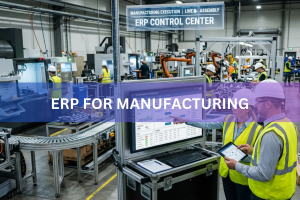
This is the gap that ERP for manufacturing closes. A good system doesn’t just record what happened. It connects demand, materials, machines, people and quality into one live picture, so planners can decide with facts instead of guesses.
In this guide, I’ll explain how ERP improves production planning and control, which features matter most, what Indian manufacturers should watch for, and how to implement it without disrupting your plant.
Quick answer: How does ERP improve production planning and control?
ERP for manufacturing improves production planning and control by linking sales orders, inventory, bills of materials, machine capacity and shop floor data in a single system. It automates material requirements planning (MRP), builds realistic schedules, tracks work orders in real time and flags delays early. The result is shorter lead times, lower inventory, better on-time delivery and less firefighting.
What Production Planning and Control Actually Means
People often use the two terms as one, but they are different jobs.
Production planning
Deciding in advance what to make, how much, when, with which materials and on which machines. It covers demand forecasting, the master production schedule, material requirements and capacity planning.
Production control
Making sure the plan actually happens. It covers releasing work orders, tracking progress, monitoring material consumption, handling breakdowns and reporting variances.
Planning without control is a wish list. Control without planning is endless reaction. Strong production planning and control needs both, and they must share the same data. That is where most manual setups fail.
Why Spreadsheets and Disconnected Tools Break Down
Many small and mid-sized plants in Pune, Ludhiana, Coimbatore, Rajkot and Faridabad still plan on Excel, with accounting in one package and inventory in another. It works at low volume. As soon as you add more SKUs, more shifts or more customers, the cracks show.
Stale data
The plan was accurate on Monday and wrong by Tuesday afternoon.
Hidden shortages
Nobody discovers a missing component until the job is already on the machine.
Unrealistic schedules
Planners promise dates without seeing true machine capacity.
Excess stock and stockouts together
You hold too much of what you don’t need and too little of what you do.
No traceability
When a customer complains about a batch, tracing the raw material takes days.
Every one of these is a data-sharing problem, not a people problem. Modern manufacturing ERP software is built to solve exactly that.
How ERP for Manufacturing Improves Production Planning
1. Demand-driven planning from one source of truth
Sales orders, forecasts and stock levels sit in the same database. When a customer order lands, the system knows what you have, what is already committed and what must be produced or purchased. Planners stop re-keying data, and sales stops promising dates blindly.
2. Automated material requirements planning (MRP)
MRP is the heart of ERP production planning. You define a bill of materials (BOM) for each product, and the system explodes it into every raw material, sub-assembly and purchased item. It compares requirements with on-hand stock, open purchase orders and lead times, then suggests what to buy or make and by when.
3. Capacity planning that reflects reality
A plan that ignores machine hours, labour availability and changeover times is just a hope. ERP maintains work centres, routings and shift calendars, checks whether a schedule is actually feasible and shows bottlenecks before they happen.
4. Finite scheduling and realistic delivery dates
The system sequences jobs based on real constraints: machine availability, tooling, material readiness and priority. Sales can give accurate available-to-promise or capable-to-promise dates, which builds customer trust over time.
5. Smarter inventory and procurement
ERP gives you reorder levels, safety stock, ABC classification and supplier lead-time tracking. Purchase requisitions can be generated straight from MRP, so procurement works from the production plan rather than from gut feel.
For a manufacturer with multi-level BOMs, such as an auto component with machined parts, castings, fasteners and packaging, MRP removes hours of manual calculation. It also cuts the classic mistake of ordering too early (cash locked up) or too late (line stops).
The same applies to capacity. If your CNC machine is already booked 110% next week, you see it on the screen today, not when the delay hits the customer. Over time, accurate delivery commitments build trust, which is worth more than any discount.
Want to see ERP production planning on your own BOMs?
Get a demo built around your products, routings and machines, not a generic example.
How ERP Strengthens Production Control on the Shop Floor
Planning is only half the story. Here is how ERP supports the control side.
6. Work order management with live status
Each production order carries its materials, operations, standard times and due date. As operators confirm operations through terminals, tablets or barcode scans, progress updates automatically. Supervisors see which jobs are running, waiting, late or complete without walking the floor with a clipboard.
7. Real-time shop floor data
Modern ERP can capture quantities produced, scrap, rework and downtime as they happen. Connect it to machines or IoT sensors and you get utilisation data without manual entry. You can’t improve overall equipment effectiveness (OEE) if you don’t measure it.
8. Accurate material consumption and costing
When materials are issued against a work order, ERP records actual consumption against the BOM. You see variance and can find out why. Many owners are surprised to discover that a product they believed was profitable was quietly losing money because of scrap or overtime.
9. Built-in quality control
Inspection checkpoints can be attached to incoming material, in-process operations and finished goods. Failed lots can be blocked automatically, and rejection reasons are logged. Quality becomes part of the production flow.
10. Batch and serial traceability
If you supply auto, pharma, food or electronics customers, traceability is not optional. ERP links each finished batch to the raw material lots, machines, operators and dates involved, so you can trace a query in minutes instead of days.
11. Maintenance linked to production
ERP connects preventive maintenance schedules with production schedules, so servicing is planned around orders, not in the middle of them. Machine history also helps you decide when repair costs more than replacement.
Before and After: What Changes in Practice
| Area | Without ERP | With ERP for Manufacturing |
|---|---|---|
| Material planning | Manual, spreadsheet-based | Automated MRP with live stock |
| Scheduling | Based on experience and guesswork | Finite scheduling with capacity checks |
| Delivery dates | Optimistic promises | Data-backed available-to-promise dates |
| Shop floor visibility | Verbal updates, paper job cards | Real-time work order tracking |
| Inventory | Overstock and stockouts | Optimised levels, fewer surprises |
| Costing | Estimated at month end | Actual cost per work order |
| Traceability | Slow, manual | Batch and serial tracking in minutes |
Business Benefits You Can Realistically Expect
Results depend on your starting point, the quality of your master data and how well your team adopts the system. Still, manufacturers commonly report improvements in these areas:
- Shorter lead times because bottlenecks and material gaps are visible early.
- Better on-time delivery thanks to realistic scheduling.
- Lower inventory carrying cost because MRP buys what you actually need.
- Less downtime and rework through planned maintenance and in-process quality checks.
- Faster decisions because the plan, the plant and the finance team see the same numbers.
- Cleaner audits with a complete record of materials, operations and approvals.
I’d avoid anyone who promises a fixed percentage gain before looking at your plant. A credible partner will measure your baseline first.
India-Specific Considerations for Manufacturers
If you operate in India, your ERP must handle more than planning logic.
GST compliance
E-invoicing, e-way bills and HSN-wise reporting built into the sales and dispatch flow.
Job work processes
Sending material to a sub-contractor under a delivery challan and tracking its return.
Multi-plant and multi-state operations
Correct tax treatment between locations, with consolidated visibility.
Local vendor ecosystems
Lead times and quality vary widely, so supplier performance tracking matters.
INR pricing and affordability
Many mid-sized manufacturers need a system that scales without enterprise-level cost.
Platforms like SAP Business One, SAP S/4HANA and Odoo each fit different company sizes and complexity. Smaller and growing plants often start with a lighter system, while larger or multi-plant groups need deeper planning functionality. The right choice depends on your products, process complexity and growth plans, not on brand name alone.
Key Features to Look For in Manufacturing ERP Software
When you compare manufacturing ERP software, check for these capabilities:
- 1Multi-level BOM and routing management for complex, layered products.
- 2MRP with lead-time and safety-stock logic so purchasing follows the plan.
- 3Finite capacity planning and scheduling that respects real machine and labour limits.
- 4Work order and shop floor tracking with simple screens for operators.
- 5Quality management and inspection plans at incoming, in-process and final stages.
- 6Batch and serial number traceability from raw material to dispatch.
- 7Maintenance management linked to the production schedule.
- 8Integrated purchasing, inventory, sales and finance on one database.
- 9Local statutory compliance including GST and e-invoicing.
- 10Dashboards and reports that planners will actually use.
Ask for a demo using your own product, with your own BOM, not a generic example. That one test reveals more than any brochure.
How to Implement ERP Without Disrupting Production
A system is only as good as its rollout. These steps reduce risk:
- 1Map your current process honestly. Document how planning really happens today, not how the manual says it should.
- 2Clean your master data first. Wrong BOMs, outdated routings and duplicate items will corrupt even the best system. This step is boring and absolutely critical.
- 3Start with a focused scope. Many plants begin with inventory, purchasing and production orders, then add scheduling, quality and maintenance in phases.
- 4Involve planners and supervisors early. They know the exceptions. If they feel the system was imposed on them, adoption suffers.
- 5Run a pilot on one product line or plant. Learn, adjust and then scale.
- 6Train, then train again. Short, role-based sessions work better than one big classroom day.
- 7Measure results. Track on-time delivery, inventory turns, schedule adherence and downtime before and after go-live.
An experienced ERP implementation partner matters here. The software is the tool, but the configuration, data migration and change management decide whether you get value from it.
Common Mistakes to Avoid
Treating ERP as an IT project
It is an operations project, and it needs a senior owner from the plant.
Skipping data cleanup
“Saving time” here costs far more after go-live.
Over-customising on day one
Every custom change adds cost and makes upgrades harder.
Ignoring shop floor users
If operators find it clumsy, they will go back to paper.
Expecting instant results
Without process discipline, even the best system underdelivers.
Choosing on price alone
Ignoring support quality often makes the cheapest option the costliest.
Where Is ERP for Manufacturing Heading?
Planning is becoming more predictive. Newer systems use AI to improve demand forecasts, suggest schedule changes when a machine fails and flag suppliers likely to deliver late. IoT connections feed live machine data into planning, and cloud deployment makes multi-plant visibility easier.
The foundation stays the same, though: clean data, connected processes and disciplined use. Get those right, and advanced features become a bonus rather than a gamble.
Frequently Asked Questions
Conclusion
Good manufacturing runs on good information. When planning lives in spreadsheets and control lives in people’s heads, delays and waste are almost guaranteed. ERP for manufacturing replaces that patchwork with one connected view, from sales order to dispatch, so your team plans with confidence and corrects problems early.
The strongest results come from the basics done well: accurate BOMs, disciplined data entry, a phased rollout and a partner who understands your shop floor. If you’re evaluating manufacturing ERP software to strengthen production planning and control, start by mapping your current bottlenecks, and let those, not a feature list, guide your choice.
Ready to see how ERP production planning would work for your plant? Talk to the 2iSolutions team, an SAP Gold Partner and Odoo Partner in India, for a walkthrough built around your products and processes.
Ready to Streamline Your Production Planning?
Talk to the experts at 2iSolutions, an SAP Gold Partner, about the right ERP for your plant.