How Manufacturing ERP Software Helps Reduce Production Costs and Material Waste
How Manufacturing ERP Software Helps Reduce Production Costs and Material Waste
See how ERP for Manufacturing connects planning, inventory, shop floor and finance, so you can cut waste, control costs and protect your margins.
Every plant manager knows the feeling. The order book is full, machines are running, and yet profit at the end of the month looks thinner than it should. Somewhere between the purchase of raw material and the dispatch of the finished product, money is quietly leaking out.
The leak usually isn’t one big failure. It is a hundred small ones: a batch of steel ordered twice, a scrap rate nobody tracked, a machine that sat idle because a part arrived late, a finished product that sat in the warehouse for six months. Spreadsheets and disconnected tools can’t catch these problems because they can’t see the whole picture.
This is exactly where ERP for Manufacturing changes the game. In this guide, we’ll explain in plain language how manufacturing ERP software helps reduce production costs and material waste, which features matter most, and how to get real results from your implementation.
Quick answer: What is ERP for Manufacturing?
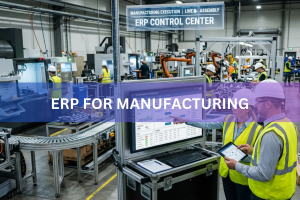
ERP for Manufacturing is a unified software system that connects purchasing, inventory, production planning, shop floor activity, quality control, sales and finance in one database. Instead of every department working from its own spreadsheet, everyone sees the same real-time data, so decisions about materials, labour and machine time are made with facts rather than guesses.
What Is ERP for Manufacturing?
Think of it as the central nervous system of your factory. When a sales order comes in, the system checks stock, plans production, orders missing materials, schedules machines, tracks every rupee spent and updates the books automatically.
Why Production Costs and Material Waste Get Out of Control
Before looking at the solution, it helps to understand the problem. In most small and mid-sized factories, cost overruns come from the same handful of root causes.
Poor demand visibility
Production is planned on gut feeling, leading to overproduction or shortages.
Disconnected systems
Purchase, stores, production and accounts use different files, so nobody trusts the numbers.
Inaccurate inventory
The system says 500 units are in stock, the shelf says 380. Teams either over-order or stop production.
Untracked scrap and rework
Waste is written off at month-end without anyone knowing why it happened.
Unplanned downtime
Breakdowns happen because maintenance is reactive.
Wrong costing
Quotes are based on outdated material prices, so the margin you think you earn isn’t the margin you actually get.
Industry studies regularly find that material typically forms the largest share of a manufacturer’s cost of goods sold, often well over half. Even a small improvement in material usage has an outsized effect on profit, which is why material waste reduction is one of the fastest routes to better margins.
9 Ways Manufacturing ERP Software Reduces Production Costs
1. Accurate Demand Forecasting and Production Planning
Overproduction is one of the costliest forms of waste because it ties up cash, space and labour in goods nobody has ordered yet. Modern manufacturing ERP software uses historical sales, open orders, seasonality and lead times to create realistic demand forecasts.
The Master Production Schedule (MPS) and Material Requirements Planning (MRP) modules then convert that forecast into exact production runs and purchase needs. You produce what you will sell, when you will sell it. The result is lower carrying cost, fewer last-minute rush orders and fewer expensive overtime shifts.
2. Smarter Material Requirements Planning (MRP)
MRP is the heart of ERP for Manufacturing. It reads your Bill of Materials (BOM), checks current stock, considers supplier lead times and tells you exactly what to buy, how much, and by when.
Without it, planners tend to “play safe” by ordering extra. With it, you carry only the buffer you truly need. Many manufacturers see a noticeable drop in excess raw material stock within the first year of using MRP properly. That frees working capital and shrinks the risk of material becoming obsolete or expiring on the shelf.
3. Real-Time Inventory Control
Accurate inventory is the foundation of every cost-saving decision. A good ERP tracks every movement of raw material, work-in-progress (WIP) and finished goods through barcode or QR scanning, batch and serial numbers, and multi-location warehousing.
When stock records match reality, you stop emergency purchases at premium prices, avoid stock-outs that halt production, and can follow FIFO or FEFO rules so older or expiring material gets used first. For industries working with chemicals, food, packaging or pharma ingredients, this alone can prevent significant write-offs.
4. Precise BOM and Routing Management
A Bill of Materials tells you what goes into a product. Routing tells you how it is made, step by step, and on which machine. If either is inaccurate, your costing, planning and purchasing are all wrong.
Manufacturing ERP keeps BOMs version-controlled, so the shop floor never builds from an outdated design. It can also model alternate materials and flag when a cheaper, approved substitute is available. Engineering changes flow to purchasing and production automatically, which removes the expensive mistakes caused by someone using an old drawing.
Want to see where your plant is losing money?
Get a free review of your planning, inventory and costing processes from our ERP team.
5. Shop Floor Visibility and Production Tracking
You can’t reduce what you can’t see. ERP captures real-time data from the shop floor: which job is running, how many units are completed, how much material was consumed and how long each operation took.
Supervisors can compare planned versus actual consumption for every work order. If a job used 8% more material than the BOM suggested, the system highlights it immediately, not at the end of the quarter. Patterns emerge quickly, such as one machine, one shift or one operator consistently producing more scrap. That is the information you need to fix the root cause.
6. Built-In Quality Management
Quality problems are expensive twice: once when you make the defective product, and again when you replace, rework or lose a customer over it. ERP quality modules let you define inspection checkpoints at receiving, in-process and final stages, record defects with reason codes, and trace any issue back to the batch, supplier or machine.
Because defects are caught earlier, less value is added to products that were going to fail anyway. Over time, the defect data also helps you negotiate with underperforming suppliers using evidence rather than opinion.
7. Preventive and Predictive Maintenance
Unplanned downtime stops production, wastes in-process material and triggers costly rush repairs. Manufacturing ERP software schedules preventive maintenance based on running hours or calendar dates, tracks spare parts, and keeps a complete service history for each asset.
When maintenance moves from “fix it when it breaks” to “service it before it breaks”, machine availability improves and the cost per unit produced goes down. Combined with IoT sensors, some systems can even predict failures before they happen.
8. Accurate Product Costing and Margin Visibility
Many factories discover they are losing money on products they believed were profitable. ERP calculates actual cost per job by combining material, labour, machine time and overheads, then compares it with the estimate.
This insight helps you price quotes correctly, drop or re-price low-margin products, and focus sales effort on work that truly pays. Costing accuracy is one of the quietest but most powerful ways ERP helps reduce production costs, because it stops bad decisions before they are made.
9. Better Supplier and Procurement Management
ERP consolidates purchase history, price trends, delivery performance and quality rejection rates for every vendor. Buyers can run comparisons, consolidate orders for volume discounts, and automate purchase requisitions and approvals.
Less time is spent chasing quotations and more time is spent negotiating from a position of knowledge. Late deliveries drop, and so do the hidden costs of waiting for materials.
How ERP for Manufacturing Reduces Material Waste
Waste in a factory comes in more forms than just scrap on the floor. Lean manufacturing describes several types, and ERP addresses many of them directly.
| Type of waste | How ERP helps |
|---|---|
| Overproduction | Demand-driven planning ensures you build to real orders and forecasts. |
| Inventory | Min-max levels, reorder points and MRP prevent over-buying and expiry. |
| Defects | Early inspection and traceability reduce rework and scrap. |
| Waiting | Synchronised purchasing and scheduling mean materials and machines are ready when the job starts. |
| Process | Planned-versus-actual reporting exposes inefficient steps and excess consumption. |
| Transport and handling | Warehouse management features guide pickers along optimal routes and reduce double handling. |
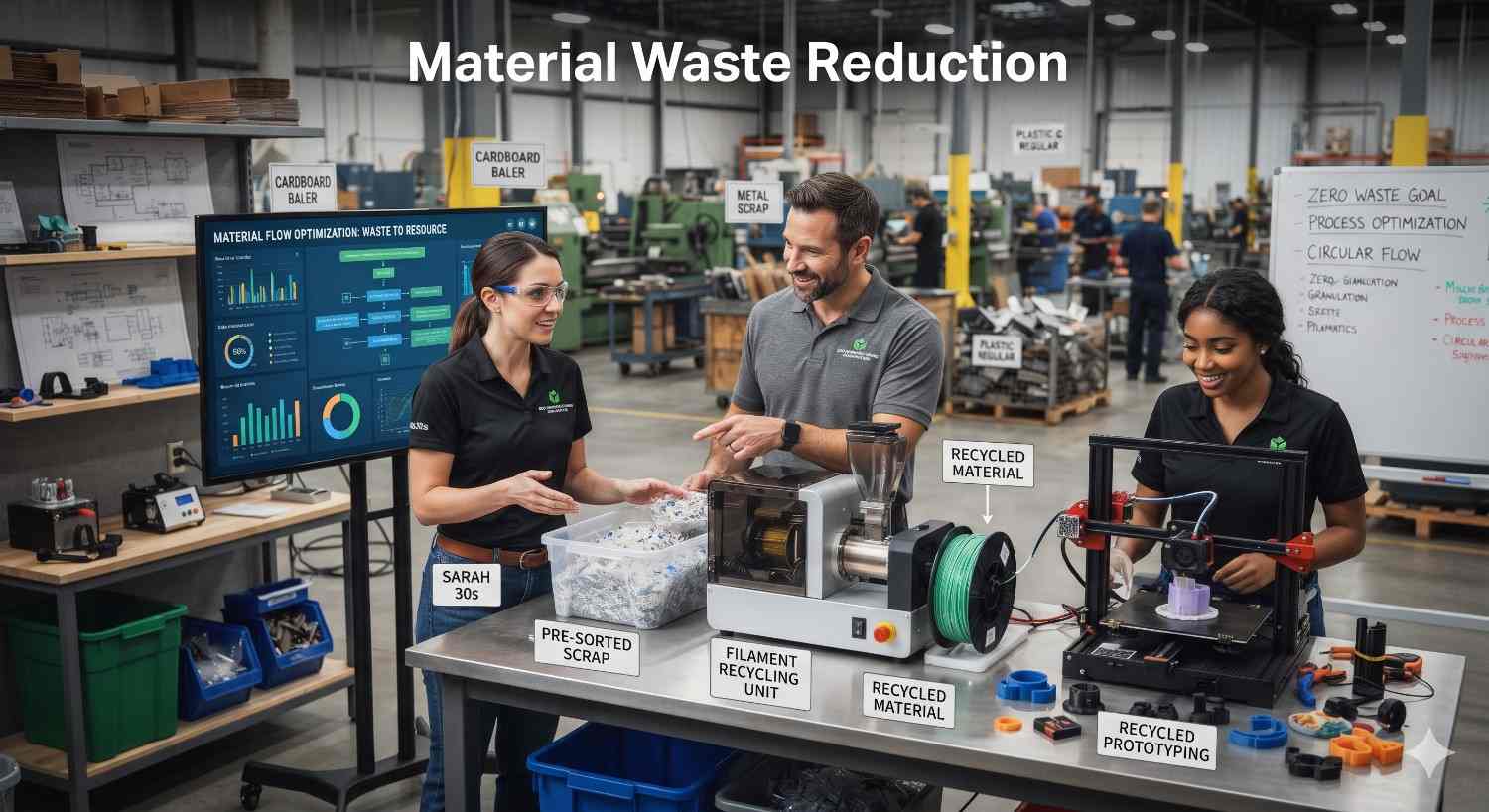
One more powerful feature is by-product and scrap tracking. Instead of treating offcuts, trimmings and leftover material as simple loss, ERP can record them, assign value, and route them back into stock for reuse or sale. In industries such as metal fabrication, packaging, textiles and plastics, this single capability can turn a cost line into a small revenue stream.
A Simple Real-World Example
Imagine a mid-sized packaging manufacturer producing custom boxes. Before ERP, the planner ordered corrugated sheets based on previous months, the store kept a manual register, and production reported scrap only at the end of each month.
After implementing manufacturing ERP software, the company linked each sales order to a BOM, set reorder rules per material, and started recording scrap at each workstation. Within a few months, the team noticed that one cutting line was producing far more trim waste than the others because of a wrong sheet size being purchased. Switching to the right size cut waste on that line significantly. At the same time, accurate stock visibility removed duplicate purchasing.
None of this required magic. It required visibility, and that is what ERP provides.
Key Features to Look for in Manufacturing ERP Software
Not every system fits every factory. When evaluating options, make sure the following are covered.
Planning and production
- Bill of Materials and routing with version control
- MRP and production scheduling
- Shop floor data capture
- Maintenance management
Control and visibility
- Real-time inventory with barcode or QR support
- Quality management and traceability
- Job costing and variance analysis
- Procurement and supplier management
Finance and compliance
- Integrated finance, GST or tax compliance and reporting
- Dashboards and analytics for management
Growth and usability
- Scalability across users, plants and products
- Mobile access for supervisors and planners
If you work in discrete, process or mixed-mode manufacturing, check that the system supports your style of production natively instead of through heavy customisation.
SAP vs Odoo: Choosing the Right ERP for Manufacturing
Two platforms come up often in conversations with Indian manufacturers, and each suits a different stage of growth.
SAP (Business One or S/4HANA)
Offers deep functionality, strong compliance, advanced planning and robust scalability. It is a strong choice for larger or fast-growing manufacturers with complex supply chains and multi-plant operations.
Depth and scaleOdoo
A modular, flexible and cost-effective option. Its Manufacturing, Inventory, Purchase, Quality and Maintenance apps work together smoothly, and many small and mid-sized manufacturers like the fast implementation and lower total cost of ownership.
Flexibility and speedThe right answer depends on your size, process complexity, budget and growth plans. An experienced implementation partner can map your workflows to the right platform before any commitment is made.
How to Get the Best Results From Your ERP Implementation
Buying software does not automatically reduce costs. Results come from how well it is implemented and used. Keep these practices in mind.
- 1Start with clean data. Clean up item masters, BOMs, units of measure and opening stock before go-live. Poor data creates poor decisions.
- 2Define clear goals. Decide what you want to improve, such as scrap percentage, inventory days or on-time delivery, and measure it before and after.
- 3Involve the shop floor. Operators and supervisors must see the system as helpful, not as extra paperwork.
- 4Train in stages. Role-based training beats one big classroom session.
- 5Go live in phases. Start with inventory and purchasing, then add production, quality and costing.
- 6Review reports regularly. The system only saves money when someone acts on what it shows.
- 7Choose an experienced partner. Domain knowledge of manufacturing makes a big difference in configuration quality.
Metrics to Track After Implementation
To prove the return on investment, monitor a small set of numbers every month.
| Metric | What it tells you |
|---|---|
| Scrap and rework rate | How much material and labour is being lost to defects |
| Material variance | Planned versus actual consumption per job |
| Inventory turnover and days of inventory | How efficiently cash is tied up in stock |
| On-time delivery rate | How reliably you meet customer dates |
| Machine uptime and OEE | How well you use equipment capacity |
| Cost per unit produced | Whether margins are truly improving |
| Order-to-delivery lead time | How fast your operation responds |
When these numbers improve steadily, you know your ERP for Manufacturing investment is working.
Common Mistakes to Avoid
Over-customising
Customising before you understand the standard features adds cost and makes upgrades harder.
Skipping data cleanup
Garbage in, garbage out.
Treating ERP as an IT project
It is a business transformation, not just a software install.
Ignoring change management
People resist what they don’t understand.
Choosing on price alone
The cheapest option often becomes the costliest.
No internal owner
Every ERP project needs a senior person accountable for the result.
Avoiding these mistakes is often the difference between an ERP that pays for itself and one that gathers dust.
The Future: AI and Smart Factories
Modern manufacturing ERP software is moving beyond record-keeping. AI-assisted forecasting, automated purchase suggestions, anomaly detection in scrap rates and predictive maintenance are becoming standard. Combined with IoT sensors and real-time analytics, ERP is the backbone of the smart factory, where waste is flagged and corrected almost as it happens.
Manufacturers who build clean, connected data foundations today will be best placed to use these capabilities tomorrow.
Frequently Asked Questions
Final Thoughts
Reducing production costs and material waste is not about working harder. It is about seeing more clearly and acting faster. ERP for Manufacturing gives you that clarity by connecting every part of your operation, from the purchase order to the delivered product, in a single source of truth.
Whether you choose SAP for scale and depth or Odoo for flexibility and speed, the principle is the same: when your data is accurate and your teams are aligned, waste shrinks and margins grow.
Ready to find out how much your factory could save? Talk to the experts at 2iSolutions, an SAP Gold Partner and Odoo Partner, for a free consultation on the right manufacturing ERP software for your business.
Ready to Cut Costs and Waste in Your Plant?
Talk to the experts at 2iSolutions, an SAP Gold Partner and Odoo Partner, about the right ERP for your manufacturing business.