SAP S/4HANA for EV Manufacturing
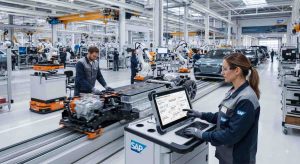
For nearly a century, automotive manufacturing ran on a predictable formula: an internal combustion engine, a few thousand mechanical parts, and a supply chain built around metal stamping, casting, and precision machining. ERP systems were designed around that formula too — bills of materials built for engines and transmissions, supply chains tuned for just-in-sequence delivery of physical components, and quality systems built to catch mechanical defects.
Electric vehicles broke that formula. A battery pack isn’t a mechanical assembly — it’s a chemical and electrical system with its own safety, traceability, and lifecycle requirements. Software now accounts for a large share of what a vehicle actually does. Charging infrastructure has become part of the product experience, not just an accessory. And the supply chain question isn’t “do we have enough steel” anymore — it’s “do we have enough lithium, and is our cobalt sourcing traceable enough to survive a regulatory audit.”
So the real question automotive manufacturers are asking isn’t whether SAP S/4HANA is a good ERP for Automotive Industry. It’s whether an ERP built for the combustion era can genuinely keep pace with the EV one — or whether it needs to be fundamentally rethought.
The EV Disruption: What’s Actually Different
Before judging whether any ERP is “EV-ready,” it helps to be specific about what changed:
- Battery cells replace engines as the core manufactured component, and batteries carry traceability, thermal, and safety requirements that combustion parts never did.
- Bills of materials are shrinking in part count but growing in complexity — fewer mechanical parts, but more software configurations, firmware versions, and electronic control units per vehicle.
- Recalls now hinge on cell-level and lot-level traceability. If a battery defect surfaces, manufacturers must trace it back to the exact production lot, supplier, and vehicle — often within hours, not days.
- Charging infrastructure has entered the ERP conversation. Managing charge point devices, charging sessions, and energy optimization across power grids is now something automotive companies have to plan for, not just their customers.
- Sustainability reporting is no longer optional. Recycled materials, end-of-life vehicle recycling, and carbon accounting are increasingly tied to regulatory compliance, not just brand positioning.
None of this fits neatly into an ERP for Automotive Industry data model designed thirty years ago for engines and gearboxes. That’s the pressure test SAP S/4HANA is actually facing.
Where Legacy ERP Falls Short in the EV Era
Older ERP systems — including earlier SAP ECC installations still running at many suppliers — were architected for batch processing. Data updated overnight. Planning ran on periodic MRP runs rather than continuous, real-time recalculation. That was tolerable when a missed sequence delay cost a few hours of line downtime.
It’s far less tolerable now. Automotive manufacturing today is unforgiving in ways general manufacturing simply isn’t — a single missed sequenced delivery can idle an entire OEM assembly line, and vehicle configurations run into the millions once trims, regions, and options multiply. Add EV-specific complexity on top of that, and a system built around overnight batch updates starts to look genuinely obsolete.
This is the core argument for S/4HANA over legacy SAP or other older-generation ERPs: it runs on an in-memory HANA database, meaning planning, production, and quality data are available the moment they change, rather than after an overnight job finishes.
What Makes S/4HANA Built for the Shift — and Where the Real Work Happens
SAP’s answer to the EV transition isn’t a single feature; it’s a set of capabilities layered onto the core S/4HANA platform.
Real-time analytics and planning.
SAP S/4HANA’s in-memory architecture allows advanced analytics to run dramatically faster than legacy systems, giving planners live inventory visibility across global operations rather than a snapshot from the previous night’s batch run. Integrated Business Planning extends that into automotive-specific forecasting, pulling in connected-vehicle data to build predictive scenarios — genuinely useful when demand for a specific EV trim can swing based on incentive programs or charging infrastructure rollout in a given region.
Battery and parts traceability.
Serial and batch traceability across organizations lets OEMs and suppliers track components and respond to anomalies without losing days chasing paper trails. For battery cells specifically, this isn’t a nice-to-have — regulators increasingly require it, and a slow recall response on a battery safety issue carries reputational risk that mechanical part recalls rarely did.
SAP E-Mobility.
This is one of the more EV-specific additions to the SAP ecosystem: a module built to manage EV charging networks, including charge point device management, charging session tracking, and energy optimization across power grid systems. It signals SAP treating charging infrastructure as a first-class ERP concern rather than an afterthought bolted on by a third party.
PLM integration.
Because EV product development cycles move faster and involve more software iteration than combustion vehicles did, S/4HANA’s integration with SAP Product Lifecycle Management lets manufacturers manage a vehicle from design and prototyping through production and post-sale service in one connected thread, rather than handing off between disconnected systems at each stage.
Supplier collaboration under pressure.
Chip shortages and material scarcity — both far more acute in EV supply chains than combustion ones — put a premium on Supplier Relationship Management capabilities that give manufacturers visibility into multi-tier supplier risk before it becomes a line-down event.
Demand-driven replenishment.
Shifting from pure forecast-based planning to demand-driven models helps manufacturers avoid overproducing a specific EV variant while underproducing another — a real risk when EV demand is still less predictable, region by region, than combustion demand ever was.
Major OEMs including BMW, Toyota, Volkswagen, and Stellantis run significant portions of their operations on SAP today, which says something about the platform’s staying power even as the underlying product it’s managing changes shape entirely.
Where S/4HANA Still Has Work to Do
None of this means S/4HANA is a finished answer. A few honest gaps are worth naming:
- Cost and complexity remain real barriers, particularly for Tier 2 and Tier 3 suppliers who don’t have OEM-scale IT budgets but still need to stay compatible with OEM systems for EDI and supplier portal interactions.
- EV-specific configuration still requires tailoring. Out-of-the-box S/4HANA covers general automotive variant configuration well, but battery chemistry variants, charging standard differences by region, and software-defined feature sets often need additional configuration work, not just a module activation.
- Autonomous vehicle data requirements are still maturing industry-wide, and ERP for Automotive Industry platforms — SAP included — are building toward those data security and infrastructure demands rather than having fully solved them.
- Sustainability reporting integration varies by deployment. The capability exists, but getting recycled-material tracking and end-of-life vehicle data flowing cleanly into financial and compliance reporting takes real configuration effort.
In other words: the platform has genuinely evolved for the EV era, but “ready” is doing a lot of work in that sentence. Readiness depends heavily on how well the implementation is scoped to a manufacturer’s actual EV roadmap — not just whether the licence includes the right modules.
SAP S/4HANA Implementation: Where EV Readiness Actually Gets Built
This is the part that gets underweighted in vendor pitches. Buying S/4HANA doesn’t make a manufacturer EV-ready — a properly scoped SAP S/4HANA Implementation does. That means:
- Mapping battery cell traceability requirements into the system’s serial and batch tracking structures before go-live, not after a recall forces the issue
- Configuring variant management to handle the specific complexity of EV trims, battery capacities, and software packages a manufacturer actually sells
- Integrating SAP E-Mobility with existing charging partner networks rather than treating it as a standalone module
- Building demand-driven planning models calibrated to EV-specific demand signals, which behave differently than decades of combustion sales history
- Testing supplier collaboration workflows against the realistic volatility of battery material sourcing, not against legacy assumptions about steel and aluminum supply
Manufacturers that treat this as a checkbox — activate the modules, migrate the data, go live — tend to discover the gaps months later, usually during their first real EV-specific supply disruption or their first battery-related quality event.
SAP S/4HANA Cloud Services: The Deployment Question EV Manufacturers Can’t Ignore

There’s a second decision sitting underneath all of this: on-premises, private cloud, or public cloud. For manufacturers navigating the EV transition, SAP S/4HANA Cloud Services have become increasingly relevant for a few practical reasons:
- Faster access to SAP’s ongoing EV-related innovation. Features like enhancements to E-Mobility or battery traceability tend to reach cloud customers faster than on-premise installations tied to custom, hard-to-upgrade configurations.
- Scalability during an uncertain transition. EV production volumes are still ramping unevenly across regions and manufacturers; cloud infrastructure absorbs that volatility more gracefully than fixed on-premise capacity planning.
- Lower infrastructure overhead for Tier 2/3 suppliers, who are under the same OEM compliance pressure as larger players but without matching IT budgets.
- Continuous updates, which matter more in a period when SAP itself is still actively building out EV-specific functionality, rather than shipping it all at once.
That said, cloud isn’t automatically the right answer for every manufacturer — data residency requirements, deep legacy customizations, and specific compliance regimes can tilt the decision back toward private cloud or hybrid models. This is a genuine strategic decision, not a default setting.
Rethinking ERP Strategy for the EV Era: A Practical Roadmap
For automotive manufacturers evaluating where they stand, a realistic sequence looks like this:
- Audit current traceability depth. Can you trace a battery cell to its production lot and vehicle within hours, today? If not, that’s the first gap to close.
- Map your EV product roadmap against your ERP’s variant configuration capability. Don’t assume general automotive configuration tools automatically cover battery and software variant complexity.
- Evaluate deployment model honestly. Cloud, private cloud, or hybrid — based on your actual compliance and legacy-system constraints, not general industry trend-chasing.
- Scope implementation around EV-specific workflows first, rather than migrating your existing combustion-era processes and treating EV as an add-on.
- Build supplier collaboration workflows around battery material volatility, since that risk profile looks nothing like traditional automotive steel and component sourcing.
Frequently Asked Questions
Is SAP S/4HANA actually built for electric vehicle manufacturing, or is it retrofitted from combustion-era ERP?
It’s a genuine evolution rather than a simple retrofit — SAP has added EV-specific capabilities like E-Mobility charging network management and enhanced battery traceability — but manufacturers still need a properly scoped implementation to make those capabilities fit their specific EV production model.
Do smaller Tier 2/3 automotive suppliers need the full S/4HANA platform for EV compliance?
Not necessarily the full enterprise deployment — many Tier 2/3 suppliers use SAP Business One or Cloud-based S/4HANA editions to maintain EDI compatibility and OEM audit credibility without the cost of a full enterprise rollout.
What’s the biggest ERP mistake automotive manufacturers make in the EV transition?
Migrating combustion-era processes into S/4HANA unchanged, then trying to bolt EV-specific traceability and variant complexity on afterward, instead of designing the implementation around EV workflows from the start.
Should automotive manufacturers move to SAP S/4HANA Cloud Services or stay on-premise for EV production?
It depends on data residency needs, existing customization depth, and how quickly a manufacturer needs access to SAP’s ongoing EV feature updates — cloud generally offers faster access to new capabilities, but on-premise can still make sense for heavily customized, compliance-sensitive deployments.
Final Thoughts
SAP S/4HANA isn’t lagging behind the EV era — but it isn’t a finished, plug-and-play answer to it either. The platform has genuinely evolved: real-time planning, battery-grade traceability, dedicated e-mobility functionality, and PLM integration built for faster, software-heavy product cycles. What separates a manufacturer that’s actually EV-ready from one that just has the right licence is the implementation underneath it — how deliberately battery traceability, variant complexity, and supplier volatility get built into the system from day one, and whether the deployment model, through SAP S/4HANA Cloud Services or otherwise, matches how fast the EV market is actually moving.
The manufacturers pulling ahead right now aren’t the ones with the biggest SAP contract. They’re the ones treating ERP for Automotive Industry as something that has to be rebuilt around the EV product, not stretched to accommodate it.
Contact form