Why ERP Implementations Fail in Manufacturing | 2iSolutions SAP Gold Partner
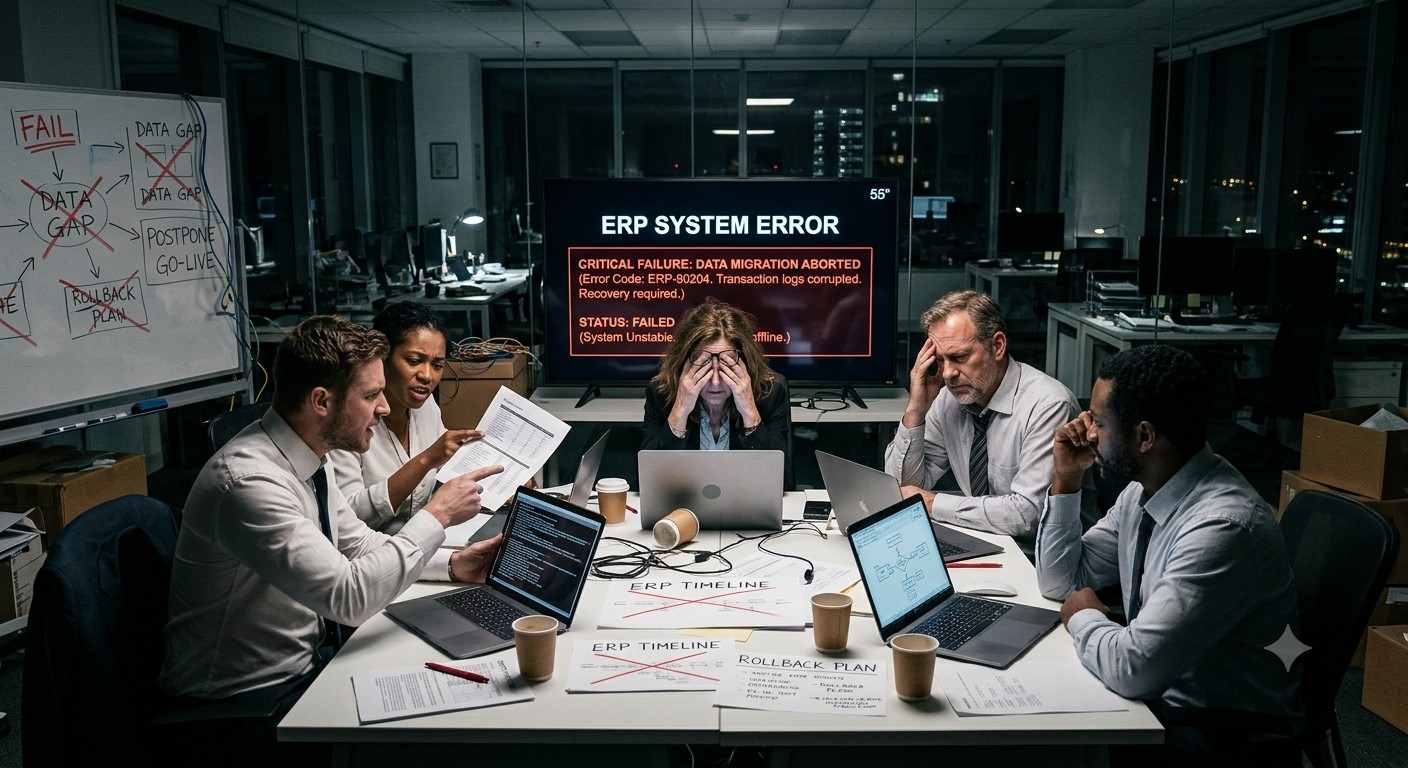
Why ERP Implementations Fail in Manufacturing (and How a 2iSolutions SAP Gold Partner Prevents It)
Eight root causes behind ERP implementation failure in manufacturing, and the practical steps a certified SAP Implementation Partner takes to prevent each one.
Quick answer: Why do ERP implementations fail in manufacturing?
ERP implementations in manufacturing fail mainly because of unclear scope, poor data, weak shop-floor involvement, too much customization and rushed go-lives. They rarely fail because of the software. A certified SAP Gold Partner like 2iSolutions prevents this with structured discovery, data cleansing, phased rollout and long-term support.
“We bought the best ERP in the market. Eighteen months later, my supervisors are back on WhatsApp and Excel.”
A plant head in Pune
That story is not rare. Most manufacturers who investigate an ERP implementation failure find the same thing. The software was fine. The way it was planned, configured, taught and supported was not.
If you’re considering ERP for Manufacturing Industry operations, or recovering from a rollout that went sideways, this guide is for you. We’ll walk through why projects fail and what a good SAP Implementation Partner does differently.
What Does “ERP Failure” Actually Mean?
Failure isn’t always a dramatic collapse. In manufacturing it usually looks like one of these:
Over budget or late
The project runs far beyond its planned cost or timeline.
Side spreadsheets survive
The system goes live, but production teams keep using Excel on the side.
Stock doesn’t match
Inventory in the system doesn’t match the physical stock.
Untrusted numbers
Costing and MRP outputs can’t be trusted.
Workarounds everywhere
Users find workarounds instead of using the system.
No ROI
The business never gets the return it was promised.
A “live” system that nobody trusts is a failed system. Keep that definition in mind, because it changes how you plan.
8 Reasons ERP Implementations Fail in Manufacturing
Each reason below comes with the way a well-run SAP project prevents it.
Reason 1: No Clear Business Case or Scope
Many projects start with “we need an ERP” instead of “we need to cut stock-outs, shorten order-to-delivery time and close the books faster.”
Without measurable goals, scope keeps growing. Every department adds requests, the timeline stretches, and the budget follows. Nobody can say whether the project succeeded, because nobody defined success.
How it’s prevented: At 2iSolutions, discovery comes before configuration. We sit down with finance, production, procurement, quality and stores to define three to five outcomes the ERP must deliver. Every later decision is tested against them.
Reason 2: Treating ERP as an IT Project
When the IT head owns the project alone, production managers feel the system is being “done to them.” Adoption drops before go-live even happens.
ERP for manufacturing touches BOMs, routings, work centres, shop-floor reporting, quality checks and dispatch. These are operational decisions, not technical ones. The people who run the plant must help shape how the system works.
How it’s prevented: We insist on a cross-functional steering group and name process owners from the shop floor. A line supervisor who helped design the production order screen will defend it to their team. One who never saw it will resist it.
Reason 3: Dirty, Incomplete Master Data
This is the silent killer of manufacturing ERP rollouts. Material masters with duplicate codes. BOMs that no longer match what’s built on the floor. Routings with outdated cycle times. Vendor records with missing GSTINs.
Load that into a new system and you get a very expensive way to produce wrong numbers. MRP suggests the wrong purchases, costing is off, and planners stop trusting the system within weeks.
How it’s prevented: Data cleansing is a formal workstream, not an afterthought. We audit material, BOM, vendor and customer data, then migrate in mock cycles, validating each one with the business before the final load.
Worried your project is heading the same way?
Get an honest readiness check from an SAP Gold Partner before you commit more budget.
Reason 4: Over-Customization
Manufacturers are proud of how they work, and that’s fair. But recreating every legacy habit in a new ERP creates heavy custom code, slow upgrades and fragile processes.
Every custom object becomes a future cost. It needs testing at each upgrade, documentation and a developer who understands it. For companies moving toward SAP S/4HANA, this directly conflicts with the clean core approach.
How it’s prevented: We follow a “fit-to-standard” approach. We map your process to standard SAP functionality first, challenge each gap, and build custom code only where it creates real competitive advantage. Where extensions are needed, we keep them outside the core using side-by-side development on SAP BTP.
Reason 5: Ignoring the Shop Floor
A beautiful ERP design means little if operators can’t confirm production on a rugged tablet in under 30 seconds. If it takes five clicks to record scrap, scrap won’t be recorded.
Many failed projects were designed in conference rooms. The people who confirm operations, issue materials and run quality inspections were involved late, if at all.
How it’s prevented: We prototype shop-floor screens early and test them with actual operators. We consider barcode scanning, Fiori apps, handheld devices and language needs. For plants in Gujarat, Tamil Nadu or Maharashtra, local-language support and simple screens often decide whether adoption works.
Reason 6: Weak Change Management and Training
People don’t resist ERP. They resist unclear expectations, extra work and fear of being blamed for mistakes.
A two-day training session just before go-live isn’t change management. Teams need to understand why the change is happening, what changes in their daily routine and who to call when something breaks.
How it’s prevented: We train in role-based sessions using your own data and scenarios, not generic demos. We identify “super users” inside each department who become first-line support. We also plan communication for management, planners, operators and finance separately, because each group worries about different things.
Reason 7: Rushed Testing and Go-Live
Deadlines such as financial year-end, a plant shutdown window or a statutory date create pressure to go live regardless of readiness. Skipped integration testing and thin user acceptance testing push the problems into production, where they cost far more.
Manufacturing is unforgiving here. A bug in goods receipt or production confirmation can stop a line or distort a month of costing.
How it’s prevented: We run structured unit, integration and user acceptance testing with real end-to-end scenarios, from sales order to production to dispatch to invoice. We also set clear go/no-go criteria. If the criteria aren’t met, we recommend adjusting the date, not hoping for the best.
Reason 8: No Support After Go-Live
The first 90 days after go-live decide whether a system sticks. Users hit edge cases nobody predicted, month-end close exposes configuration gaps, and a vendor who disappears after go-live leaves the team alone.
How it’s prevented: Hypercare is built into our plan, followed by managed services and application support. Your team has a direct line to consultants who already know your configuration.
Indian Manufacturing Realities That Often Get Missed
An ERP that works well in a textbook may still struggle in an Indian plant. Common gaps include:
GST and e-invoicing
Correct tax determination, e-invoice generation, e-way bills and reconciliation with GSTR returns must work from day one.
Job work processes
Many Indian manufacturers send material to subcontractors, so challan tracking and ITC-04 reporting need proper handling.
Multi-location operations
Plants, warehouses and branches across several states need consistent but flexible controls.
Mixed-skill workforce
Interfaces should be simple enough for operators with varied technical comfort.
Cost sensitivity
Mid-sized manufacturers need a right-sized solution, not an oversized licence bill.
A partner without real experience in India’s compliance environment will learn these on your project, at your expense.
Why the Right SAP Implementation Partner Matters
Choosing software is only half the decision. Choosing who implements it often matters more.
A strong SAP Implementation Partner brings three things your internal team can’t build quickly:
Pattern recognition
They’ve seen what breaks in similar plants and avoid it.
Proven methodology
They follow a structured path from discovery to hypercare instead of improvising.
Product depth
They know which SAP solution fits your size, budget and growth plan.
That last point is important. Not every manufacturer needs the same product:
SAP Business One
Often suits small and mid-sized manufacturers who need integrated inventory, production, purchasing, sales and finance without heavy complexity.
Small and mid-sizedSAP S/4HANA
Suits larger or more complex operations needing advanced planning, deeper analytics and scalability.
Larger, complex operationsGROW with SAP
Offers a faster, cloud-based adoption path for growing mid-market businesses.
Cloud-first mid-marketA good partner recommends the one that fits you, even if it isn’t the biggest licence.
What Being an SAP Gold Partner Means for You
When evaluating vendors, the credentials behind the name matter. An SAP Gold Partner has met SAP’s standards for certified consultants, customer success and delivery capability. For a manufacturer, that translates into practical benefits:
- Access to certified consultants who’ve been trained on current SAP solutions
- A tested implementation methodology backed by SAP’s own guidance
- Better access to SAP resources and updates
- Greater accountability, because partner status depends on customer outcomes
At 2iSolutions, being an SAP Gold Partner isn’t a badge on a website. It’s the standard we hold our delivery teams to, from the first workshop to long-term support. We also work as an Odoo partner, which means we can compare options honestly instead of pushing a single product.
How 2iSolutions Prevents ERP Implementation Failure: Our Approach
Here’s how a typical manufacturing engagement runs.
- 1Discovery and business blueprint. We study your processes, pain points and growth plans. The result is a clear scope, success measures and a realistic timeline.
- 2Fit-to-standard workshops. We map your operations against standard SAP functionality and decide what to adopt, adapt or extend.
- 3Data readiness. We cleanse and validate master data before it ever touches the new system.
- 4Configuration and shop-floor prototyping. We build in iterations, showing your team working screens early so feedback arrives while changes are still cheap.
- 5Testing and training. We run end-to-end tests and role-based training with your own data.
- 6Cutover and go-live. We plan the cutover carefully, with rollback options and clear go/no-go checkpoints.
- 7Hypercare and managed services. We stay close after go-live to stabilise operations, then continue with ongoing support and optimisation.
A Quick Self-Check Before You Start
Ask yourself these questions. If you answer “no” to more than two, your project is at risk.
- ✓Can we name three measurable outcomes the ERP must deliver?
- ✓Do production, stores and quality leaders sit on the steering group?
- ✓Has someone audited our BOMs, material masters and vendor data?
- ✓Do we know which processes are truly unique and which are just habits?
- ✓Have we planned role-based training and super users?
- ✓Is there a go/no-go checklist, not just a go-live date?
- ✓Do we have a support plan for the first 90 days and beyond?
Questions to Ask Any ERP Partner
Before you sign, ask:
- How many manufacturing implementations have you completed in India?
- Can you share references from companies of my size and sector?
- How do you approach data migration and validation?
- How do you limit customization?
- What does post-go-live support include, and for how long?
- Which SAP certifications and partner level do you hold?
Honest answers tell you more than any brochure.
Frequently Asked Questions
Final Thoughts
Manufacturing ERP projects fail for human and process reasons far more often than technical ones. The encouraging news is that nearly every cause is preventable with the right planning, data discipline, shop-floor involvement and delivery partner.
If you’re planning ERP for Manufacturing Industry operations, or trying to rescue a stalled rollout, talk to a team that has done this before. As an SAP Gold Partner, 2iSolutions combines certified expertise with practical Indian manufacturing experience, so your system is trusted, used and delivering value long after go-live.
Ready to avoid an ERP implementation failure? Book a free consultation with 2iSolutions and get an honest assessment of your readiness.
Ready to Avoid an ERP Implementation Failure?
Talk to the experts at 2iSolutions, an SAP Gold Partner, for an honest assessment of your ERP readiness.