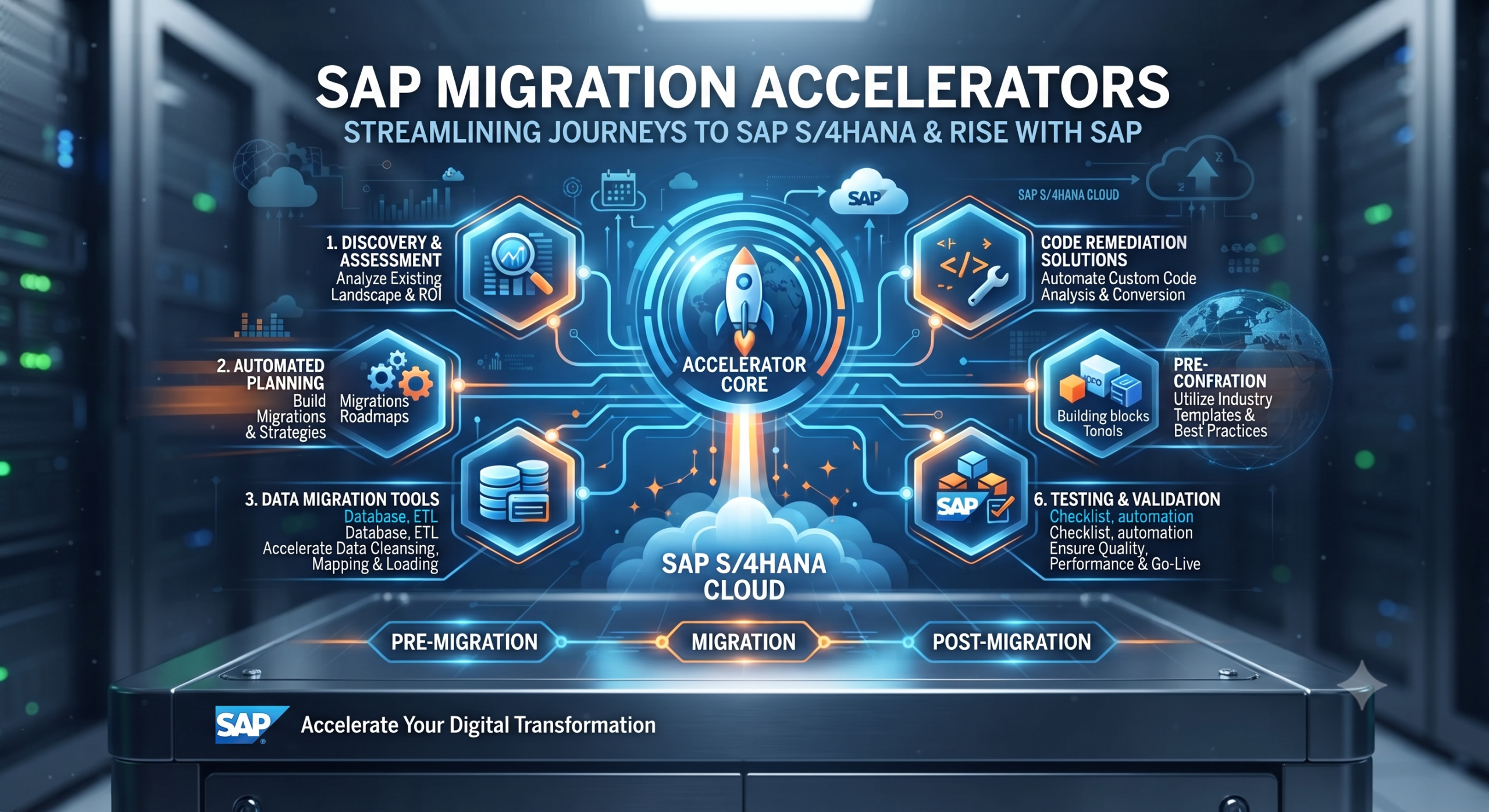
How SAP Migration Accelerators Simplify SAP S/4HANA Migration
If you’ve been anywhere near an SAP program in the last two years, you’ve heard the deadline by now: SAP is ending mainstream maintenance for ECC in December 2027. That single fact has turned SAP Migration & Upgrades from a “someday” line item into a boardroom priority for thousands of companies still running ECC 6.0 on-premises. But here’s what rarely gets said out loud in vendor pitches — a late migration rarely fails because the consulting team didn’t understand SAP. It fails because of five very human, very preventable problems: scope that keeps growing, custom code nobody assessed early, integrations that only break once real data hits them, master data that was never actually clean, and a cutover plan that got written two weeks before go-live instead of two months before.
This post breaks down what actually goes wrong in SAP S/4HANA migration projects, why SAP data migration specifically is the single biggest predictor of a delayed go-live, what a proper SAP migration cutover plan should look like, and where the right SAP Migration Accelerators can genuinely compress your timeline instead of just sounding good in a sales deck.
Why “SAP Migration & Upgrades” Has Become an Urgent Conversation in 2026
For most of the last decade, SAP Migration & Upgrades sat on the IT roadmap as a “nice to have eventually.” That changed once the ECC end-of-mainstream-maintenance date got locked in. Organizations running ECC now fall into three buckets: those who’ve already moved to S/4HANA, those actively migrating, and those still deciding between RISE with SAP, GROW with SAP, or a brownfield conversion — and running out of runway to decide.
What makes this round of SAP Migration & Upgrades different from the ERP transitions of the 2010s is the scale of data and customization involved. A company that implemented ECC in 2008 has 15+ years of transactional history, custom Z-tables, bolted-on interfaces to warehouse systems, tax engines, and possibly a dozen add-ons nobody fully documented. None of that goes away just because you’re moving to a new database and UI. It has to be assessed, cleaned, mapped, tested, and cut over — and that’s where projects either stay on schedule or quietly slide by three, six, or twelve months.
Quick answer: SAP Migration & Upgrades refers to the process of moving an organization’s SAP environment — typically from ECC to S/4HANA, or between SAP versions/deployment models (on-premise, private cloud, RISE with SAP) — including data migration, custom code remediation, integration testing, and cutover planning.
What SAP Migration Accelerators Actually Do (And Don’t Do)
The term “accelerator” gets thrown around loosely in SAP proposals, so it’s worth being precise about it. SAP Migration Accelerators are pre-built templates, tools, and frameworks — reusable mapping sheets, pre-configured migration objects, automated validation scripts, ATC-based custom code scans, and cutover runbook templates — that remove repetitive setup work so a project team can spend its time on decisions, not plumbing. They don’t remove the need for good data quality, custom code remediation, or a rehearsed cutover. What they do is compress the time it takes to get to those decisions, because the team isn’t rebuilding mapping logic or validation scripts from a blank page on every wave.
Quick answer: SAP Migration Accelerators are reusable templates, pre-configured tools, and automation frameworks — such as mapping templates, migration object presets, and cutover runbooks — that reduce manual setup and rework across SAP migration and upgrade projects.
Used well, SAP Migration Accelerators show up in three places: reusable data mapping and staging templates that don’t need to be rebuilt for each migration wave, automated ATC-based scans that flag custom code risk early instead of at integration testing, and cutover runbook templates that already encode the sequencing lessons from prior go-lives. Used poorly, “accelerator” becomes a marketing word attached to a generic toolkit that still requires the same manual rework every project needs — which is why it’s worth asking any implementation partner exactly what their accelerators automate, and what they still leave to be built from scratch.
The Real Reasons SAP S/4HANA Migration Projects Slip
Ask any consultant who has run more than a handful of these programs, and you’ll hear the same list of causes over and over.
- Scope creep with no defined “minimum lovable go-live.” Every stakeholder wants their favorite report, workflow tweak, or custom field carried over. Without a hard-line phase-1 scope and a backlog for everything else, the project timeline stretches indefinitely because nobody said no early enough.
- Custom code that wasn’t assessed until integration testing. S/4HANA’s simplified data model retires or changes tables that older custom ABAP reports and extracts depend on. If custom code assessment happens late, teams discover breakage during system integration testing — the most expensive and stressful point to find it.
- Integrations that only fail with real data. Interfaces to warehouse management, tax engines, CRM, or third-party logistics providers often “work” in isolated unit tests but break the moment production-volume, real-world data flows through them.
- Data quality problems surfacing at mock migration. This is the single most common root cause of a delayed cutover. Duplicate vendor records, missing material master fields, inconsistent customer data — if this isn’t caught and fixed before the first mock load, it resurfaces at every subsequent load, each time costing days.
- A cutover plan drafted too late to rehearse properly. Cutover isn’t a checklist you write the week before go-live. It’s a rehearsed, timed, owned sequence of steps — and if you’ve only run it once, you’ve never actually tested it.
SAP Data Migration: The Workstream That Determines Everything Else
If there’s one lesson from hundreds of SAP transformation programs, it’s this: SAP data migration is not a technical afterthought — it’s a tracked workstream with its own KPIs, owners, and cadence. Treating it as “something the Basis team handles in the background” is how migrations end up rebuilding the same mapping logic three times across three go-live waves.
A disciplined approach to SAP data migration typically includes:
- Source data profiling in a staging layer — surfacing duplicates, missing fields, and inconsistencies from ECC extracts before they ever reach a load, not after.
- Master data cleansing is done upfront — customer, vendor, and material master records are corrected before migration, not discovered as errors mid-cutover.
- Reusable mapping templates — a core example of SAP Migration Accelerators in practice: built once, reused across every migration wave instead of being recreated for each entity or rollout phase.
- Delta migration via SLT (SAP Landscape Transformation) — capturing ongoing changes incrementally so the final cutover window stays short, with the ability to run fast delta reloads if something goes wrong.
- Weekly data-quality KPIs with named domain owners — so readiness is tracked on a cadence rather than discovered as a crisis the week before go-live.
- Documented, auditable corrections — every fix logged so the migration trail holds up under later scrutiny, which matters enormously for regulated industries like pharma and manufacturing.
What is SAP data migration?
SAP data migration is the process of extracting, cleansing, mapping, and loading legacy data (from ECC or a non-SAP system) into a new SAP environment such as S/4HANA, using tools like the SAP Migration Cockpit and SLT for staged, validated, and reconciled data transfer.
Alongside data prep, SAP’s standard Migration Cockpit handles the technical load and validation — but most cockpit load failures don’t originate in the cockpit itself. They originate from data that was never properly staged before the load was attempted. That’s why migration object configuration, staged and validated loads (never a single all-or-nothing run), balance-and-reconciliation checks against source trial balances, and multiple mock migration cycles matter just as much as the tool itself.
Custom Code Assessment: Know What Breaks Before It Breaks in Production
S/4HANA’s simplified data model changes classic table structures that legacy custom reports rely on. An early ATC (ABAP Test Cockpit) readiness scan against simplification items and deprecated table references tells you, months in advance, exactly which custom objects need remediation, which can be retired outright, and which are low-risk. Skipping this step doesn’t make the problem disappear — it just moves the discovery point from “planning phase, low cost to fix” to “integration testing, high cost and high stress to fix.”
An honest interface catalogue — every integration documented and tested end-to-end with real data — belongs in this same early phase, not bolted on afterward.
Building a SAP Migration Cutover Plan That Actually Holds Up

This is where “the plan looked perfect on paper” meets reality — and reality only cooperates if you’ve rehearsed enough times.
A solid SAP migration cutover plan includes:
- A detailed cutover runbook — ideally built from proven SAP Migration Accelerators rather than a blank template, with every step sequenced to a named owner and a defined time window, drafted during planning, not the week before go-live.
- Multiple rehearsals — the full cutover sequence practiced more than once, with results reviewed and gaps closed between each run.
- Objective go/no-go criteria — defined thresholds decided in advance, so the decision to proceed isn’t a judgment call made under pressure at 2 a.m.
- Parallel run validation — old and new systems running in parallel where feasible, confirming results match before the legacy system is decommissioned.
- Hypercare standby — the project team on standby through the first live transactions, not handed off the moment the system goes live.
- A documented rollback contingency — a fallback path decided in advance, not improvised mid-cutover if something goes wrong.
AEO Snapshot — How do you plan an SAP cutover? An effective SAP migration cutover plan defines a detailed, owner-assigned runbook, sets objective go/no-go criteria, includes at least two full rehearsals before go-live, validates data through parallel runs, and keeps the project team on hypercare standby through the first live transactions.
Why India-Based Organizations Face an Extra Layer of Complexity
For manufacturing, pharmaceutical, and retail businesses operating in India, SAP Migration & Upgrades carries compliance weight that global templates don’t always account for. GST return formats, e-invoicing (IRN generation and e-way bill integration), and multi-state GSTIN structures all need to be validated as part of data migration and integration testing — not assumed to “just carry over” from ECC. A migration that goes live smoothly from a technical standpoint but breaks GST-compliant invoicing in the first billing cycle isn’t a success, regardless of how clean the cutover runbook looked. Cities like Rudrapur, Pune, and Ahmedabad — with dense manufacturing and pharma clusters — are seeing a wave of ECC-to-S/4HANA moves specifically driven by the 2027 deadline, and INR-denominated pricing models for local implementation partners remain a deciding factor for mid-market companies weighing RISE with SAP against a self-managed on-premise upgrade.
Change Management: The Part IT Teams Underestimate
A migration is IT-led, but finance and the business own the data and the outcome. Stakeholder alignment early in the project, named business owners for each data domain, a structured communication plan for changes that affect daily work, and training that starts before or immediately at go-live (not as an afterthought) are what determine whether a new system gets adopted or quietly worked around by frustrated end users reverting to spreadsheets.
The Bottom Line on SAP Migration & Upgrades
None of this is exotic. The organizations that hit their go-live dates aren’t the ones with secret tools — they’re the ones who treat SAP Migration & Upgrades as a disciplined program with tracked data quality KPIs, an early custom code assessment, proven SAP Migration Accelerators instead of ad-hoc scripts, genuine business participation in UAT, and a cutover plan rehearsed more than once. The ones that slip are almost always the ones who assumed “we know SAP” was enough and skipped the unglamorous groundwork.
If you’re staring down the 2027 ECC deadline and want to know exactly where your own program is exposed, a structured readiness assessment — checking your data quality, custom code footprint, and cutover plan against these known failure points — is worth doing before you lock in a go-live date, not after.
Frequently Asked Questions
What is SAP Migration & Upgrades?
SAP Migration & Upgrades covers the process of moving an SAP environment to a new version or deployment model — most commonly ECC to S/4HANA — including data migration, custom code remediation, integration testing, and cutover execution.
What are SAP Migration Accelerators?
SAP Migration Accelerators are reusable templates, pre-configured migration objects, automated code-scanning tools, and cutover runbook frameworks that reduce repetitive setup work, letting project teams focus on data quality and business decisions instead of rebuilding tools from scratch on every project.
What is the biggest reason SAP S/4HANA migration projects get delayed?
Data quality issues are the most common root cause. When master data isn’t cleansed before the first mock migration, the same errors resurface at every subsequent load, costing days at each stage.
What tools are used for SAP data migration?
SAP’s Migration Cockpit handles technical transfer and validation of migration objects, while SLT (SAP Landscape Transformation) supports delta/incremental data capture to minimize the final cutover window.
How many times should a cutover be rehearsed before go-live?
At minimum twice, with results reviewed and gaps addressed between each rehearsal. Running the cutover sequence live for the first time during actual go-live is one of the most common causes of a chaotic transition.
When does SAP ECC mainstream maintenance end?
December 2027, which is why most organizations still on ECC are now actively planning or executing their SAP S/4HANA migration.
Contact form