Build vs. Buy: Custom Supplier Portal vs. SAP Business Network
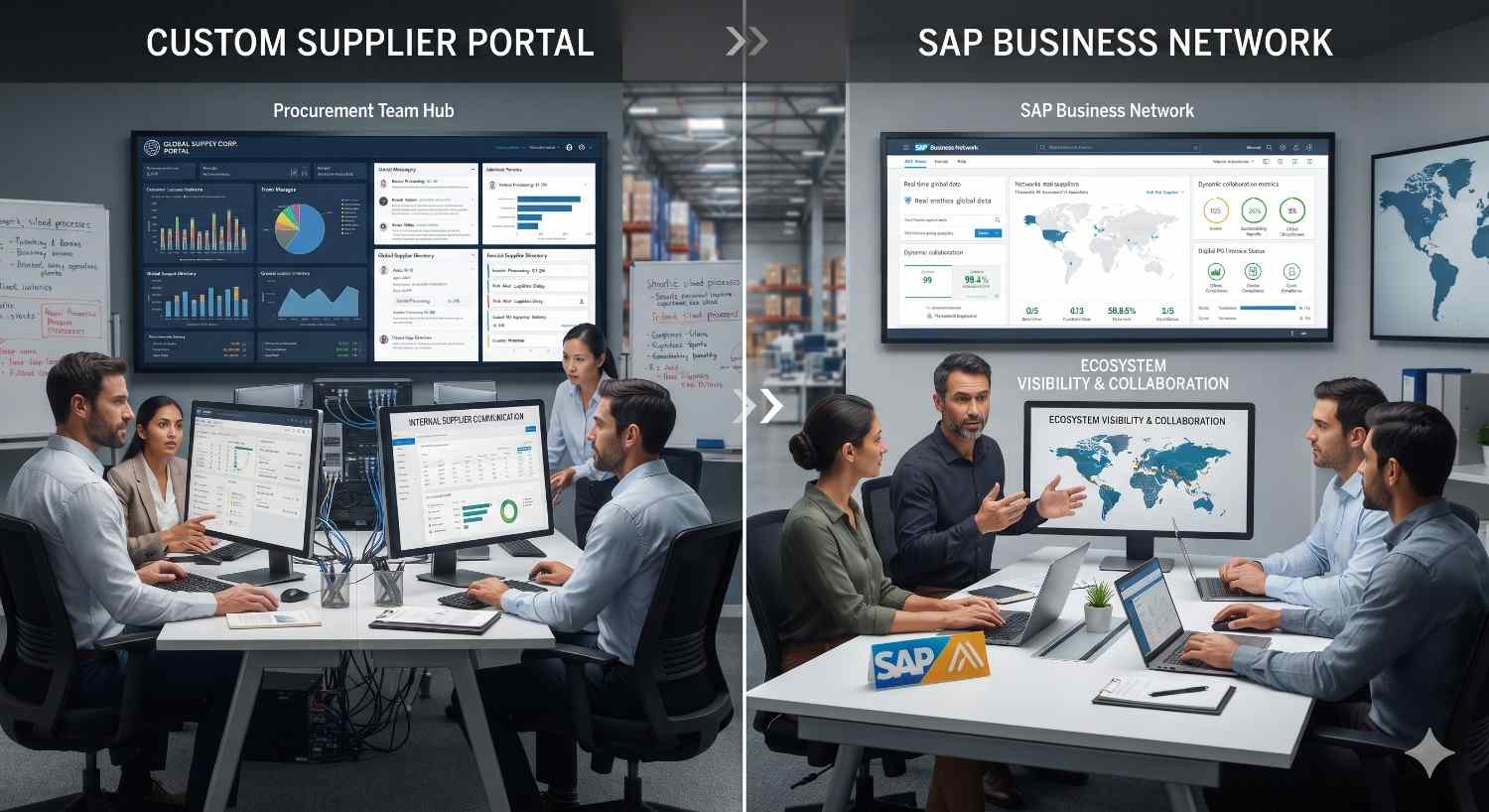
Build vs. Buy: Custom Supplier Portal vs. SAP Business Network
Compare cost, speed, risk and supplier adoption, then use a simple seven-question framework to decide whether to build a custom supplier portal or buy SAP Business Network.
Quick Answer: Build a Supplier Portal or Buy SAP Business Network?
For most mid-size and large enterprises running SAP, buying SAP Business Network is faster, cheaper over three to five years, and lower risk. Building a custom supplier portal makes sense only when your supplier workflows are truly unique, your supplier base is small and strategic, or you need full control over the user experience. Many companies end up with a hybrid: the network for transactions, a light custom layer for what’s left.
Why This Decision Matters More Than It Looks
Every procurement team hits this moment. Suppliers email invoices as PDFs. Purchase order confirmations live in someone’s inbox. Onboarding a new vendor takes three weeks and four spreadsheets. Someone says, “We need a supplier portal.”
Then the real argument starts. IT says they can build one in-house. Procurement says SAP already has a network for this. Finance asks what it will cost, and nobody agrees on an answer.
The build vs buy supplier portal question is really a question about where you want your team’s time and money to go. A portal is not a one-off project. It’s a product you’ll maintain for years, with real users (your suppliers) who will tell you loudly when it breaks.
This guide walks through both options honestly, with the trade-offs we see in real ERP projects, so you can decide with clear eyes.
What Is a Supplier Portal?
A supplier portal is a secure, web-based space where your suppliers and your company exchange business information. Instead of email and phone calls, suppliers log in to:
Orders and delivery
- Receive and confirm purchase orders
- Share shipping notices and delivery schedules
Invoices and catalogs
- Submit invoices and track payment status
- Update catalogs, prices and lead times
Onboarding and sourcing
- Complete onboarding and compliance documents
- Respond to RFQs and sourcing events
A good portal cuts manual data entry, reduces errors, and gives both sides one version of the truth.
What Is SAP Business Network?
SAP Business Network is SAP’s cloud-based commerce network that connects buyers, suppliers, and logistics partners. It brings together what used to be separate products, including the Ariba Network, and lets companies run procurement, invoicing, and collaboration processes in a shared digital space.
The key idea is that you’re not building a private portal that every supplier must learn from scratch. You’re plugging into a network that many suppliers already use. If your supplier already transacts with other buyers on the network, onboarding them to yours is often much easier.
It integrates natively with SAP S/4HANA, SAP ECC, and SAP Ariba solutions. It also supports standard formats such as cXML and EDI for companies with mixed systems.
The Case for Building a Custom Supplier Portal
Custom isn’t automatically a mistake. There are good reasons companies go this route.
1. Total control over workflows
You decide every screen, field and approval step. If your industry has multi-stage quality inspections, complex tolling arrangements or regulated documentation, a custom build can model them exactly.
2. Unique branding and experience
With custom supplier portal development, you control the design, language and flow, so the portal feels like a natural extension of your brand.
3. Deep integration with non-standard systems
If your core stack mixes legacy tools, homegrown systems or niche industry software, a custom build can bridge them in ways a standard network may not.
4. No dependence on a vendor roadmap
You aren’t waiting for SAP to release a feature. If you need it, you build it.
5. A small, strategic supplier base
If you work with 30 critical suppliers instead of 3,000, the economics of a network matter less, and a tailored portal may fit better.
Not sure which way to go?
Get an honest, vendor-neutral assessment of your supplier workflows before you commit budget.
The Case for Buying SAP Business Network
1. Faster time to value
The network is built and maintained. Implementation focuses on configuration, integration and supplier onboarding rather than writing software from scratch. Many companies see their first processes running in a fraction of the time a custom build requires.
2. Native SAP integration
If you run S/4HANA or ECC, the integration path is well documented and supported. Purchase orders, goods receipts, invoices and payment data flow with far less custom plumbing.
3. Existing supplier network
Many of your suppliers may already have an account. That lowers resistance, reduces training and speeds up adoption, which is often the real bottleneck.
4. Built-in compliance and security
SAP handles infrastructure security, certifications and many regional e-invoicing requirements. That’s a significant weight off your IT and legal teams.
5. Continuous innovation
New capabilities, including AI-assisted features, risk monitoring and analytics, arrive as part of the platform. You don’t fund R&D for them.
6. Predictable operating model
Subscription costs are easier to forecast than an open-ended development roadmap. Confirm exact commercial terms with SAP or your implementation partner, since pricing depends on your contract and transaction volumes.
The Limits of SAP Business Network
An honest comparison needs the downsides too.
- Less customization. You work within the platform’s structure. Highly unusual workflows may need workarounds.
- Subscription costs scale with usage. For very high transaction volumes, review commercial terms carefully.
- Vendor dependency. Your roadmap is partly SAP’s roadmap.
- Supplier onboarding still takes effort. Some smaller suppliers resist new systems regardless of platform, so you need a clear enablement plan.
- Implementation expertise matters. A badly configured network is nearly as frustrating as a badly built portal. Working with an experienced SAP partner makes a real difference.
Side-by-Side Comparison
| Factor | Custom Supplier Portal | SAP Business Network |
|---|---|---|
| Time to launch | Long (months to a year or more) | Shorter (configuration-led) |
| Upfront cost | High (development) | Lower (implementation + subscription) |
| Long-term cost | Ongoing dev, hosting, support | Subscription + support |
| Customization | Unlimited | Moderate, within platform |
| SAP integration | Must be built and maintained | Native and supported |
| Supplier adoption | Harder (new login for suppliers) | Easier (many already on network) |
| Compliance updates | Your responsibility | Largely handled by SAP |
| Security | Your responsibility | Vendor-managed |
| Scalability | Depends on your architecture | Built for scale |
| Best for | Unique workflows, small supplier base | Most mid-size and enterprise buyers |
A Simple Framework: How to Decide
Ask yourself these seven questions.
- 1Are our supplier workflows truly unique? Be honest. “We do things differently” is often “we’ve always done it this way.” If 80% of your processes are standard purchase-to-pay, buy.
- 2How many suppliers do we have? Hundreds or thousands favor a network. A few dozen strategic partners may justify custom.
- 3What’s our ERP landscape? Running SAP S/4HANA or ECC strongly favors SAP Business Network because of native integration.
- 4Do we have a long-term product team? A portal needs product owners, developers and support staff indefinitely. If you can’t commit to that, don’t build.
- 5How fast do we need results? If procurement leadership wants measurable savings this fiscal year, buying wins.
- 6What are our compliance obligations? Multi-country operations with changing e-invoicing rules are painful to maintain in-house.
- 7What would we do with the engineering time we’d save? If your developers could build revenue-generating features instead, that’s a strong argument to buy.
Rule of thumb: Buy the commodity, build the differentiator. Procurement transactions are rarely a competitive differentiator.
The Hybrid Approach
You don’t always need to choose one side. A growing number of enterprises use SAP Business Network for core transactions such as purchase orders, invoices, and catalogs, and build a small custom layer on SAP BTP for niche needs like specialized onboarding forms, internal dashboards, or industry-specific compliance checks.
This gives you the speed and reliability of a platform without giving up your edge cases. It’s often the most pragmatic answer.
Real-World Scenarios
Scenario A: Mid-size manufacturer
1,200 suppliers, running S/4HANA. Native integration, existing supplier reach and faster ROI outweigh the customization limits.
Verdict: BuyScenario B: Specialized engineering firm
40 critical suppliers, bespoke quality documentation. The supplier base is small and the workflows are distinctive.
Verdict: Custom or hybridScenario C: Multi-country retail group
Expanding across regions. Regional compliance and scale are hard to maintain in-house.
Verdict: BuyScenario D: Mixed legacy ERPs
No SAP core. SAP’s native advantages shrink without an SAP backbone, so a custom portal or a different platform may fit better.
Verdict: Evaluate carefullyCommon Mistakes to Avoid
- 1Underestimating maintenance. The build cost is a down payment, not the full price.
- 2Ignoring supplier experience. If suppliers hate it, your savings disappear.
- 3Skipping a pilot. Start with a small group of suppliers before a full rollout.
- 4Choosing on features alone. Adoption and integration matter more than feature lists.
- 5Doing it without a partner. Whether you buy or build, experienced guidance prevents expensive rework.
Implementation Tips That Apply Either Way
- Map your current procure-to-pay process before choosing anything.
- Segment suppliers by size, volume, and technical readiness.
- Define success metrics up front, such as invoice cycle time, error rate, and onboarding days.
- Communicate with suppliers early and explain what’s in it for them.
- Plan for support, because suppliers will have questions.
Frequently Asked Questions
Final Verdict
The build vs buy supplier portal debate rarely has a universal answer, but it has a common pattern. Companies with standard procurement processes, large supplier bases, and SAP at the core get more value, faster, from SAP Business Network. Companies with unusual requirements, small supplier bases, and strong engineering teams may justify custom supplier portal development.
Whichever way you lean, the worst outcome is a half-built portal that suppliers avoid. Decide based on total cost of ownership, supplier adoption, and the opportunity cost of your team’s time, not on the excitement of building something new.
Need Help Deciding?
At 2iSolutions, an SAP Gold Partner and Odoo Silver Partner in India, we help procurement and IT teams assess their supplier workflows, compare options, and implement the right solution. If you’re weighing a custom supplier portal against SAP Business Network, talk to our SAP consulting team for an honest assessment.
Ready to Decide: Build or Buy?
Talk to the SAP experts at 2iSolutions, an SAP Gold Partner, about the right supplier portal approach for your business.