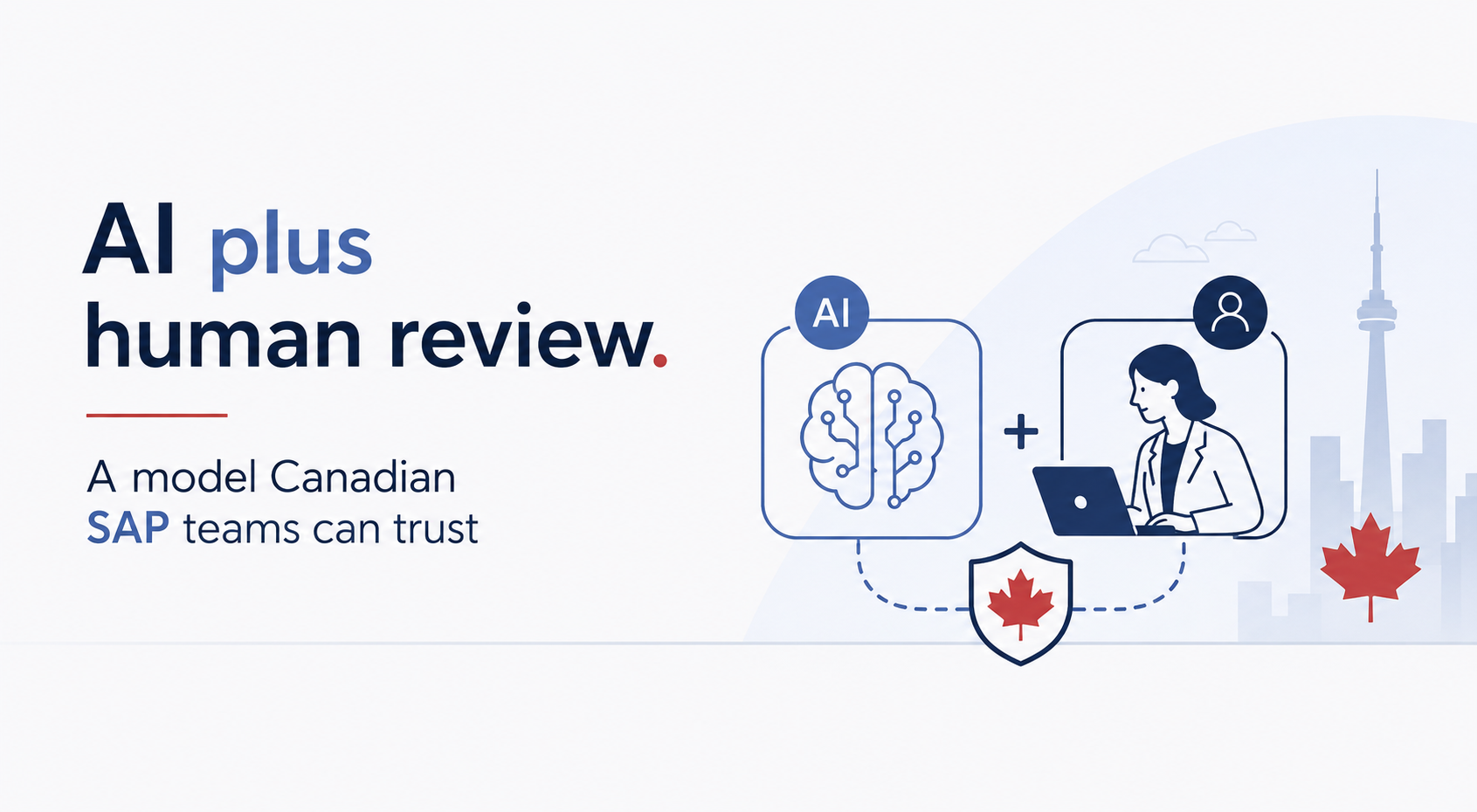
In regulated industries, a single unreviewed decision can trigger a compliance audit, delay a product release, or attract a securities regulator. That is why Canadian pharma, utility, and financial services organizations are not adopting AI for SAP projects blindly. They are pairing it with structured human review, and the combination is changing how SAP programs are governed, staffed, and delivered. This makes SAP Implementation Partner Canada essential for modern businesses.
This is not about slowing AI down with bureaucracy. It is about giving AI a lane to run in, and giving humans the oversight authority they need to stand behind the output.
Why Regulated Industries Need a Different Approach: SAP Implementation Partner Canada
Speed matters. However, in a federally regulated Canadian environment, speed without accountability is a liability. A pharmaceutical company migrating to SAP S/4HANA must validate every data transformation against Health Canada requirements. A utility operating under provincial energy board rules cannot afford configuration drift. A financial institution subject to OSFI guidelines needs an audit trail before any system change goes live.
Standard AI tools are impressive at pattern recognition, data mapping, and test script generation. They move fast. The problem is that none of those outputs come with regulatory accountability attached. A large language model does not hold a P.Eng. designation or a CPA license. It cannot sign a validation protocol.
So the question is not whether AI belongs in Canadian SAP projects. It clearly does. The question is how you structure the handoff between what the machine generates and what a qualified human certifies.
The Governance Gap AI Alone Cannot Close
Industry research suggests that AI-assisted SAP implementations reduce initial configuration timelines by a meaningful margin. However, the same research consistently shows that organizations without formal human review gates see higher rates of rework in regulated environments. The AI draft is fast. The cleanup without oversight is expensive.
Human reviewers add something AI cannot replicate. They carry professional accountability. They understand the specific regulatory context of a Canadian organization. They know what a Health Canada auditor will look for, or what OSFI expects in a model risk framework. That knowledge is not in any training dataset.
How the Pairing Actually Works in Practice
The AI-plus-human model is not theoretical. Specific workflow patterns are already in use across Canadian SAP programs. They break down into three layers.
Layer One: AI-Assisted Discovery and Drafting
At the start of a project, AI tools analyze legacy data, flag mapping inconsistencies, draft functional specifications, and generate test scenarios at a speed no human team can match. For an SAP S4HANA Implementation Canada project spanning multiple legal entities and data domains, this alone saves weeks.
The output from this layer is treated as a draft. Nothing is approved, configured, or documented as final at this stage. The AI is a very fast junior analyst producing structured inputs for review.
Layer Two: Structured Human Review Gates
Each AI output passes through a defined review gate. The gate is not a vague “someone checks this.” It is a documented step with a named reviewer, a checklist, and a sign-off field. In a pharmaceutical context, this maps directly to GxP validation protocols. In financial services, it maps to model risk governance frameworks.
Reviewers at this layer are typically senior SAP consultants or functional leads with domain expertise. They are not reviewing AI output line by line to fix grammar. They are making judgment calls about regulatory fit, business logic, and risk. That is a skilled task. It requires the kind of professional who brings exactly the experience a strong SAP Implementation Partner Canada would field on a complex engagement. According to PwC Canada’s AI trust findings, Canadian organizations are increasingly recognizing the importance of structured oversight and human accountability in AI-driven processes, especially in regulated sectors.
Layer Three: Documentation and Traceability
After review and approval, the final output is documented with full traceability. Who reviewed it. What version of the AI-generated draft was reviewed. What changes were made. When the sign-off occurred. This creates an audit trail that satisfies regulators and gives internal stakeholders the confidence to move forward.
In practice, this traceability layer is where many organizations underinvest. They run the AI, they do the review, and then they document poorly. That gap destroys the value of the governance model when an auditor shows up.
Sector-Specific Benefits Across Canadian Industries
The AI-plus-human model does not apply the same way in every sector. Each regulated industry in Canada has distinct requirements that shape how the framework gets implemented.
Pharmaceutical and Life Sciences
In pharma, the concept of computer system validation is non-negotiable. Health Canada’s guidance on GxP-compliant systems requires documented evidence that a system does what it claims to do, consistently and traceably. AI can accelerate the drafting of User Requirements Specifications and Functional Design Documents. However, a qualified reviewer must sign each document before it becomes part of the validation package.
Organizations working with an experienced provider of SAP Consulting Services Canada understand this distinction well. The consultant’s role is not to replace the AI. It is to take the AI-generated draft and apply the regulatory knowledge that turns a good document into a compliant one.
Utilities and Energy
Canadian utilities operate under complex provincial regulatory structures. Configuration decisions in SAP for billing, asset management, and outage tracking carry direct compliance implications. AI tools can model configuration options and flag rule conflicts. However, a utility engineer or regulatory affairs specialist must review the output before it shapes the system design.
Also, utilities often work with decades of legacy data. AI can surface data quality issues faster than any manual process. However, the decision about what to do with those issues, whether to cleanse, archive, or remediate, belongs to a human with accountability for the outcome.
Financial Services
OSFI’s model risk management guidelines require banks and insurers to validate any model that influences a material decision. In financial services SAP environments, this applies to planning models, reporting hierarchies, and any automated calculation that feeds a regulatory return. AI tools used in SAP BPC planning configuration or financial close processes fall squarely into this category.
The human review gate here is not optional. It is a regulatory requirement. Moreover, the reviewer must be able to document their assessment in a way that satisfies an internal audit or an OSFI examination. That is a different standard than a general quality check.
Building the Right Team for AI-Governed SAP Projects
The AI-plus-human model only works if you have the right humans. That sounds obvious. In practice, it is the hardest part of making this approach work at scale.
What the Reviewer Role Actually Requires
The reviewer in this model needs three things. Domain knowledge of the regulatory environment. Deep familiarity with SAP in the relevant functional area. And the professional maturity to push back on AI output when something is wrong, even when the project schedule is tight.
That combination is rare. You cannot train a junior consultant to do this in two weeks. Organizations that try to staff the review layer cheaply end up with rubber-stamp approvals, which defeats the entire purpose of the governance framework.
Finding consultants with this profile is one reason organizations across the country turn to specialized staffing support. A provider with a strong track record in SAP Support Services Canada knows how to identify these individuals, because the profile requirements are specific and the pool is not large.
Structuring the Team for Scale
On a large transformation, you may have dozens of AI-generated outputs moving through review simultaneously. The review layer needs to be organized as a function, not a series of ad hoc check-ins. That means:
- Defined reviewer roles: for each functional area (FI, CO, MM, PP, QM)
- A review queue: with clear SLAs tied to project milestones
- A governance lead: who owns the traceability documentation
- An escalation path: when a reviewer and a project manager disagree about risk
Without this structure, the human review layer becomes a bottleneck rather than a control. Projects slow down, reviewers get bypassed under schedule pressure, and the governance model collapses.
How Technology Is Changing What Reviewers Actually Do
The relationship between AI and human review is not static. The tools are evolving, and so is the role of the reviewer.
Early AI-assisted SAP tools generated text and code that reviewers had to evaluate largely on their own judgment. Newer tooling can flag specific risk categories, highlight sections where regulatory language may not align with a jurisdiction, and annotate drafts with confidence scores. This does not reduce the need for human review. However, it makes reviewers faster and more targeted.
For Canadian organizations running SAP S/4HANA, the practical result is that the review layer becomes less about reading everything and more about focusing judgment where it matters most. A reviewer spending time on a low-risk configuration change is a reviewer not spending time on a high-risk data transformation. Better tooling creates better prioritization.
Furthermore, as more Canadian SAP teams build institutional experience with the AI-plus-human model, the review process itself becomes more efficient. Checklists get refined. Common AI errors get documented and filtered. The feedback loop between AI output quality and human review quality tightens over time.
Making the Case Internally to Stakeholders
Governance frameworks need champions inside the organization. The AI-plus-human model is not always an easy sell to a budget committee focused on transformation costs. The argument needs to be made clearly and with specificity.
The case rests on three points. First, AI without human review creates audit exposure that is far more expensive than the cost of structured oversight. In a sector like pharma or financial services, a single compliance finding can cost multiples of the entire review budget. Second, the AI layer generates real speed gains that offset the cost of the review layer. The net timeline is still faster than a purely manual approach. Third, the documentation produced by a governed AI-plus-human process becomes a long-term asset. It supports change management, training, and future upgrades in ways that undocumented implementations do not.
For organizations evaluating their options for a major transformation, the conversation with an SAP Implementation Partner Canada is a natural place to pressure-test this model. A partner that has run regulated-industry projects in Canada will have direct experience with what governance structures work and which ones create friction without adding value.
Frequently Asked Questions
Q. Is the AI-plus-human model only relevant for large SAP programs?
A. No. Even smaller SAP implementations in regulated industries carry compliance obligations that require documented oversight. The review layer can be scaled to fit the size of the engagement, but the principle of human sign-off on regulated outputs applies regardless of project scale.
Q. How does this model affect project timelines compared to traditional SAP delivery?
A. In most cases, the combined model is faster than traditional delivery for the initial phases of a project, because AI accelerates discovery, drafting, and test preparation significantly. The human review layer adds time, but typically less than the time AI saves. Net timelines are generally competitive or better.
Q. What qualifications should a human reviewer hold for a pharma SAP project?
A. For GxP-relevant SAP work, reviewers should have hands-on experience with computer system validation, familiarity with Health Canada and ICH Q10 guidance, and functional SAP expertise in the relevant module. A background in quality assurance or regulatory affairs is a strong asset.
Q. Can the traceability documentation from AI review satisfy a regulatory audit?
A. It can, provided it is structured correctly from the start. The documentation needs to capture what was reviewed, who reviewed it, what changes were made to the AI draft, and when approval was granted. Organizations that treat this as a checkbox exercise rather than a real audit trail will struggle under examination.
Q. How do you prevent the human review layer from becoming a bottleneck?
A. Structure is the answer. Assign clear reviewers to specific functional domains, set SLA expectations tied to the project schedule, and give the governance lead authority to escalate when reviews are delayed. A review queue with no ownership is a queue that will slow down under pressure.
Conclusion
The AI-plus-human model is not a compromise between two competing philosophies. It is a practical response to the reality of regulated industry work in Canada. AI delivers speed at a scale human teams cannot match. Human review delivers the accountability and regulatory judgment that AI cannot provide. Together, they produce outputs that are faster than traditional delivery and trustworthy enough to withstand scrutiny.
For Canadian organizations in pharma, utilities, and financial services, the governance framework matters as much as the technology. A well-structured review process turns AI output into certified deliverables. A poorly structured one turns it into technical debt waiting to surface during an audit.
The teams that will lead SAP transformation in Canada over the next several years are the ones building this capability now. They are investing in reviewers with real domain expertise, in traceability processes that hold up under examination, and in partners who understand that governance is not an obstacle to speed. It is the condition that makes speed sustainable.
Explore how these ideas apply to your SAP environment. Join us Aug 5