How to Manage Custom Jewellery Orders Efficiently with ERP Software
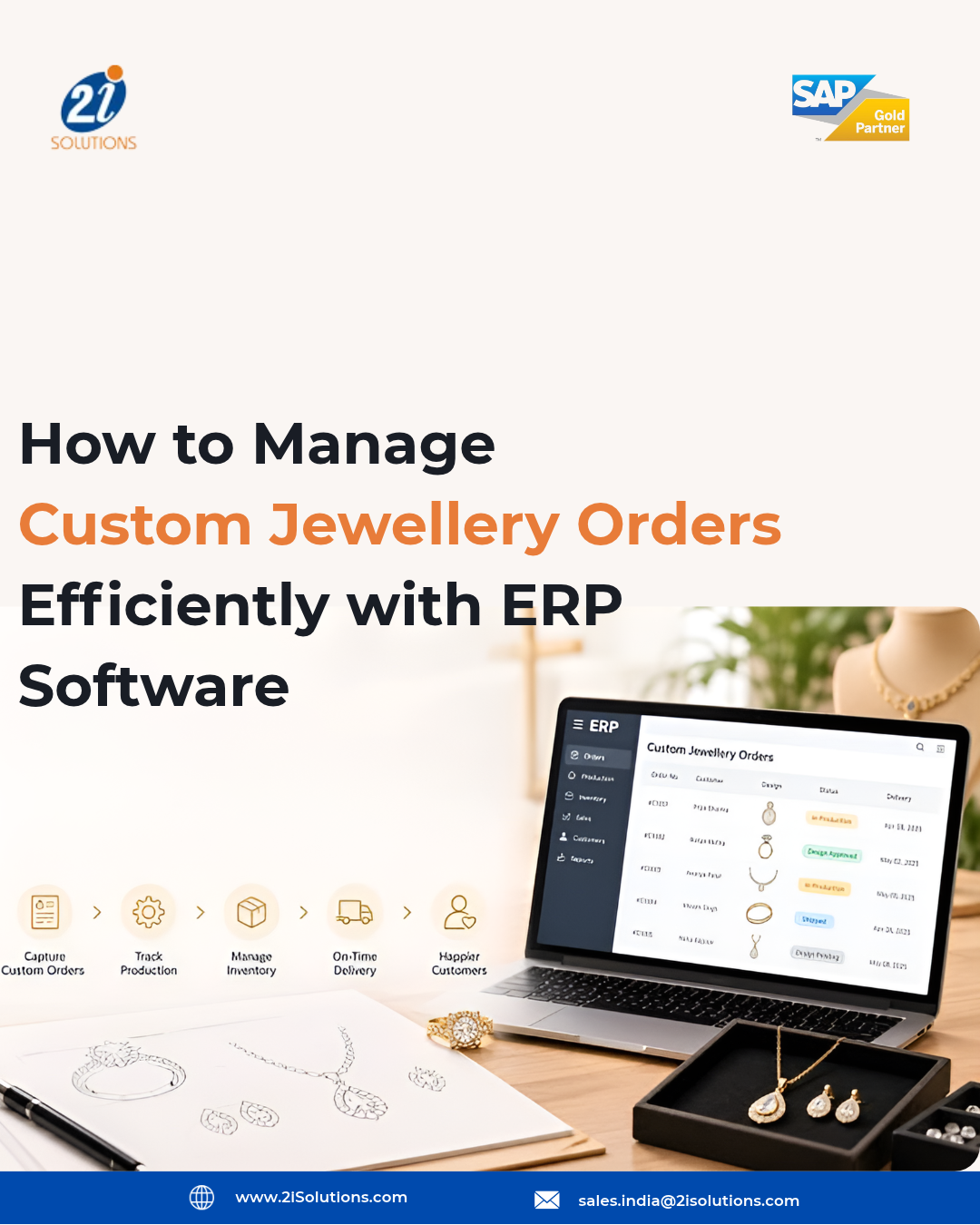
How to Manage Custom Jewellery Orders Efficiently with ERP Software
See how ERP for the jewellery industry connects design, karigar job work, gold and stone tracking, hallmarking and billing, and how Odoo, SAP Business One and SAP S/4HANA compare for bespoke orders.
A customer walks into a showroom in Surat, Jaipur or Mumbai and asks for a bespoke diamond necklace set for her daughter’s wedding in 45 days. The designer sketches it, the sales team quotes a price, and the order goes to the workshop. Three weeks later, nobody can say which karigar has the gold, how much has been lost in filing, or whether the stones have arrived.
If that sounds familiar, you’re not alone. Custom orders are the most profitable part of a jewellery business, and also the hardest to control. This guide shows how ERP for the jewellery industry brings order to bespoke work, and how Odoo, SAP S/4HANA and SAP Business One compare for this job.
Quick answer: How do you manage custom jewellery orders with ERP?
Custom jewellery orders are managed efficiently by connecting design approval, metal and stone allocation, karigar job work, quality checks, hallmarking and billing in one ERP system. Every order gets a unique ID. Every gram of gold and every stone is tracked from issue to return, and the customer’s approved design, price and delivery date stay linked to the order. This removes manual registers, reduces metal loss and shortens delivery times.
Why Custom Jewellery Orders Are So Hard to Manage
A standard ring from a catalogue follows a predictable path. A custom order doesn’t. Each piece carries its own design, metal weight, purity, stone specifications, labour and deadline. Here is where most jewellers lose money and time.
Information lives in too many places
The designer has a sketch in WhatsApp, the sales team has a quote in Excel, and the karigar has a verbal instruction. When the customer asks for a change, half the chain never hears about it.
Metal and stone tracking relies on paper
Gold is issued to karigars by weight and returned as finished jewellery, scrap and dust. Without a live ledger, wastage disputes are common and pilferage is hard to detect.
Pricing is guesswork
Gold rates move daily. If a quote doesn’t lock the rate or include making charges, wastage and stone costs correctly, margins disappear.
Deadlines slip silently
With no visibility into which stage an order is in, wedding and festival orders get delayed without anyone noticing until the customer calls.
Compliance adds pressure
In India, jewellers deal with BIS hallmarking and HUID, GST on gold jewellery and job work, e-invoicing for larger businesses, and PAN rules on high-value transactions. Manual processes make audits stressful.
A good Jewellery ERP Software solves these problems by treating every custom order as a tracked project with its own materials, labour, costs and timeline.
What a Custom Order Looks Like Inside an ERP
Here is the ideal flow when Custom Jewellery Order Management runs on ERP.
- 1Enquiry and design capture. The sales executive records the customer’s requirements, budget, occasion and delivery date. Design sketches, CAD files or reference images are attached to the order record.
- 2Quotation with locked rates. The system calculates the estimate from the current gold rate, purity, expected weight, wastage percentage, stone cost, making charges and GST. The customer approves, pays an advance, and the rate can be locked.
- 3Order confirmation and job card. A job card is created with a unique order number. It lists the design, metal and stone specifications, assigned workshop or karigar, and the promised date.
- 4Material issue. Gold, silver, diamonds and gemstones are issued from the vault against the job card. The ERP records weight, purity and, for stones, certificate numbers or lot details.
- 5Production stages. The job moves through casting, filing, setting, polishing and finishing. At every stage, weight is recorded, so the system calculates wastage automatically.
- 6Quality check and hallmarking. The finished piece is checked against the approved design. For gold jewellery, hallmarking and HUID details are linked to the item.
- 7Final billing and delivery. The ERP generates the GST-compliant invoice, adjusts the advance, and updates inventory and accounts. The customer gets a clear breakdown.
When every step is recorded in one place, owners can see at a glance what is pending, delayed or over budget.
Running custom jewellery orders on registers and Excel?
Get a free review of your order-to-delivery process and a demo built around your own workflow.
Key ERP Features Every Jewellery Business Needs
When evaluating ERP for the jewellery industry, look for these capabilities.
Multi-unit inventory
Track items in grams, carats and pieces, and by purity (22K, 18K, 925 silver), at the same time.
Karigar and job work management
Maintain a metal ledger per karigar, with issue, receipt, wastage and balance.
Stone and diamond tracking
Record certificate numbers, cut, clarity, colour and carat for every stone.
Dynamic pricing
Link daily gold and silver rates to quotations and invoices.
Order and project tracking
Stage-wise status for every custom order, visible to sales, workshop and management.
Barcode and RFID tagging
Unique tags for finished pieces and tracking inside vaults.
GST and e-invoicing support
Correct tax treatment for jewellery sales, making charges and job work.
Customer relationship management
Purchase history, anniversaries, preferences and repeat order triggers.
Multi-branch visibility
Stock and orders across showrooms, workshops and franchise locations.
Reports and analytics
Wastage trends, karigar productivity, margin per order and slow-moving designs.
No platform ships with all of this perfectly for jewellery out of the box. The difference between platforms lies in how easily they can be configured and extended, which is what we compare next.
Odoo vs SAP S/4HANA vs SAP Business One for Custom Jewellery Orders
All three are credible ERP platforms. The right fit depends on your size, budget, complexity and growth plans. Here is an honest comparison.
Odoo for Jewellery
A modular, open-source-based ERP known for flexibility and fast implementation. It has no dedicated jewellery edition by default, but its Inventory, Manufacturing, Sales, Accounting and Studio apps can be configured and extended for jewellery workflows.
- Lower entry cost and lighter licence model
- Quick customisation of job cards, weight-based units and approval flows
- Modern interface that teams adopt quickly
- Strong e-commerce and CRM integration
- Purity conversion, karigar metal ledgers and wastage rules typically need custom development or add-ons
- Heavily customised setups need disciplined upgrade planning
SAP Business One for Jewellery
SAP’s ERP for small and mid-sized businesses, with strong financials, inventory, production and purchasing control and India localisation for GST and e-invoicing. Jewellery-specific needs are generally met through SAP-certified add-ons or tailored extensions.
- Reliable batch and serial tracking for high-value goods
- Strong financial controls and audit trails
- Production orders and BOMs map well to job cards
- Scales from one showroom to multiple branches
- Needs a skilled partner to design jewellery processes
- Costs are higher than entry-level tools
SAP S/4HANA for Jewellery
SAP’s enterprise-grade ERP for complex, multi-entity, multi-plant operations, with deep financials, supply chain and analytics.
- Real-time reporting across groups, factories and exports
- Advanced supply chain, procurement and costing
- Strong governance for large or listed groups
- Extensions through SAP BTP for specialised needs
- Higher investment and longer timelines
- Often more than a small jeweller needs
Side-by-side comparison
| Criteria | Odoo | SAP Business One | SAP S/4HANA |
|---|---|---|---|
| Ideal business size | Small to mid-sized | Mid-sized | Large enterprises |
| Cost of ownership | Lower | Moderate | Higher |
| Implementation speed | Fast | Moderate | Longer |
| Customisation flexibility | Very high | Moderate to high | High, with governance |
| Jewellery-specific features | Via customisation or add-ons | Via certified add-ons or extensions | Via configuration and BTP extensions |
| Inventory and weight tracking | Strong when configured | Strong | Very strong |
| Financial controls | Good | Strong | Enterprise-grade |
| Multi-branch and group scale | Good | Good | Excellent |
| GST and e-invoicing in India | Supported | Supported | Supported |
A practical rule of thumb: If speed and flexibility matter most, start with Odoo. If control and compliance are the priority for a mid-sized business, SAP Business One for Jewellery is a strong fit, and a proper SAP Business One implementation with jewellery-aware configuration makes the difference. If you operate at group scale with multiple legal entities, SAP S/4HANA is the safer long-term platform.
How ERP Reduces Metal Loss and Improves Margins
Metal loss is the quiet profit killer in jewellery. Even a small, unexplained variance across hundreds of orders adds up to lakhs of rupees a year. ERP helps in four ways.
Karigar-wise metal ledgers
Every gram issued and returned is recorded, so you can see each karigar’s balance and wastage percentage at any moment.
Standard vs actual wastage
Set a permitted wastage per design or process. The ERP flags orders that exceed it, so you investigate the same day instead of at month-end.
Scrap and dust recovery
Filings, sweepings and scrap are recorded and refined, and the recovered metal is credited back to the right account.
Accurate costing
With real weights, labour and stone costs captured, you know the true profit on each custom order rather than a rough guess.
Improving Delivery Times and Customer Experience
Custom jewellery is an emotional purchase. A late delivery for a wedding or a festival like Dhanteras or Akshaya Tritiya can lose a customer for life. ERP improves delivery in practical ways.
- Stage-wise tracking shows exactly where each order sits.
- Automated alerts warn the manager when a job is about to miss its date.
- Customer updates by SMS or WhatsApp can be triggered at design approval, setting, and ready-for-pickup.
- Capacity planning shows which workshops are overloaded before you promise a date.
A transparent process also builds trust. Customers who receive timely updates and clear invoices are far more likely to return for the next occasion.
Compliance Made Simpler: Hallmarking, GST and Audits
Indian jewellers operate under tighter compliance than ever. Mandatory BIS hallmarking with HUID, GST on jewellery sales and job work, e-invoicing thresholds, and documentation for high-value cash transactions all demand clean records. An ERP helps by:
- Linking HUID and hallmark details to each item
- Applying the correct GST treatment to sales, job work and making charges
- Generating e-invoices and e-way bills where applicable
- Keeping a complete audit trail for stock, vouchers and customer KYC
Regulations change, so always confirm current rules with your chartered accountant and ERP partner before configuring tax logic.
How to Choose the Right ERP Partner
Software is only half the decision. The implementation partner decides whether your ERP actually fits the way a jewellery workshop works. Ask these questions before you sign.
- 1Jewellery experience. Have you implemented ERP for jewellery or high-value inventory before?
- 2Weight, purity and karigar logic. How will you handle weight-based units, purity conversion and karigar ledgers?
- 3Standard vs custom. Which parts are standard, and which are custom or add-on?
- 4Data migration. How will you migrate our existing stock, customer and karigar data?
- 5Training and support. What training and post go-live support do you provide?
- 6Scalability. Can the system scale if we open new showrooms or start exporting?
A SAP Gold Partner or experienced Odoo partner with strong India localisation experience can map your processes properly and avoid expensive rework later.
A Simple Implementation Roadmap
- 1Map your current process. Document how a custom order flows from enquiry to delivery, and where it breaks.
- 2Define must-have requirements. Separate essentials (metal ledger, job cards, GST) from nice-to-haves.
- 3Shortlist platforms. Compare Odoo, SAP Business One and SAP S/4HANA against your size and budget.
- 4Run a pilot. Start with one showroom or workshop to validate the design.
- 5Migrate data carefully. Clean stock, rate, design and customer data before loading.
- 6Train the team. Karigars, vault managers and sales staff all need role-specific training.
- 7Go live and review. Track wastage, delivery times and margin in the first 90 days, then refine.
Frequently Asked Questions
Final Thoughts
Custom jewellery will always be a craft, but running it shouldn’t depend on memory, registers and WhatsApp messages. The right ERP for the Jewellery Industry gives you control over metal, clarity on cost, and confidence in every delivery date. Whether you choose Odoo for its flexibility, SAP Business One for Jewellery businesses that want stronger governance, or SAP S/4HANA for enterprise scale, the winning factor is a partner who understands both ERP and the realities of the jewellery trade.
Ready to bring order to your custom jewellery orders? Talk to 2iSolutions, an SAP Gold Partner and Odoo Partner in India, for a free consultation on the right ERP for your jewellery business.
Ready to Bring Order to Your Custom Jewellery Orders?
Talk to the experts at 2iSolutions, an SAP Gold Partner and Odoo Partner, about the right ERP for your jewellery business.
