How an SAP BTP-Based Vendor Portal Transforms Supplier Collaboration
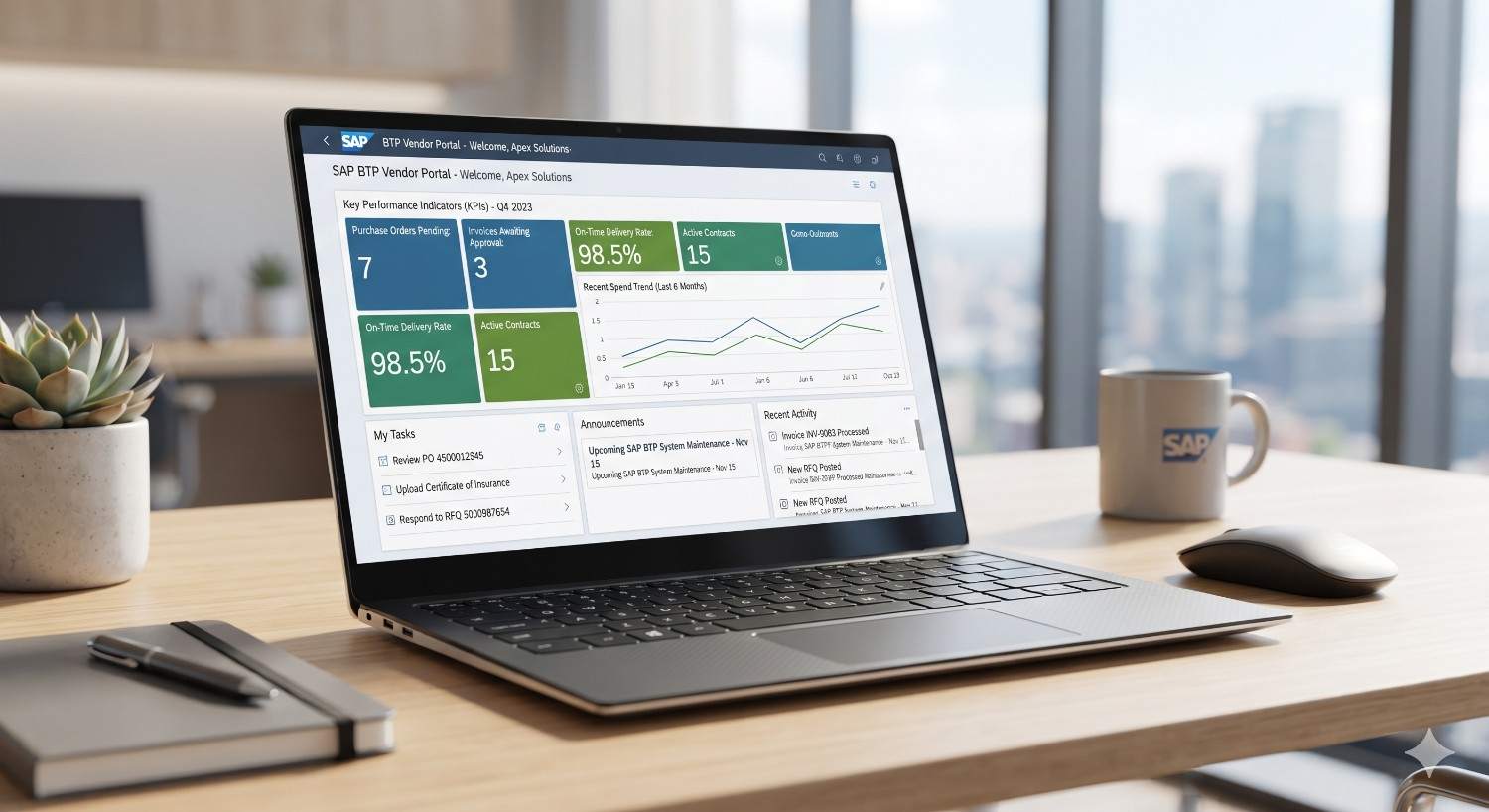
How an SAP BTP-Based Vendor Portal Transforms Supplier Collaboration
An SAP BTP vendor portal gives suppliers one secure place to onboard, view purchase orders, submit invoices and track payments, while your team works from live SAP data instead of inboxes.
Every procurement team knows the daily grind: a supplier emails an invoice, someone re-keys it into SAP, a second supplier calls asking about a payment, and a third sends an updated bank detail in a spreadsheet nobody can verify. None of this is strategic work, yet it consumes hours every week.
A vendor portal built on SAP Business Technology Platform fixes this. This guide explains what an SAP BTP vendor portal is, how it works, what it changes for procurement and finance teams, and how SAP BTP Services help you build one that suppliers actually use.
What Is an SAP BTP Vendor Portal?
Quick answer: An SAP BTP vendor portal is a web-based supplier collaboration portal built on SAP Business Technology Platform. It connects directly to your SAP S/4HANA or SAP ECC system through APIs, so suppliers can manage onboarding, purchase orders, advance shipping notices, invoices and payment status in real time, without emailing your team or needing access to your core ERP.
In short: the ERP stays protected, and suppliers get a clean, self-service front door.
Why Traditional Supplier Communication Breaks Down
Most organisations run supplier communication on a mix of email, phone calls, shared drives and manual data entry. The problems are predictable:
Slow onboarding
Collecting tax documents, bank details and compliance certificates by email can take weeks.
Data errors
Re-keying invoices and master data introduces typos, duplicate vendors and payment mistakes.
No visibility
Suppliers can't see whether an invoice was received, approved or scheduled, so they chase your team.
Weak security
Bank detail changes sent over email are a classic fraud route.
Poor audit trails
When approvals live in inboxes, proving who approved what, and when, becomes painful.
These aren't people problems. They're process and platform problems, and that's where SAP BTP comes in.
Why SAP BTP Is the Right Foundation
SAP BTP is SAP's cloud platform for integration, application development, data management and automation. For a vendor portal, it offers four practical advantages.
1. Clean-core extension
You build the portal outside your ERP, so S/4HANA upgrades don't break your customisations.
2. Native SAP connectivity
Standard APIs and SAP Integration Suite connect the portal to purchasing, finance and master data.
3. Enterprise-grade security
Identity, role-based access and encryption are built into the platform.
4. Scalability
The same portal can serve 50 suppliers or 5,000 without a redesign.
This is why many enterprises adopt SAP BTP Services as the standard route for supplier-facing applications rather than bolting on third-party tools.
Core Building Blocks of an SAP BTP Vendor Portal
A typical architecture combines several SAP BTP components. You don't need every one on day one.
| Component | SAP BTP Service | What it does |
|---|---|---|
| Supplier interface | SAP Build Apps / SAP Business Application Studio | Low-code or full-code supplier-facing screens |
| Integration | SAP Integration Suite | Secure APIs and prebuilt connectors to SAP back-end systems |
| Workflow | SAP Build Process Automation | Approvals for onboarding, invoice exceptions and bank changes |
| Security | SAP Cloud Identity Services / XSUAA | Authentication, single sign-on and role-based access |
| Data | SAP HANA Cloud | Storage for portal data and analytics |
| Documents | SAP Document Management Service | Secure storage for contracts, certificates and invoices |
| Analytics | SAP Analytics Cloud | Dashboards on supplier performance and payment cycles |
Tip: Most companies start with onboarding and invoice tracking, then expand. Your SAP BTP partner should confirm current service names and licensing before you finalise scope.
Key Features That Transform Supplier Collaboration
These are the capabilities that change how suppliers and your team work day to day.
1. Digital supplier onboarding
New suppliers register through a guided form, upload documents and accept compliance terms online. Workflows route the request to procurement, finance and compliance, and the vendor master record is created in SAP automatically. Onboarding that took weeks can drop to days.
2. Real-time PO visibility
Suppliers see open purchase orders, quantities, prices and delivery dates. They can acknowledge orders, propose date changes and flag issues, all of which update SAP directly.
3. ASNs and delivery tracking
Suppliers submit advance shipping notices so your warehouse knows what's arriving and when. Goods receipt planning improves and delivery disputes shrink.
4. Self-service invoicing
Suppliers upload invoices against POs, and the portal validates them against PO and goods receipt data before they reach accounts payable. Status updates cut payment enquiries sharply.
5. Secure bank detail management
Bank changes go through verification workflows with multi-step approval and a full audit trail, closing a major fraud gap left open by email.
6. Document and contract repository
Certificates, contracts, NDAs and compliance documents live in one governed place, with expiry alerts so nothing lapses unnoticed.
7. Supplier performance dashboards
On-time delivery, quality scores and invoice accuracy become visible metrics. Buyers get facts for negotiations, and suppliers see how to improve.
Planning an SAP BTP Vendor Portal?
See how SAP BTP Services connect to your SAP landscape in a walkthrough built around your supplier network.
Business Benefits You Can Expect
Faster procure-to-pay
Automated validation and routing reduce invoice processing time and help capture early-payment discounts.
Lower operating costs
Less manual entry means fewer errors and fewer hours spent on supplier queries.
Stronger relationships
When suppliers see their own payment status, trust grows and disputes fall.
Audit readiness
Every action is logged, and approvals follow defined rules.
Reduced fraud risk
Controlled bank detail changes and role-based access protect your payments.
Better decisions
Real-time supplier data helps leaders spot risks and underperformers earlier.
A Real-World Scenario
Consider a mid-sized manufacturer with 800 active suppliers. Its accounts payable team spent a large part of each week answering "where is my payment?" emails. After launching a supplier collaboration portal on SAP BTP, suppliers checked invoice status themselves. The AP team redirected that time to exception handling and early-payment discount capture, and onboarding moved from a multi-week email chase to a structured online workflow.
Results vary by company, but the pattern is consistent: when suppliers can self-serve, internal teams stop acting as human switchboards.
How to Build an SAP BTP Vendor Portal: Step-by-Step
- 1Map your current supplier processes. Document onboarding, PO, invoice and payment flows and note where delays occur.
- 2Define scope and priorities. Start with the two or three processes causing the most pain, usually onboarding and invoice tracking.
- 3Design the architecture. Decide which BTP services you need, how the portal connects to S/4HANA or ECC, and how identity will be managed.
- 4Build the integration layer. Use SAP Integration Suite to expose the required data securely through APIs.
- 5Develop the supplier experience. Keep the interface simple and mobile-friendly. Suppliers won't adopt a portal that's harder than email.
- 6Configure workflows and security. Set approval rules, roles and audit logging.
- 7Pilot with a small supplier group. Collect feedback and fix friction early.
- 8Roll out in phases. Train suppliers with short guides and videos, then expand by region or category.
- 9Measure and improve. Track adoption, processing times and support tickets, and refine every quarter.
Common Mistakes to Avoid
- Trying to automate everything at launch. A focused first release gets adopted faster.
- Ignoring supplier experience. If suppliers find it clumsy, they'll go back to email.
- Weak data governance. Dirty master data in means dirty data out. Clean it first.
- Skipping change management. Both your internal team and your suppliers need onboarding and support.
- Over-customising the ERP. Keep the core clean and build extensions on BTP.
How SAP BTP Services Support Long-Term Success
A vendor portal isn't a one-time project. Suppliers change, regulations evolve and SAP releases updates. Working with an experienced partner for SAP BTP Services helps you keep the portal secure, performant and aligned with your wider SAP roadmap. Typical services include solution design, integration development, security configuration, workflow automation, UI development, testing and ongoing managed support.
The advantage of building on BTP rather than a standalone tool is continuity: the portal grows with your SAP landscape, whether you're on S/4HANA Cloud, S/4HANA on-premise or mid-migration from ECC.
Metrics to Track After Launch
Review these monthly to see whether your SAP BTP vendor portal is delivering measurable value.
Onboarding time
Days to activate a new supplier.
Digital invoice share
Percentage of invoices submitted through the portal.
Invoice cycle time
Time from submission to approval.
Status-enquiry tickets
Number of "where is my payment?" requests.
First-pass match rate
Invoices matching PO and goods receipt first time.
Portal adoption
Share of active suppliers logging in monthly.
Early-payment discounts
Discount value captured.
Frequently Asked Questions
Conclusion
Supplier collaboration shouldn't depend on inboxes and spreadsheets. An SAP BTP vendor portal replaces that friction with a secure, transparent and automated experience that benefits both sides: suppliers get clarity and faster payments, and your team gets cleaner data, stronger controls and time back for strategic work.
If you're planning one, start small, design for the supplier, keep your ERP core clean and choose a partner experienced in SAP BTP Services.
Ready to Build Your Own Supplier Portal?
Talk to the SAP and Odoo experts at 2iSolutions, an SAP Gold Partner, to discuss your supplier collaboration roadmap.