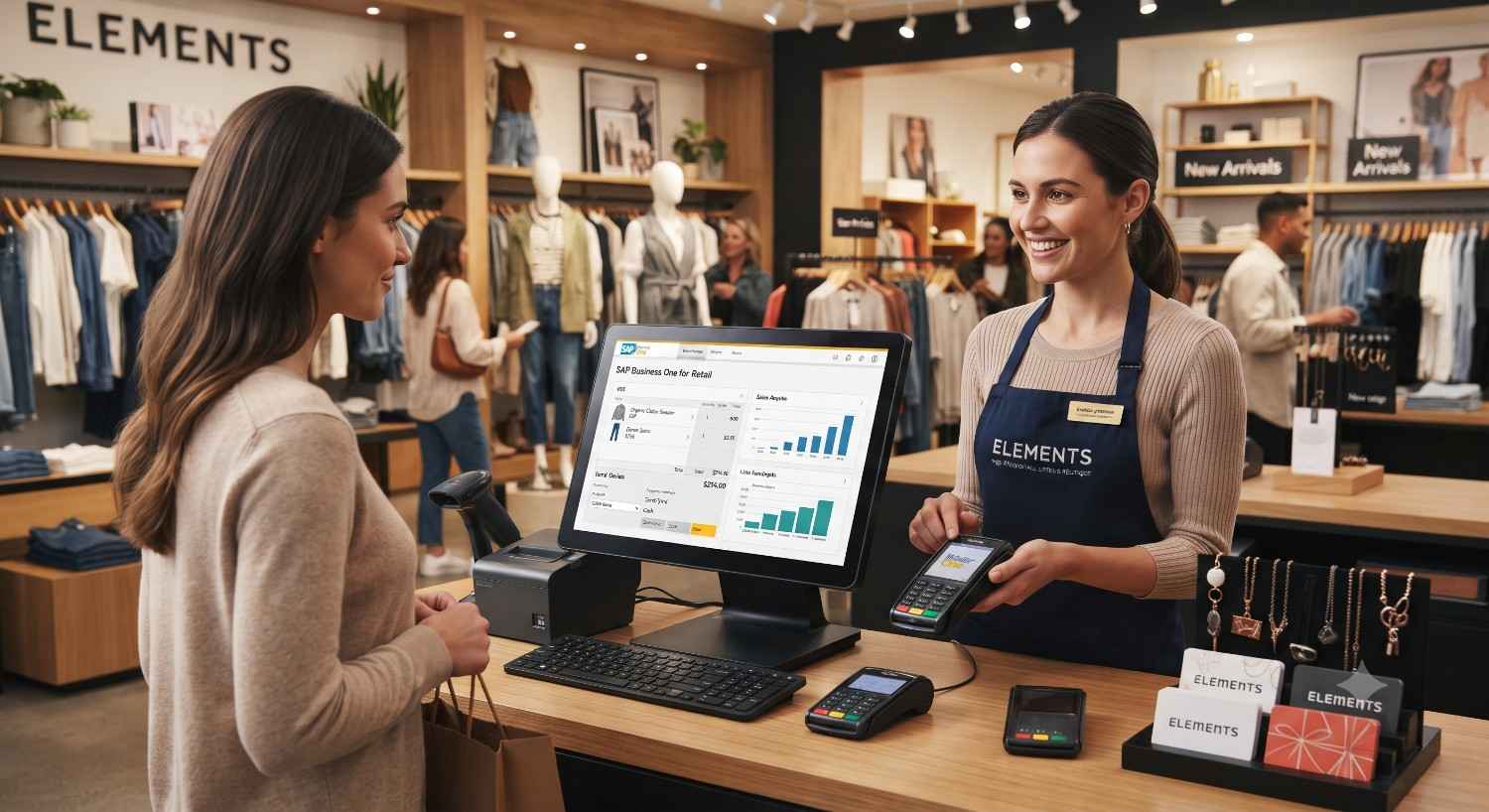
SAP Business One for Retail
SAP Business One for Retail simplifies seasonal demand planning by combining historical sales trends, real-time inventory data, and automated forecasting into one system, so retailers can prepare accurately for Diwali, EOSS, wedding season, and other peak periods without overstocking or running out of bestsellers.
Every Indian retailer knows the pattern. Sales stay flat for weeks, and then Navratri, Diwali, Republic Day sales, or the wedding season arrives and demand triples almost overnight. The stores that get it right sell through their best lines at full price and walk into the next quarter with clean inventory. The stores that get it wrong either run out of stock on day two of the festive rush or sit on unsold winter stock well into March. The difference rarely comes down to merchandising instinct. It comes down to whether the business has a system that can actually plan for seasonality, or whether it is still relying on spreadsheets, gut feel, and a purchase manager’s memory of “what sold last year."
This is where SAP Business One for Retail changes the equation. It is not a generic accounting package with an inventory tab bolted on. It is an ERP for retail industry operations, built to connect sales history, current stock, purchasing, and finance into one live picture, so seasonal demand planning stops being a guessing game and starts being a repeatable process.
Why Seasonal Demand Planning Breaks Down Without the Right ERP
Most retail businesses in India do not fail at seasonal planning because they lack data. They fail because their data lives in five different places. POS reports sit in one export. Warehouse stock counts are updated in a separate register. The e-commerce channel has its own dashboard. And the purchase team is working off last year’s Excel sheet, adjusted by a rough percentage that someone decided felt right.
By the time all of this is reconciled, the festive window has often already opened, and the business is reacting instead of planning. A few patterns show up again and again in retail chains that have outgrown manual planning:
● Bestsellers from the previous festive season go out of stock in the first week, while slow movers pile up unsold.
● Store managers over-order out of caution, tying up working capital in stock that will need markdowns later.
● Purchase orders go out late because nobody had a clear, current view of what was actually left in the warehouse.
● Finance finds out about the cash impact of seasonal buying only after the purchase commitments are already made.
None of this is a people problem. It is a systems problem. And it is exactly the gap that a proper ERP for retail industry use cases is designed to close.
How SAP Business One for Retail Simplifies Seasonal Forecasting
SAP Business One approaches seasonal demand planning as a continuous, data-driven cycle rather than a once-a-year scramble. A few capabilities do most of the heavy lifting:
1. Demand Forecasting Built on Real Sales History
SAP Business One’s forecasting tools pull from actual historical sales, adjusted for trend and seasonality, rather than a flat percentage guess. A retailer can generate a forecast for the upcoming Diwali season that reflects what actually happened last Diwali, the Diwali before that, and any growth trend in between, broken down by SKU, category, and even individual store location.
2. Material Requirements Planning (MRP) for Retail Replenishment
Once a forecast is set, SAP Business One’s MRP engine translates it into concrete purchase recommendations. It accounts for current stock on hand, stock already on order, supplier lead times, and minimum order quantities, then tells the purchase team exactly what to order and when, store by store or for central warehouse distribution.
3. Real-Time, Multi-Location Inventory Visibility
For any retailer running more than one store, or running stores alongside an online channel, inventory visibility is the single biggest lever for seasonal planning. SAP Business One gives a live, consolidated view of stock across every location, so a manager can see that Store A is overstocked on a SKU that Store B is about to run out of, and move inventory before it becomes a lost sale on one side and a markdown on the other.
4. Integrated Point-of-Sale and E-Commerce Data
Because SAP Business One connects directly with POS systems and e-commerce platforms, sales data flows into the forecasting and inventory engine in near real time. There is no end-of-day export, no manual reconciliation, and no lag between what is selling on the floor and what the system knows about it.
SAP Business One Implementation: What It Looks Like for a Retail Business
A well-planned SAP Business One Implementation for a retail chain is not just software installation. It is a structured project that maps how the business actually buys, sells, and moves stock, and then configures the system around that reality. For most mid-sized Indian retailers, an implementation follows a few clear stages:
● Discovery and process mapping — understanding current purchase cycles, store formats, POS setup, and seasonal buying patterns.
● Master data preparation — cleaning and structuring SKU, vendor, and customer data so forecasting has something reliable to work with.
● Configuration — setting up warehouses, price lists, GST-compliant tax codes, and multi-location inventory rules.
● Integration — connecting POS hardware, e-commerce storefronts, and any marketplace or ONDC-linked channels.
● Testing and pilot rollout — validating the system in one store or region before a full chain-wide go-live.
● Go-live and stabilization — moving to production with close monitoring through the first sales cycle.
Retailers who plan this well time their SAP Business One Implementation to finish well before their next peak season, ideally with at least one full sales cycle of stable operation before the system has to carry the weight of a festive rush. Rushing an implementation into the middle of the Diwali run-up is one of the most common and most avoidable mistakes in retail ERP projects.
A Practical Example: Planning for the Festive Season
Consider a mid-sized apparel and lifestyle retailer with twelve stores across two states, plus an online store. In previous years, the purchase team built the festive buying plan in a spreadsheet, using last year’s total sales as a baseline and adjusting by feel for expected growth. The result was predictable: fast-selling categories like ethnic wear ran out within the first ten days of the festive window, while certain colourways and sizes in western wear sat unsold well past the season.
After implementing SAP Business One for Retail, the same business built its festive forecast directly from three years of SKU-level sales history, segmented by store and by channel. The system flagged that ethnic wear demand in two specific stores was growing faster than the chain average, and recommended a higher allocation for those locations. It also identified slow-moving sizes early enough for the purchase team to trim orders before committing working capital to stock that historically needed markdowns.
The outcome was not a dramatic reinvention of the business. It was a steadier, more accurate version of what the team was already trying to do, backed by real numbers instead of memory and instinct. That is the core value of using SAP Business One for Retail for seasonal demand planning: it does not replace merchandising judgment, it gives that judgment something reliable to work from.
SAP Business One Support: Keeping the System Ready for Every Season
Seasonal demand planning is not a one-time setup. Buying patterns shift, new stores open, product ranges change, and forecast models need recalibration after every major sales cycle. This is where ongoing SAP Business One Support matters as much as the original implementation.
A retail business gets the most value from SAP Business One when support covers:
● Forecast model recalibration after each major season, so predictions improve year over year instead of staying static.
● New store and channel onboarding, including inventory structure and POS integration for expansion.
● GST and compliance readiness, keeping tax codes and e-invoicing configuration current as regulations evolve.
● Performance monitoring during peak periods, so the system stays fast and stable when transaction volumes spike around Diwali, EOSS, or Republic Day sales.
● Custom reporting for finance and category teams who need visibility beyond the standard dashboards.
Retailers who treat SAP Business One Support as an ongoing partnership, rather than a break-fix contact for when something goes wrong, consistently walk into each new season with a system that reflects the current state of the business rather than the state it was in at go-live.
Built for the Realities of Indian Retail
Seasonal demand planning in India carries its own specific pressures that a generic global retail system often misses. SAP Business One for Retail is configured to handle these directly:
● GST-compliant billing and e-invoicing, including the current e-invoicing turnover thresholds, so festive-season transaction volumes stay compliant without manual intervention.
● UPI and digital payment reconciliation integrated with POS, which matters enormously during high-volume periods when digital payments dominate footfall.
● ONDC and marketplace connectivity, giving retailers a way to plan demand across open-network and marketplace channels alongside their own stores.
● Multi-state, multi-GSTIN operations, common for retail chains operating across state lines, with inventory and tax handled correctly at each location.
These are not add-ons. They are core to why SAP Business One works as an ERP for retail industry operations in India specifically, rather than a system adapted from a different market.
Why Retailers Choose SAP Business One for Retail Over Point Solutions
Many retailers start with separate tools: a POS system, a basic accounting package, and a spreadsheet for planning. This works at a small scale, but it breaks down exactly when seasonal demand planning matters most, because none of those tools talk to each other in real time. SAP Business One for Retail replaces that patchwork with one connected system where sales, inventory, purchasing, and finance all draw from the same live data.
The practical result for seasonal planning is straightforward. Forecasts are based on actual data instead of memory. Purchase orders reflect real stock positions instead of guesses. And finance sees the cash impact of seasonal buying as it happens, not weeks later during a reconciliation cycle.
Getting Started
For a retail business heading into its next major buying cycle, the right time to evaluate an ERP for retail industry platform is well before the season starts, not during it. A phased SAP Business One Implementation, backed by dependable SAP Business One Support, gives retailers a real planning advantage: accurate forecasts, fewer stockouts, less markdown pressure, and a clearer view of the business across every store and channel.
Seasonal demand does not have to mean seasonal chaos. With SAP Business One for Retail, it becomes a planning cycle the business can prepare for with confidence, season after season.
Frequently Asked Questions
How does SAP Business One help with seasonal demand planning in retail?
SAP Business One for Retail uses historical sales data, current stock levels, and configurable forecast models to predict demand spikes before events like Diwali, EOSS, and wedding season. It then triggers automated replenishment and purchase recommendations so retailers order the right quantities at the right time, instead of relying on manual spreadsheet guesswork.
Is SAP Business One suitable for small and mid-sized retail chains in India?
Yes. SAP Business One is purpose-built for small and mid-sized businesses, including multi-store retailers and D2C brands. It supports GST-compliant billing, multi-location inventory, and POS integration, making it a practical ERP for retail industry needs without the cost or complexity of a large enterprise system.
How long does a SAP Business One implementation take for a retail business?
A typical SAP Business One Implementation for a mid-sized retail chain in India takes 8 to 14 weeks, depending on the number of stores, existing POS and e-commerce integrations, and data migration complexity. Retailers often plan the implementation timeline around a slow season so the system is stable before the next peak period.
What kind of ongoing support does SAP Business One need after go-live?
Retailers typically need SAP Business One Support for seasonal forecast recalibration, new store rollouts, promotional pricing setup, year-end and GST filing readiness, and performance tuning during high-traffic periods like festive sales. A managed support partner handles these proactively instead of retailers discovering issues mid-season.
Can SAP Business One handle multi-channel retail, including ONDC and marketplaces?
Yes. SAP Business One for Retail can integrate with POS systems, e-commerce platforms, and marketplace or ONDC-linked channels through APIs, giving retailers a single, real-time view of inventory and demand across every selling channel rather than reconciling stock counts manually.
