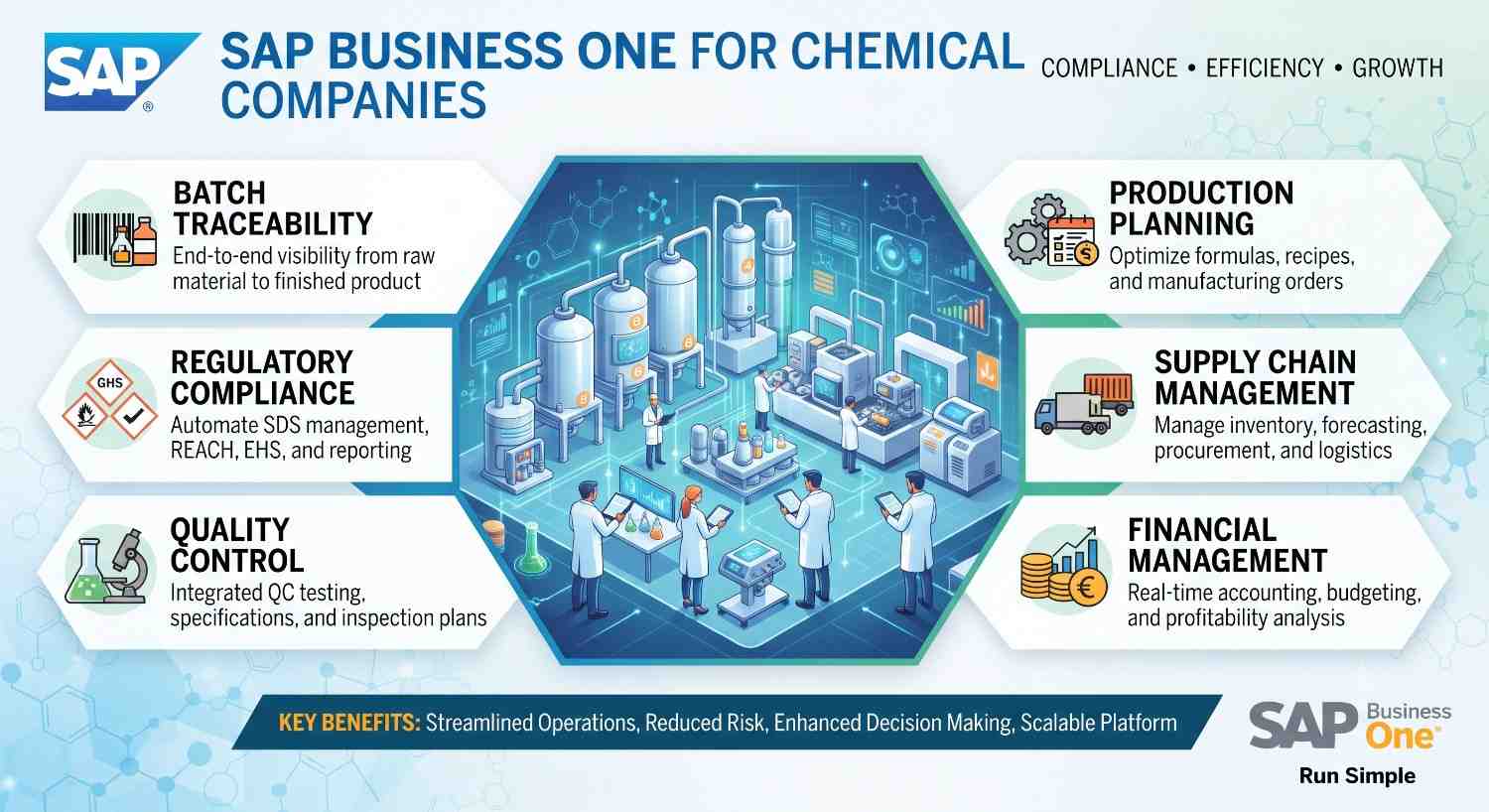
SAP Business One for Chemical Companies
Chemical manufacturing is not like assembling furniture or packing consumer goods. A single formula might involve a dozen raw materials, strict temperature and mixing sequences, hazardous material handling rules, and a shelf life that starts ticking the moment production ends. One missed batch record or one untracked lot number can mean a failed audit, a recalled shipment, or worse — a safety incident.
This is exactly why generic, off-the-shelf software rarely works for chemical producers. What the industry needs is an ERP for manufacturing that was built to handle formulas, batches, expiry dates, and compliance documentation as first-class citizens — not as an afterthought bolted onto a basic accounting system.
SAP Business One has become one of the most trusted platforms for small and mid-sized SAP Business One for Chemical Companies for precisely this reason. In this guide, we’ll walk through how SAP Business One manages batch manufacturing, keeps you compliant with regulatory bodies, and gives you real-time control over inventory — and why the right SAP Business One Implementation partner, backed by dependable SAP Business One Support, makes all the difference.
Why Chemical Companies Need a Specialized ERP
Chemical businesses deal with challenges that most manufacturing sectors simply don’t face:
-
Formulas and recipes that must be followed exactly, batch after batch
-
Raw materials with their own expiry dates, hazard classifications, and storage conditions
-
Full traceability requirements — from the supplier’s raw material lot all the way to the customer’s finished goods lot
-
Regulatory frameworks such as REACH, GHS, OSHA, and ISO 9001/14001
-
Variable yields, where the actual output of a batch can differ slightly from the planned output
-
Safety Data Sheets (SDS) that must travel with every shipment
A spreadsheet-and-email approach — or even a basic accounting package — cannot keep up with this level of complexity. This is where a purpose-fit ERP for manufacturing like SAP Business One steps in, unifying production, quality, compliance, and finance into a single connected system.
What Makes SAP Business One a Strong Fit for Chemical Manufacturing?
SAP Business One is built for small and mid-sized businesses, but it carries enterprise-grade functionality for process manufacturing when configured correctly — often with the help of industry-specific add-ons for batch and formula management.
At its core, it gives chemical manufacturers:
-
Batch and lot-controlled inventory as a native feature, not a workaround
-
Bill of Materials (BOM) and formula management for recipe-based production
-
Quality control checkpoints built into the production process
-
Real-time inventory valuation and costing
-
Integrated compliance documentation, including SDS and certificates of analysis
-
Full financial integration, so production costs, purchasing, and sales all flow into one ledger
Because everything sits on one platform, a plant manager, a quality officer, and a finance controller are all looking at the same real-time data — not three different spreadsheets that were last updated on three different days.
Managing Batch Manufacturing in SAP Business One
What is batch manufacturing, and why does it need dedicated software?
Batch manufacturing produces a fixed quantity of product in a single production run, following a defined formula. In the chemical industry, even small variations in raw material ratios, mixing time, or temperature can change the final product’s properties — which is why every batch needs to be planned, executed, and recorded precisely.
Here’s how SAP Business One supports the batch production lifecycle:
1. Formula and recipe management Every product’s Bill of Materials is stored digitally, including raw material quantities, processing steps, and expected yield. When a batch is triggered, the system pulls the exact formula version that’s approved for production — eliminating the risk of an outdated recipe being used by mistake.
2. Batch numbering and genealogy Each production run is assigned a unique batch number automatically. SAP Business One then tracks the “genealogy" of that batch — which raw material lots went into it, which machine and shift produced it, and which finished goods lots came out of it. If an issue is discovered later, you can trace it backward to the source in minutes rather than days.
3. Yield and variance tracking Actual output rarely matches planned output exactly. The system captures the variance between planned and actual yield for every batch, which helps quality teams spot process drift before it becomes a bigger problem.
4. Production scheduling Batches can be scheduled around raw material availability, equipment capacity, and shelf-life constraints, reducing idle time and material waste — a critical concern when your raw materials themselves have expiry dates.
5. Costing accuracy Since batch production involves raw materials, labor, and overhead, SAP Business One calculates the true cost of every batch as it’s produced, giving finance teams accurate, real-time product costing instead of month-end estimates.
Regulatory Compliance: Turning a Burden Into a Built-In Process
How does SAP Business One help with chemical industry compliance?
SAP Business One centralizes compliance documentation and traceability data so that audit preparation becomes a matter of running a report — not weeks of digging through file cabinets and shared drives.
Chemical companies typically need to demonstrate compliance with:
-
REACH (Registration, Evaluation, Authorisation and Restriction of Chemicals) — relevant for companies operating in or exporting to the EU
-
GHS (Globally Harmonized System) for hazard classification and labeling
-
OSHA workplace safety standards
-
ISO 9001 for quality management and ISO 14001 for environmental management
-
Country-specific chemical handling and transport regulations
With SAP Business One, compliance-related information is linked directly to the production and inventory record, including:
-
Automatic attachment of Safety Data Sheets (SDS) to relevant products
-
Certificate of Analysis (COA) generation per batch
-
Full forward and backward batch traceability for recall management
-
Expiry date and shelf-life monitoring with automated alerts
-
Document version control, so only approved SDS and formula versions are in circulation
When an auditor or regulator asks “show me every customer who received product from batch #4471," a properly configured SAP Business One system can answer that in a few clicks — not a few weeks.
Inventory Management: Precision Where It Matters Most
Why is inventory control harder for chemical companies than for other industries?
Chemical inventory isn’t just about “how many units are in stock." It’s about tracking quantity, lot number, expiry date, storage conditions, and hazard classification simultaneously — for every single item.
SAP Business One addresses this through:
Lot and batch tracking Every inbound and outbound movement is tied to a specific lot, so you always know exactly which lot is in which warehouse, in what quantity, and how much shelf life remains.
First-Expiry-First-Out (FEFO) picking Rather than the simpler First-In-First-Out logic used in many industries, chemical warehouses often need FEFO logic, ensuring materials closest to expiry are used or shipped first — reducing waste and write-offs.
Multi-warehouse and bin location management For companies storing hazardous materials separately from general stock, SAP Business One supports bin-level location tracking so hazardous and non-hazardous inventory never get mixed up on the warehouse floor.
Real-time stock visibility Purchasing, production, and sales teams all see the same live inventory numbers, avoiding the classic problem of a sales order being confirmed for stock that’s already been consumed on the shop floor.
Automated reorder points Because raw materials for SAP Business One for Chemical Companies production often have long lead times, SAP Business One can trigger purchase requisitions automatically once stock dips below a defined threshold — helping prevent production delays.
The Role of the Right SAP Business One Implementation
Buying the software license is the easy part. The real value comes from a SAP Business One Implementation that’s configured specifically around chemical industry workflows — batch numbering conventions, formula approval hierarchies, SDS attachment rules, and FEFO warehouse logic.
A poorly scoped implementation, done by a partner unfamiliar with process manufacturing, often results in a system that technically “works" but doesn’t actually reflect how a chemical plant operates. That leads to workarounds, shadow spreadsheets, and — eventually — the same compliance risks the ERP was supposed to eliminate.
When evaluating an implementation partner, look for:
-
Proven experience with process or batch manufacturing, not just discrete manufacturing
-
Familiarity with chemical industry compliance requirements (REACH, GHS, OSHA)
-
A clear data migration plan for existing batch and lot history
-
A realistic training plan for plant floor staff, not just office users
-
A documented go-live and stabilization roadmap
Why Ongoing SAP Business One Support Matters More in Chemical Manufacturing
Implementation is day one. What happens on day 400 matters just as much — arguably more, since regulations change, new products get introduced, and production volumes grow.
Reliable SAP Business One Support should include:
-
Fast response times for production-floor issues, since downtime on a batch process can mean lost raw materials, not just lost time
-
Periodic system health checks to catch performance issues before they affect production
-
Support for regulatory updates — for example, adjusting compliance workflows when a new REACH restriction is published
-
Assistance with system upgrades and patches without disrupting active production schedules
-
User training refreshers as staff turnover happens
SAP Business One for Chemical Companies that treat support as an ongoing partnership — rather than a one-time helpdesk ticket — get significantly more long-term value out of their ERP investment.
SAP Business One vs. Generic ERP for Manufacturing
It’s worth addressing directly: why not just use a generic ERP for manufacturing platform?
For small and mid-sized chemical manufacturers specifically, SAP Business One tends to offer the deepest batch and compliance functionality without the enterprise-level cost and complexity of platforms like SAP S/4HANA.
Frequently Asked Questions
Does SAP Business One support batch and lot traceability out of the box?
SAP Business One includes native batch management functionality, and chemical manufacturers typically extend it with industry add-ons for advanced formula management, FEFO logic, and compliance documentation.
Can SAP Business One help with REACH and GHS compliance?
Yes. It centralizes Safety Data Sheets, batch records, and traceability data, which are the core documentation regulators request during REACH and GHS-related audits.
How long does a typical SAP Business One Implementation take for a chemical company?
Depending on complexity, most implementations take between 8 and 16 weeks, including data migration, formula setup, and staff training on both office and plant-floor workflows.
Is SAP Business One suitable for small chemical manufacturers, or only large plants?
It’s specifically designed for small and mid-sized businesses, making it one of the more accessible ERP for manufacturing options for growing chemical companies that don’t need full enterprise-scale software.
What kind of ongoing SAP Business One Support should a chemical company expect?
At minimum, responsive issue resolution, regular system health checks, help adapting to regulatory changes, and support during upgrades — ideally from a partner who understands batch manufacturing, not just general ERP administration.
Final Thoughts
SAP Business One for Chemical Companies runs on precision — precise formulas, precise batch records, precise compliance documentation. Generic software forces your team to build precision manually, batch after batch, audit after audit. SAP Business One, when set up through a well-planned SAP Business One Implementation and backed by responsive SAP Business One Support, builds that precision directly into your daily operations.
If your current system is making batch traceability, compliance reporting, or inventory accuracy harder than it should be, it may be time to evaluate whether your ERP for manufacturing is actually built for the chemical industry — or just adapted to survive it.
Contact form


