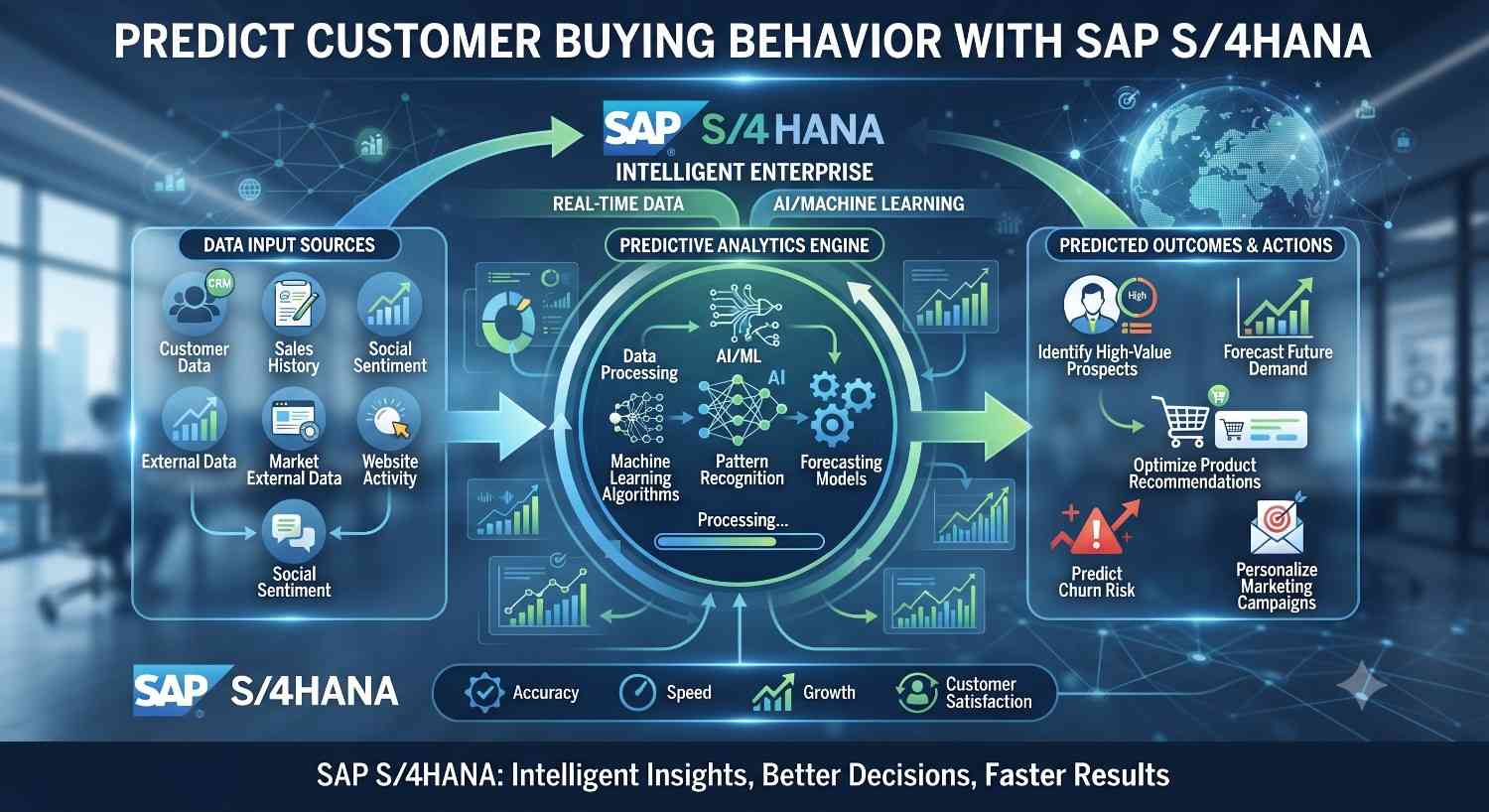
SAP S/4HANA Predict Customer Buying Behavior
Every retailer has had this moment: a product sells out in three stores and sits untouched in a fourth, and nobody saw it coming until the numbers were already bad. Multiply that across thousands of SKUs, dozens of locations, and a customer base that changes its mind by the season, and “predicting demand" stops sounding like a nice-to-have and starts sounding like the whole game.
So the question retailers are actually asking isn’t philosophical — it’s operational: can the ERP for Retail Industry system they already run their business on also tell them what’s about to sell? For a growing number of SAP customers, the answer is yes, and it’s happening inside SAP S/4HANA itself rather than in a separate analytics tool bolted on the side.
Here’s what that actually looks like in practice, and where it does and doesn’t work.
What “Predicting What Customers Will Buy Next" Really Means
Before going further, it helps to separate two things people often lump together: forecasting and prediction.
Forecasting is aggregate — how many units of a product category will sell next quarter. Prediction, in the sense retailers care about today, is granular — which specific customer, or which specific store, is likely to want which specific product, and when. SAP S/4HANA is increasingly built to do both, using the same transactional backbone that already runs sales orders, inventory, and finance.
That matters because prediction built on top of your actual transaction data is fundamentally different from prediction built on a sample export sent to a third-party tool weeks later. The data is live, it’s complete, and it’s already connected to inventory and fulfillment — so a prediction can turn into an action (reorder, reprice, restock a specific store) without a data hand-off in between.
How SAP S/4HANA Turns Transaction Data Into Predictions
The foundation is SAP HANA’s in-memory database, which lets S/4HANA process huge volumes of transactional and behavioral data in real time instead of overnight batch runs. On top of that, retailers use SAP’s Customer Activity Repository (CAR) — retailers use SAP’s Customer Activity Repository to analyze buying patterns and personalize promotions, which strengthens sales and customer loyalty. CAR essentially becomes the single point where POS transactions, e-commerce orders, and loyalty data converge, which is what makes pattern detection possible in the first place.
From there, several purpose-built engines do the actual predictive work:
-
SAP Predictive Analytics Library (PAL), embedded in HANA, gives data teams statistical and machine learning models for clustering, forecasting, and pattern recognition for enterprises needing real-time, in-memory predictive insights within their ERP system.
-
SAP AI Core analyzes customer behavior to help tailor marketing and personalize product recommendations and is used for AI-driven fraud detection, predictive maintenance, and anomaly detection across the broader business.
-
Demand sensing capabilities focus specifically on short-term shifts, predicting near-term changes in customer buying habits rather than only long-range seasonal trends.
-
Sentiment analysis tools read social media reviews and customer feedback to gauge how popular a product actually is, adding a signal that pure transaction data can’t capture on its own.
The practical workflow looks something like this: data is ingested from POS systems and e-commerce carts, cleaned to remove duplicates and errors, run through pattern-recognition models that identify which products sell during specific hours or seasons, and turned into an actionable insight — for example, a suggestion to move stock to a high-demand store before execution tools like SAP Joule can automate the reordering process.
Real-World Use Cases: Where This Actually Shows Up
Personalized product recommendations.
SAP Customer Data Cloud combined with SAP AI Core analyzes customer behavior to tailor marketing campaigns, with e-commerce brands using this to personalize product recommendations at the individual customer level rather than broad segments.
Predictive replenishment.
Instead of static reorder points, S/4HANA’s embedded analytics let retailers dynamically adjust warehouse stock levels based on real-time sales data, which is a direct answer to the “sold out in one store, overstocked in another" problem.
Demand forecasting that reacts to live signals.
Rather than relying purely on historical sales, modern SAP-based forecasting pulls in live POS data to detect demand spikes or dips, customer sentiment from reviews and social media, and competitor pricing and promotional activity as inputs.
Dynamic pricing.
Some embedded AI features are designed to automatically adjust prices in response to competitor stock and market conditions, rather than requiring a manual pricing review cycle.
Churn prediction.
The same predictive engines that identify what a customer might buy next can also flag who’s at risk of not buying again — SAP’s Predictive Analytics Library in HANA is used to detect early signs of customer churn so businesses can offer retention incentives before losing the customer entirely.
Taken together, this is less “one predictive feature" and more a layered system: sensing demand shifts, understanding sentiment, personalizing recommendations, and adjusting inventory and pricing — all pulling from the same operational data instead of five disconnected tools.
Why This Is Different From a Bolt-On Analytics Tool
A fair question is: couldn’t a retailer get the same result from a standalone AI/analytics platform sitting outside the ERP? Sometimes — but there’s a structural advantage to prediction living inside the system that already owns inventory, orders, and fulfillment.
SAP’s current retail architecture is built around what it calls a “clean core" approach — keeping the ERP’s core stable and standard while AI and analytics capabilities plug into it through defined extension points, rather than through custom code that breaks with every upgrade. This is also part of a broader shift SAP has been pushing at recent industry events, where the company has been building AI into the core of retail so that businesses are present wherever buying decisions are actually made, as shopping journeys increasingly start with AI assistants rather than a storefront or search engine. That includes making retailer inventory and pricing data discoverable to AI-driven search and summary tools, not just traditional web search.
Practically, this means a prediction generated inside S/4HANA isn’t a report someone reads and acts on manually two days later — it can trigger a purchase order, a stock transfer, or a pricing update directly, because the prediction engine and the transactional system are the same platform.
Where ERP for Retail Industry Needs Get Complicated
None of this happens by flipping a switch. Retail is one of the more demanding verticals for ERP for Retail Industry deployments specifically because the data volume is high, the SKU complexity is real, and customer behavior genuinely does shift week to week — a promotion, a viral social post, or a competitor’s price change can all move demand overnight.
A few honest limitations worth knowing before assuming predictive AI in S/4HANA is a plug-and-play feature:
-
Data quality is the real bottleneck. Predictive models are only as good as the POS, e-commerce, and loyalty data feeding them. Messy, duplicated, or siloed data undermines the prediction long before the algorithm does.
-
Not every prediction should be automated. Dynamic pricing and auto-reordering sound appealing, but retailers usually need guardrails and human review built in, especially early on.
-
Model training takes time and volume. New product lines or new stores often don’t have enough historical data yet for predictions to be reliable, which is a gap retailers need to plan around rather than be surprised by.
-
Integration debt from legacy systems. Retailers migrating from older SAP ECC systems or a patchwork of POS and inventory tools often underestimate how much cleanup is needed before predictive features are even usable.
Why SAP S/4HANA Implementation Matters More Than the Feature List
This is really the crux of it: the predictive capabilities exist in the platform, but whether they actually work for a specific retailer depends almost entirely on how the SAP S/4HANA Implementation is scoped. A rushed or generic implementation tends to leave CAR half-configured, POS data poorly mapped, and predictive models trained on incomplete history — which produces exactly the kind of unreliable forecasts that make teams distrust the system altogether.
A properly scoped implementation typically includes:
-
Data architecture planning — mapping POS, e-commerce, and loyalty data sources into CAR and HANA before any predictive model goes live.
-
Phased rollout by use case — starting with one high-value use case (often replenishment or demand sensing) rather than trying to activate every AI feature at once.
-
Governance around automation — defining which predictions trigger automatic actions (like reorders) versus which stay advisory for a human to approve.
-
Change management for store and merchandising teams — because predictive tools only create value if planners and buyers actually trust and use the recommendations.
The Ongoing Role of SAP S/4HANA Cloud Services
Predictive retail AI isn’t a “set it up once" capability — the models, the embedded AI features, and the underlying platform all continue to evolve, sometimes quickly. This is where SAP S/4HANA Cloud Services matter beyond the initial go-live: cloud-hosted S/4HANA environments get new AI and machine learning capabilities as SAP rolls them out, without the retailer needing to manage the infrastructure upgrade themselves.
That continuous delivery model is particularly relevant right now, since SAP has been actively expanding AI-native capabilities for retail — including making inventory and pricing data discoverable not just to traditional search engines but to AI-generated summaries and assistants that are increasingly replacing conventional search results. Retailers on managed cloud services are positioned to adopt these capabilities as they arrive, rather than waiting years for a major on-premise upgrade cycle.
Best Practices for Retailers Considering This
-
Start with one predictive use case, not five. Demand sensing or predictive replenishment usually deliver visible ROI faster than trying to launch personalization, dynamic pricing, and churn prediction simultaneously.
-
Audit your data sources before go-live. POS, e-commerce, and loyalty data all need to feed CAR cleanly for predictions to be trustworthy.
-
Keep a human in the loop initially. Treat early predictions as recommendations for planners and buyers, not fully automated decisions, until confidence is established.
-
Plan for continuous improvement. Predictive models need retraining as customer behavior shifts — this isn’t a one-time implementation task.
-
Involve merchandising and store operations early. The best predictive system in the world fails if the people making buying and stocking decisions don’t trust or use it.
Frequently Asked Questions
Does SAP S/4HANA use AI to predict customer purchases, or is this a separate add-on tool?
Predictive capabilities are increasingly embedded directly in S/4HANA through tools like the Customer Activity Repository, Predictive Analytics Library, and SAP AI Core, rather than requiring a fully separate analytics platform — though some advanced use cases still extend into SAP Business Technology Platform.
How accurate is SAP’s demand prediction for retail?
Accuracy depends heavily on data quality and history. Retailers with clean, centralized POS and e-commerce data typically see much more reliable predictions than those with fragmented legacy systems, especially for new products with limited sales history.
Do small or mid-sized retailers need SAP S/4HANA Cloud Services to access predictive AI features?
Not strictly, but cloud-hosted deployments generally get new AI capabilities faster and with less internal IT overhead than on-premise systems, which matters given how quickly SAP is expanding these features.
What’s the biggest mistake retailers make when trying to use predictive AI in S/4HANA?
Turning on every predictive feature at once without cleaning up underlying data first. A phased, use-case-driven SAP S/4HANA Implementation almost always outperforms a broad, rushed rollout.
Can predictive insights from S/4HANA automatically trigger reorders or price changes?
Yes, that’s technically possible through automation tools within the platform, but most retailers start with advisory recommendations reviewed by planners before enabling fully automated actions.
Final Thoughts
So, can SAP S/4HANA help retailers predict what customers will buy next? Genuinely, yes — through embedded tools like the Customer Activity Repository, the Predictive Analytics Library, demand sensing, and sentiment analysis, all working off the same live transactional data that already runs the business. But the feature list isn’t the hard part. The hard part is data quality, a realistic rollout plan, and a system built by people who understand both SAP’s architecture and how retail actually operates day to day.
That’s really the difference between an ERP for Retail Industry that technically has predictive AI switched on, and one where a well-planned SAP S/4HANA Implementation and ongoing SAP S/4HANA Cloud Services turn that AI into forecasts merchandisers actually trust and act on.
Contact form