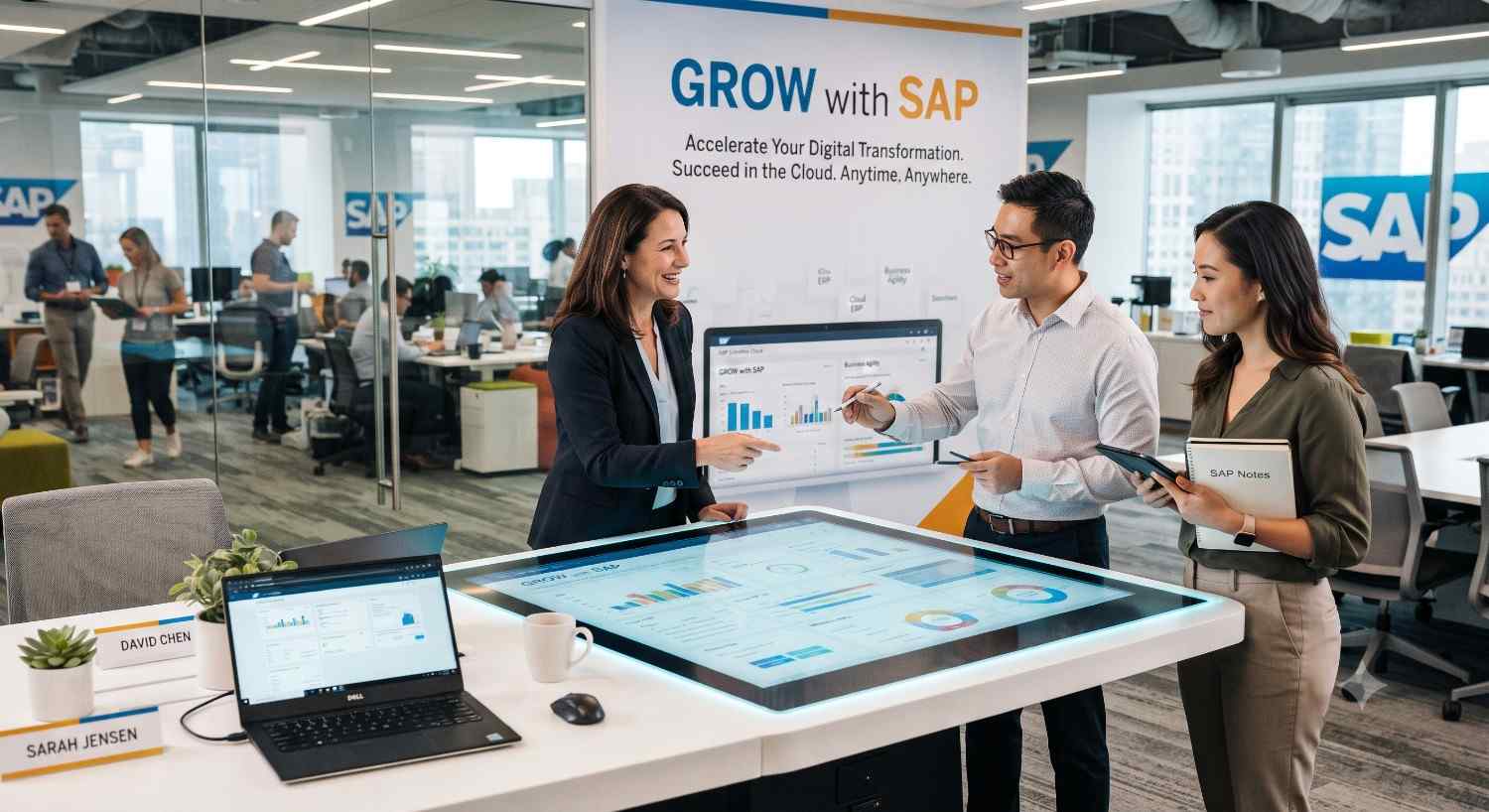
End of an Era for SAP ECC Customers Should Move to GROW with SAP
For nearly three decades, SAP ECC has been the operational backbone of enterprises across manufacturing, distribution, retail, engineering, and services. Across India — from Delhi-NCR to Mumbai, Pune, Bengaluru, and Chennai — thousands of mid-market and large enterprises have run finance, procurement, production, and sales on ECC with genuine success. It has delivered stability, reliability, and scalability for a generation of businesses.
But the business environment of 2026 looks nothing like the one ECC was designed for. Today’s enterprises expect AI-assisted decision-making, mobile-first user experience, real-time analytics, continuous regulatory compliance (GST returns, e-invoicing, e-way bills), rapid business adaptation, and a lower total cost of IT ownership. None of this can be delivered by simply patching an aging ERP landscape.
The question enterprise leaders are asking has quietly changed. It is no longer “Should we leave ECC?” — with SAP’s confirmed end of mainstream maintenance for ECC in December 2027, that decision has effectively been made for them. The real question is: “How quickly can we move to an ERP platform built for the future — and who can get us there without disrupting the business?”
For most organizations with reasonably standard business processes, GROW with SAP is the most compelling answer available today. And the right GROW with SAP Implementation partner makes the difference between a rushed technical migration and a genuine transformation program.
1. Artificial Intelligence Has Become a Business Requirement, Not a Nice-to-Have
Every business leader today is asking a similar set of questions. Can AI answer operational questions in plain language? Can it predict delays before they happen? Can it generate reports without a request to IT? Can it automate the repetitive work that eats up an employee’s day?
SAP is investing heavily in Business AI and its embedded digital assistant, Joule. New AI capabilities are being introduced directly into SAP S/4HANA Public Cloud on a near-quarterly release cycle — AI-assisted procurement, AI-based finance insights, intelligent supply chain recommendations, natural language reporting, automated document processing, AI-powered forecasting, and the embedded Joule assistant across finance, sales, and supply chain modules.
These innovations are arriving first — and in many cases exclusively — in the cloud editions covered under GROW with SAP Services. An ECC customer simply cannot access these capabilities without moving onto the modern SAP S/4HANA Cloud platform.
2. Mobility Is No Longer Optional
Today’s workforce, whether in a Bengaluru tech park or a Gujarat manufacturing plant, expects ERP access from anywhere. Approving purchase orders, checking inventory, reviewing sales orders, and approving expenses should work seamlessly from a phone or tablet, not just a VPN-tethered desktop.
GROW with SAP delivers responsive Fiori applications, role-based user experiences, browser-based access, mobile-ready interfaces, and consumer-grade usability — a sharp contrast to traditional SAP GUI transactions built for a desk-bound workforce. Employee expectations have changed permanently, and ERP has to evolve with them.
3. Performance and Real-Time Expectations Keep Rising
Businesses increasingly expect instant reporting, real-time dashboards, immediate MRP results, faster planning cycles, and live operational visibility. SAP S/4HANA’s simplified data model eliminates many of the aggregate and index tables that ECC relied on, resulting in real-time operational reporting, embedded analytics, faster transaction processing, a simplified data architecture, and reduced data redundancy.
Decision-makers no longer need to wait for an overnight batch job to understand how the business performed yesterday — SAP S/4HANA Cloud makes that visibility continuous.
4. Innovation Is Happening in the Cloud First
SAP’s innovation strategy is unambiguous: most new capabilities are delivered to cloud customers first. Organizations remaining on ECC — or even on traditional on-premise S/4HANA — will increasingly experience slower innovation cycles and fewer new features.
Cloud customers on SAP S/4HANA Public Cloud benefit from quarterly innovation releases, continuous feature enhancements, faster adoption of AI, built-in regulatory updates, ongoing security improvements, and pre-packaged industry best practices. The innovation gap between cloud and legacy ERP will only widen from here.
5. Access to Advanced Business Capabilities Out of the Box
Many organizations continue relying on third-party bolt-on tools simply because ECC lacks modern planning and optimization capabilities. GROW with SAP includes access to advanced functionality that used to require separate systems and separate implementation projects:
Advanced Available-to-Promise (aATP)
Product substitutions, alternative confirmations, backorder processing, and intelligent order fulfillment.
Production Planning and Detailed Scheduling (PP/DS)
Finite capacity planning, optimized sequencing, constraint-based scheduling, and improved production utilization.
Financial Closing Cockpit
Standardized close processes, automated financial closing tasks, better governance, and a faster month-end.
Dispute Management
Structured customer dispute resolution, better collections, improved cash flow, and reduced receivables aging.
Embedded Analytics
Live operational dashboards, KPI monitoring, and drill-down reporting without a separate BW requirement for most reporting scenarios.
Additional Modern Capabilities
Organizations also gain Flexible Workflow, Situation Handling, Predictive MRP, Intelligent Returns Management, Advanced Credit Management, Group Reporting, Event-Based Revenue Recognition, selected embedded EWM scope, Central Procurement capabilities, SAP Build Process Automation integration, SAP Business Technology Platform extensibility, and integration with SAP Business Data Cloud and SAP Analytics Cloud.
6. Continuous Compliance Without Repeated Upgrade Projects
Taxation, e-invoicing, e-way bills, GST return formats, ESG reporting, statutory reporting, and country-specific legal requirements keep evolving — a reality every Indian finance team knows well. Cloud ERP delivers regular legal updates, regulatory compliance content, security patches, and new localization content automatically, without organizations having to run a large technical upgrade project every few years just to stay compliant.
7. Reduced Technical Complexity for IT Teams
Traditional ECC landscapes typically involve database administration, operating system maintenance, hardware refresh cycles, backup infrastructure, disaster recovery planning, performance tuning, and periodic upgrade projects. With GROW with SAP, much of this responsibility shifts to SAP itself, freeing internal IT teams to focus on business innovation rather than infrastructure firefighting.
8. A Lower Total Cost of Ownership, Viewed Correctly
Subscription pricing under GROW with SAP sometimes looks higher than legacy perpetual licensing on a line-item basis. But the real comparison has to include the full cost of ownership: reduced infrastructure investment, lower hardware refresh costs, a smaller Basis administration footprint, elimination of major upgrade projects, less downtime, standardized processes, faster implementation timelines, and reduced customization overhead.
The conversation should shift from “what does the software cost” to “what does this platform make possible” — that’s the lens any serious GROW with SAP Implementation business case should use.
9. Are There Better Alternatives to GROW with SAP?
Many organizations evaluate alternatives such as Microsoft Dynamics 365 Finance & Operations, Infor CloudSuite, Oracle NetSuite, Oracle Fusion Cloud, and IFS Cloud. These are capable platforms, but a few realities are worth weighing carefully:
- Subscription costs on competing cloud ERPs are often comparable to SAP’s own pricing.
- Migration effort is significant no matter which target platform is chosen.
- Business process redesign is required with any ERP replacement, not just an SAP migration.
- Retraining users and rebuilding integrations adds cost and risk regardless of vendor.
- Existing SAP knowledge, master data structures, and past customization investments are best leveraged by staying inside the SAP ecosystem.
For organizations already running SAP ECC, migrating to SAP S/4HANA Cloud through GROW with SAP is generally a lower-risk modernization path than replacing SAP outright with an unfamiliar platform.
10. Future-Proofing the Enterprise
An ERP system is expected to support the business for the next ten to fifteen years. Selecting an ERP today isn’t just a finance, procurement, manufacturing, or sales decision anymore — it’s a decision about which platform can absorb artificial intelligence, automation, machine learning, digital workflows, mobile-first operations, advanced analytics, continuous innovation, sustainability reporting, and a composable enterprise architecture as they mature. These capabilities are what will define competitive advantage over the next decade, and they are the reason SAP ECC to S/4HANA Migration conversations belong in the boardroom, not just in IT.
Why the Right GROW with SAP Implementation Partner Matters

GROW with SAP is a strong platform, but the outcome an organization gets from it depends heavily on execution. A structured GROW with SAP Implementation — grounded in SAP Activate methodology, fit-to-standard workshops, clean core principles, and India-specific localization for GST and e-invoicing — determines whether a business realizes transformation benefits in months or struggles with a stalled rollout.
This is where experienced GROW with SAP Services partners add real value: guiding fit-to-standard decisions, managing organizational change, handling data migration from ECC cleanly, and configuring the platform around proven best practices rather than replicating old ECC customizations that no longer serve the business.
Planning Your Move from ECC to GROW with SAP
Before committing to a timeline, most ECC customers benefit from a short readiness assessment — reviewing current customizations, integrations, and reporting dependencies against the fit-to-standard model that SAP S/4HANA Cloud is built around. This step alone often reshapes the business case, since it reveals how many “custom” processes in ECC were actually workarounds for gaps that SAP S/4HANA Cloud has since closed natively.
A well-run SAP ECC to S/4HANA Migration typically moves through discovery, fit-to-standard workshops, data migration and validation, integration rebuild, user enablement, and a phased go-live — each stage supported by experienced GROW with SAP Services consultants who understand both the technical migration path and the change management side that determines whether adoption actually sticks. Organizations that treat this as a cross-functional business initiative, not a side project for IT, consistently see faster time-to-value from their GROW with SAP Implementation.
For enterprises still weighing ECC against SAP S/4HANA Public Cloud, the practical starting point is a scoped assessment: what breaks, what transfers cleanly, and what the organization stands to gain in the first twelve months of running on modern cloud ERP.
Frequently Asked Questions
What is GROW with SAP?
GROW with SAP is SAP’s packaged offering that bundles SAP S/4HANA Cloud Public Edition, pre-configured best-practice processes, embedded AI tools like Joule, a guided implementation methodology (SAP Activate), and learning resources into a single subscription designed to help ECC and legacy ERP customers move to modern cloud ERP faster.
Why should ECC customers move to GROW with SAP instead of staying on ECC?
SAP ECC’s mainstream maintenance ends in December 2027, and new innovations such as embedded AI, real-time analytics, and mobile-first Fiori experiences are being delivered primarily to SAP S/4HANA Cloud customers. Staying on ECC means falling further behind on both compliance support and business capability over time.
Is GROW with SAP only for large enterprises?
No. GROW with SAP was specifically designed to be accessible to mid-market and growing businesses, offering a faster, more standardized implementation path than traditional on-premise SAP projects historically required.
How long does a typical GROW with SAP Implementation take?
Timelines vary by scope and data complexity, but fit-to-standard, cloud-based implementations under GROW with SAP are generally faster than traditional on-premise SAP S/4HANA projects, since much of the configuration follows pre-built best-practice templates rather than custom-built processes.
Does GROW with SAP support Indian compliance requirements like GST and e-invoicing?
Yes. SAP S/4HANA Cloud under GROW with SAP receives ongoing localization updates for GST return formats, e-invoicing, and e-way bill requirements as part of its regular release cycle, reducing the compliance burden on internal teams.
Is moving from ECC to GROW with SAP cheaper than switching to a non-SAP ERP?
When total cost of ownership is considered, including data migration, retraining, integration rebuilding, and business process redesign, moving within the SAP ecosystem via GROW with SAP is often a lower-risk and more cost-predictable path than replacing SAP entirely with an unfamiliar platform.
Final Thoughts
The migration from SAP ECC to GROW with SAP should not be viewed as a technical upgrade driven by a maintenance deadline. It is a strategic investment in agility, innovation, and long-term competitiveness. Organizations that modernize today position themselves to take advantage of continuous innovation, embedded AI, modern user experiences, and best-practice business processes — while those that delay may find themselves spending increasing effort just to keep legacy systems alive, as competitors move ahead with smarter, faster, more connected enterprises.
The future belongs to organizations that treat ERP not as software to maintain, but as a platform for continuous business transformation. With the right GROW with SAP Services partner guiding the journey, GROW with SAP is built to be exactly that platform.
Contact form