ERP for Small and Mid-Size Manufacturers
Let’s be honest. Buying an ERP system is one of the most significant — and most stressful — decisions a small or mid-size manufacturer will ever make. Get it right, and your operations become leaner, faster, and more scalable than you ever imagined. Get it wrong, and you’re looking at months of disruption, wasted budget, and a team that resents the software they’re forced to use every day.
The problem is, most of the advice out there is written for enterprise companies with dedicated IT departments, unlimited budgets, and the luxury of a two-year implementation timeline. If you’re running a manufacturing operation with 20 to 500 employees, that advice doesn’t apply to you — and following it can lead you straight to the wrong platform.
This guide is written specifically for owners, operations managers, and decision-makers evaluating ERP for small and mid-size manufacturers for the first time — or replacing a system that has stopped working. Whether you’re searching for ERP for small businesses in general or a platform purpose-built for manufacturing operations, we’ll walk through everything you need to know before you write a single check: what features actually matter, what vendors won’t tell you, how to fairly compare the best manufacturing ERP system options, and how to set your implementation up for success from day one.
No jargon. No vendor bias. Just practical guidance from the trenches.
Why small and mid-size manufacturers need ERP now more than ever
There was a time when spreadsheets and standalone tools were “good enough.” A basic inventory system, a simple accounting package, maybe a job costing tool your operations manager built in Excel a decade ago. It worked — until it didn’t.
The reality facing manufacturers today is different from even five years ago. Customer expectations around lead times have tightened dramatically. Supply chains have become more volatile and harder to manage manually. Skilled labor is expensive, which means every hour wasted on manual data entry or chasing information across disconnected systems is a real, measurable cost.
ERP for small and mid-size manufacturers addresses all of this by consolidating your business functions — production planning, inventory, purchasing, quality, sales, and finance — into a single connected platform. When your inventory system talks to your production schedule, and your production schedule talks to your purchasing team, and all of that feeds into financial reporting automatically, you stop making decisions based on yesterday’s data.
One of the biggest misconceptions is that ERP for small businesses is too complex or too expensive to be practical. That was true a decade ago. Today, modern cloud-based platforms have completely dismantled that barrier — offering enterprise-grade manufacturing capabilities at price points and implementation timelines that genuinely work for growing businesses.
That’s not a luxury anymore. For manufacturers competing in today’s market, it’s table stakes.
The 6 must-have features in any manufacturing ERP system
Not all ERP platforms are created equal, and not every feature in a glossy demo is actually useful. Before evaluating vendors, get clear on what you genuinely need. Here are the six capabilities that separate a truly capable best manufacturing ERP system from one that just looks good in a sales presentation.
1. Production planning and scheduling
This is non-negotiable. A best manufacturing ERP system must let you create and manage manufacturing orders, assign them to workcenters, track progress in real time, and flag delays before they cascade into missed delivery dates. Look for systems that support both make-to-stock and make-to-order workflows, and bonus points for a visual Gantt-style schedule that planners can use without specialist training.
2. Inventory and materials management
Real-time inventory visibility across all locations and production stages is foundational. ERP software for small business manufacturing should include lot and serial number tracking, reorder point alerts, and support for multiple units of measure. If your system can’t tell you within 30 seconds whether you have enough components to fulfill a rush order, it’s not doing its job.
3. Bill of materials management
A flexible, multi-level BoM engine is the backbone of any manufacturing ERP. Your BoMs should be easy to create, version-controlled, and directly linked to production orders so material consumption is tracked automatically as jobs move through the shop floor. If your product line includes variants — different sizes, configurations, or finishes — make sure the system handles them natively without requiring a separate BoM for every SKU.
4. Purchasing and supplier management
Manufacturing ERP implementation projects frequently underestimate how important the purchasing module is. When production demand drives automatic purchase order suggestions, and those orders flow to suppliers with accurate quantities and delivery dates, you eliminate one of the most common causes of production stoppages: running out of materials because someone forgot to reorder. Look for vendor price lists, lead time tracking, and purchase receipts that update inventory automatically on arrival.
5. Quality control
Quality issues caught late are expensive. Quality issues that reach your customers are devastating. A proper ERP for small and mid-size manufacturers should embed quality checkpoints directly into production workflows — not bolt them on as an afterthought. You want configurable inspection criteria, pass/fail logging, threshold alerts, and scrap and rework tracking tied to specific jobs or batches. Traceability is especially critical for food, pharma, medical devices, or any regulated environment.
6. Financial integration and job costing
The ultimate purpose of all the operational data flowing through your ERP is to tell you whether you’re making money — and on which products. That requires tight integration between production data and financial accounting, specifically job costing: actual material, labor, and overhead costs versus the standard estimate for every manufacturing order. Without this built into your best manufacturing ERP system, margin problems stay invisible until they show up in your P&L months later.
What vendors won’t tell you: the hidden costs of ERP
Every ERP sales rep will show you an impressive demo, quote a per-user monthly fee, and paint a picture of a smooth 90-day implementation. The reality is almost always more complex — and more expensive.
Implementation services are where the real cost lives
The software license is rarely where the money goes. For most businesses evaluating ERP for small and mid-size manufacturers, manufacturing ERP implementation services — consulting, configuration, data migration, training, and go-live support — cost anywhere from one to three times the annual license fee. Sometimes more. Always ask vendors for a full total cost of ownership estimate, not just the subscription price.
Data migration is harder than it looks
Getting your existing data — customer records, supplier records, open orders, inventory counts, Bills of Materials, historical costs — into a new system cleanly is genuinely difficult work. It takes time, careful validation, and if done poorly, it can corrupt the integrity of your new system from day one. Budget real time and real resources for migration. If your vendor is minimizing this in the sales process, that’s a red flag.
Training is an ongoing investment, not a one-time event
Every new ERP system requires behavior change. Operators learn new interfaces. Managers build new reporting habits. Finance learns how production data flows into accounts. This doesn’t happen in a two-hour session. The best ERP software for small business manufacturing implementations include structured, role-based training programs — not just documentation and a YouTube tutorial library. This is one area where ERP for small businesses often gets shortchanged — vendors under-scope training to win the deal, and customers pay for it post go-live.
Customization can become a trap
Most vendors will tell you their system can be customized to fit your exact workflows. This is usually true — for a price. Heavy customization makes upgrades expensive, locks you into specific partners, and introduces instability over time. A better philosophy: choose a system whose standard functionality covers 80–90% of your needs, and adapt your processes to fit the software for the rest.
Be especially cautious of vendors who quote unusually low implementation costs. In manufacturing ERP, you almost always get what you pay for during implementation — and cutting corners here creates problems that are expensive to fix later.
How to evaluate ERP options: a practical framework
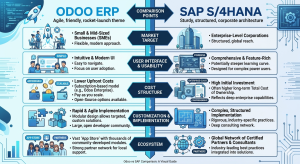
With dozens of ERP for small and mid-size manufacturers platforms on the market — from Odoo and Epicor to JobBOSS, Katana, and NetSuite — how do you make a rational comparison? The good news is that most modern ERP for small businesses platforms have matured significantly, offering scalable pricing and faster deployment models than ever before. Use this framework to cut through the noise.
Step 1: Define your non-negotiables first
Before you look at a single demo, write down the five to ten capabilities your business absolutely cannot function without. These are your filters. Any platform that can’t meet them is eliminated immediately, regardless of price or brand name.
Step 2: Run scenarios, not feature checklists
Feature checklists are almost meaningless — every vendor will check every box. Instead, prepare three to five real scenarios from your actual business. “Show me how you handle a rush order when one component is out of stock.” “Walk me through how a quality rejection on the shop floor affects a manufacturing order.” “Show me the job cost for a completed production run.” The answers will tell you far more than any feature matrix.
Step 3: Talk to reference customers in your industry
Always call references. Ask specifically: How long did manufacturing ERP implementation actually take? What went wrong that you didn’t expect? What would you do differently? What do your production floor workers think of the system day-to-day? These conversations are worth more than any demo.
Step 4: Evaluate the partner ecosystem, not just the software
For most small and mid-size manufacturers, the vendor’s certified implementation partners are who you’ll actually work with daily. Evaluate the quality, manufacturing experience, and local availability of those partners as carefully as you evaluate the software itself.
Step 5: Think about where you’ll be in five years
The best manufacturing ERP system for your business today needs to still be the right system when you’ve doubled in size, added a second facility, or expanded your product line. Ask vendors directly: what does our implementation look like at twice our current scale? What does that cost?
Common mistakes small manufacturers make when buying ERP

After watching hundreds of manufacturing ERP projects succeed and fail, certain patterns emerge. Here are the most common mistakes — and how to avoid them.
- Buying for today’s problems, not tomorrow’s scale. The system perfect for 25 employees may be completely inadequate at 100. Think ahead before you sign.
- Letting IT drive the decision without operations input. The people who live in the system every day — planners, warehouse staff, quality managers — must be part of the evaluation. Their buy-in is essential for adoption.
- Choosing the cheapest option. ERP software for small business manufacturing that seems inexpensive upfront often carries hidden costs in customization, limited functionality, or poor support. Total cost of ownership matters more than sticker price.
- Skipping the phased rollout. Going live with every module at once is high-risk. A phased manufacturing ERP implementation — starting with core production and inventory, then adding quality, purchasing, and finance — gives your team time to adapt and reduces risk significantly.
- Underestimating change management. Software doesn’t transform businesses. People do. The cultural and behavioral change required for ERP success is just as important as the technical work. Invest in communication, training, and leadership alignment throughout.
The right mindset: ERP is a business transformation, not a software purchase
Here’s the most important thing to understand before you buy: implementing ERP for small and mid-size manufacturers is not primarily a technology project. It’s a business transformation project that happens to involve technology. This is true whether you’re a 15-person job shop exploring ERP for small businesses for the first time, or a 300-person operation migrating off a legacy platform.
The manufacturers who get the most out of their ERP investments are the ones who treat the implementation as an opportunity to rethink and improve their processes — not just to digitize the way they’ve always done things. They challenge assumptions. They standardize workflows. They eliminate workarounds that accumulated over years because “that’s how we’ve always done it.”
The ones who struggle are the ones who force the new system to replicate every quirk and exception of their old processes, then wonder why they spent all that money and nothing feels different.
Go in with the right mindset. The goal is not a better version of your old system. The goal is a smarter, more visible, more scalable manufacturing operation. A well-chosen, well-implemented best manufacturing ERP system is the foundation that makes that possible.
Conclusion: Do the work before you buy
Choosing ERP for small and mid-size manufacturers is too important to rush, and too complex to outsource entirely to a vendor’s sales team. The manufacturers who navigate it successfully invest time upfront: defining requirements clearly, evaluating options rigorously, planning manufacturing ERP implementation realistically, and bringing their teams along for the journey.
The right ERP software for small business manufacturing platform exists for your business. And whether you’re just beginning your search for ERP for small businesses or deep into a competitive evaluation, the fundamentals never change: know your requirements, evaluate honestly, plan realistically, and bring your people along. With the right foundation, the right partner, and the right approach to change management, it will become one of the most valuable investments your company has ever made.
Do your homework. Ask the hard questions. And don’t let anyone rush you into a decision you’re not ready to make.
Looking for guidance on choosing the best manufacturing ERP system for your business? Connect with an experienced manufacturing ERP consultant to get a needs assessment tailored to your operation.